Chapel of Blessed Augustine Kažotić in Zagreb Cathedral
With the rich history of the Dominican from Trogir and Bishop of Zagreb, his chapel beneath the northern bell tower is also available for a virtual tour.
With the rich history of the Dominican from Trogir and Bishop of Zagreb, his chapel beneath the northern bell tower is also available for a virtual tour.
In the northern part of Zagreb Cathedral, beneath the bell tower, lies the chapel dedicated to Blessed Augustine Kažotić, one of the most significant figures in the ecclesiastical history of Zagreb. What is particularly intriguing is that this spiritual and historical site can now be explored from the comfort of your own home, via a virtual tour on the official website katedrala.hr.
Augustine Kažotić was born in Trogir, and his spiritual journey began in Split, where he entered the Order of St. Dominic and studied philosophy and theology. After a dramatic journey to Paris, during which he narrowly escaped death, he began his studies at the renowned Sorbonne in 1287. His subsequent work is closely linked to Brother Nicholas Boccasini, the Master General of the Order, who later became Cardinal and Pope Benedict XI. It was he who appointed Augustine as Bishop of Zagreb in 1303.
As bishop, Kažotić distinguished himself through extraordinary pastoral zeal. He reformed the liturgy and introduced the original "Zagreb Rite." In the cathedral, he introduced the communal recitation of the Divine Office and founded the cathedral school, intended not only for future priests but also for laypeople. He held at least two diocesan synods, in 1307 and 1314, and also participated in the General Council of Vienne in France.
He was also active in secular matters. As a member of the Croatian Parliament, in 1318 he led a delegation of the episcopate to Avignon, where he presented to the Pope the problems caused by King Charles Robert of Anjou. The king did not allow him to return to the Diocese of Zagreb, so the Pope appointed him Bishop of Lucera, a city in southern Italy, where he died a year later.
Living a modest personal life, he was particularly concerned for the poorest. He forbade the canon administrator of the cathedral school from demanding money or any services from poor students, and he regularly distributed a large portion of his episcopal income to those in need. He also paid special attention to public health-he ordered a health manual from Bamberg and encouraged the digging of wells and the planting of medicinal herbs in villages.
His name is also associated with the legend of the origin of Manduševac. The historian and canon Baltazar Krčelić recorded that in 1312, during a great drought and the construction of the cathedral, a spring of water gushed forth at today's Ban Jelačić Square through Augustine's intercession.
The people immediately venerated him as a saint. As early as 1325, Charles, Duke of Calabria, petitioned the Pope for his canonization. He was beatified by Pope Clement XI in 1702. In the nine-century succession of Zagreb bishops, alongside Cardinal Stepinac, Kažotić is the only one raised to the honors of the altar, and a process for his canonization is also underway.
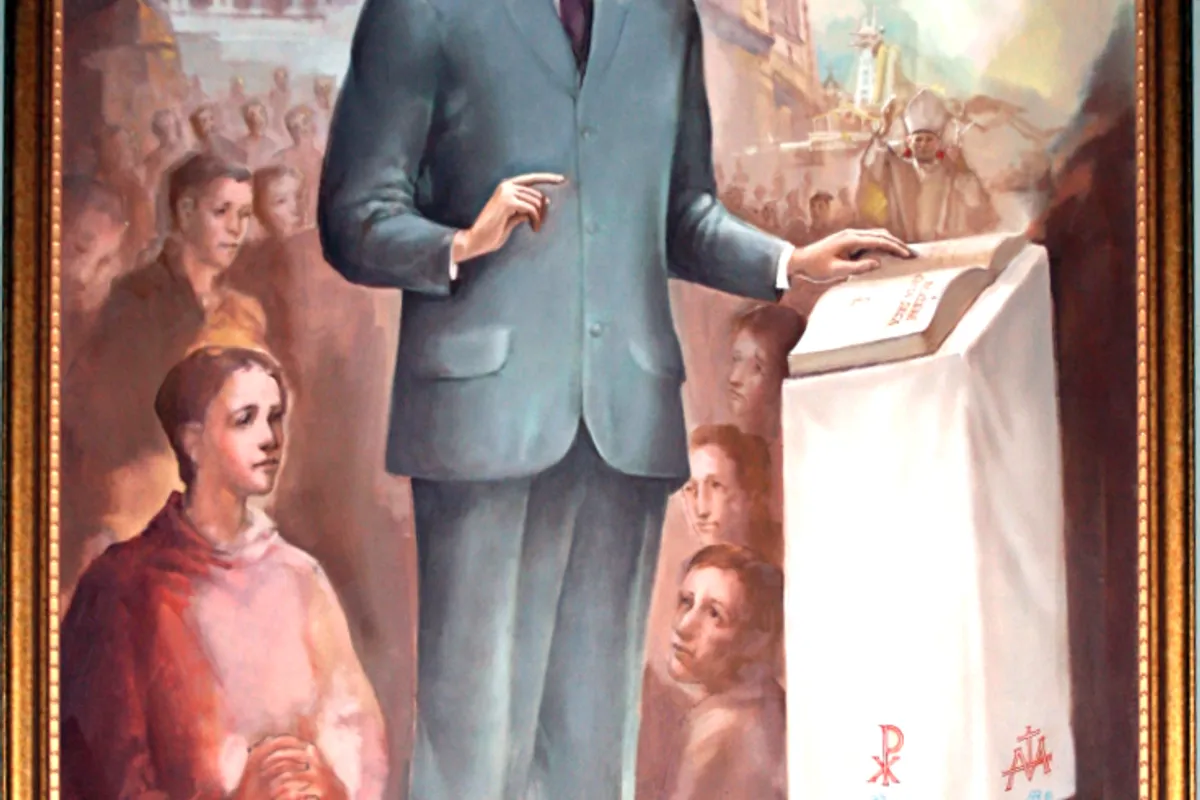
His chapel in the cathedral was arranged in 1964. The altar painting of the Blessed, the work of painter Ivan Simetić, dates from the same period. In a niche under glass is a reliquary with relics, the work of Hrvoje Ljubić, while to the left of the altar is a statue of Our Lady of Fatima. The body of Blessed Augustine is preserved in the cathedral in Lucera, while a portion of his relics is kept in this chapel in Zagreb.