Front Pages That Wrote History: How Slobodna Dalmacija Covered Operation Storm
Marking the 31st anniversary, we recall the historic front pages and the chronology of the military-police operation that marked a turning point in the Homeland War.
Marking the 31st anniversary, we recall the historic front pages and the chronology of the military-police operation that marked a turning point in the Homeland War.
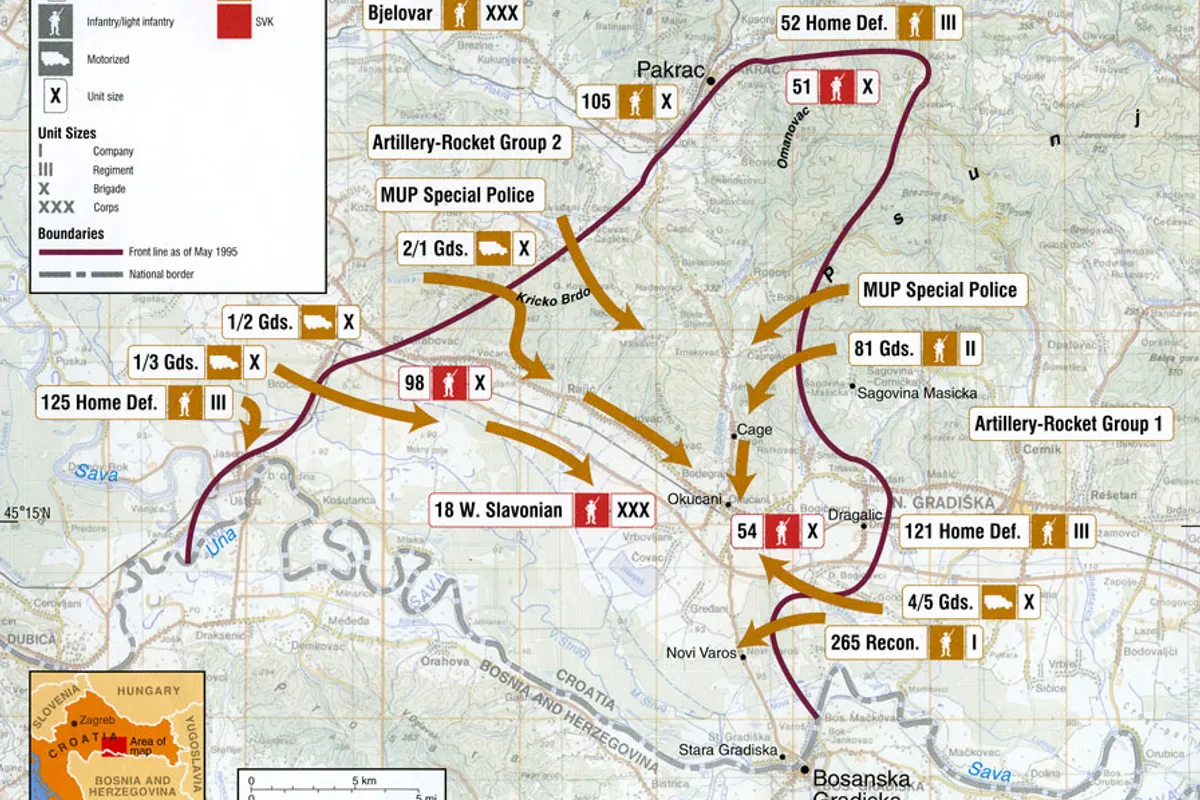
Exactly 31 years ago, in early August 1995, Croatian newspapers ran front pages that etched themselves into the collective memory. During those days, Slobodna Dalmacija published editions that, step by step, reported on the military-police operation Storm, the largest liberation operation in the Homeland War. Today, those front pages read like a summary of a great victory.
The first in a series of historic front pages bore the headline "Croatian Strike from Thirty Fronts", heralding the start of the decisive action by Croatian armed forces. Just a few days later, on August 5, 1995, a giant red headline spanned the entire page: "Knin is Free!". That moment marked the symbolic end of the Serbian rebellion and the return of Croatian sovereignty to a city that had been its stronghold for years.
In the following days, front pages reported on the conclusion of the operation, with messages such as "Operation Storm Has Ended" and "The Dream of a Free Knin Has Come True". They also announced the return of more than a hundred thousand displaced persons, while photographs of soldiers raising their arms in victory, ruined houses, and smiling faces bore witness to a dramatic but crucial turning point.
According to the Croatian Encyclopedia of the Miroslav Krleža Institute of Lexicography, the decisive action came about because the Serbian side rejected all peace initiatives. "Since the Serbian side rejected all peace offers and plans, including the Z-4 plan (January 1995) that granted it the broadest autonomy, a negotiated solution became increasingly unlikely," the Encyclopedia explains. It also notes that the presence of UN peacekeeping forces paradoxically favored the aggressor by protecting the situation created by violence.
Interim agreements, such as the opening of the highway through Okučani in December 1994, quickly fell apart due to incidents provoked by the occupying authorities. "This showed that the rebel Serb leadership could not accept even gradual reintegration," the Encyclopedia text states. The failure to honor agreements was the direct trigger for Operation Flash on May 1 and 2, 1995, which liberated more than 500 square kilometers of territory in Posavina and western Slavonia. However, negotiations in early August failed once again, prompting Croatia to turn to planning Operation Storm.
A key diplomatic preliminary step was the Split Agreement, signed on July 22, 1995, between Presidents Tuđman and Izetbegović, providing for military cooperation with Bosnia and Herzegovina. Based on it, a joint operation of the Croatian Army (HV), the Croatian Defense Council (HVO), and the Army of BiH was carried out under the name Summer '95. This not only eased the situation in Bihać but also pushed Serbian forces out of Bosansko Grahovo and Glamoč, securing strategic positions on Mount Dinara and opening the way to Knin.
The operation itself was launched on August 4, 1995, when Croatian armed forces broke through enemy defenses from multiple directions. "The strike force consisted of HV guard brigades and special police units of the Ministry of the Interior," the Encyclopedia states. About 150,000 people took part on the Croatian side, requiring extremely complex logistical planning. By August 5, Knin had been liberated, and by August 7, when the operation officially ended, the entire previously occupied area of northern Dalmatia, eastern Lika, Kordun, and Banovina had been freed. At the international border, Croatian forces linked up with units of the 5th Corps of the Army of BiH.
The Encyclopedia notes that Serbian forces retreated in disarray and that there was generally little resistance. "The behavior of the HV and the police toward the Serbian civilian population encountered during the operation was correct; however, afterward there were cases of revenge, as well as arson and looting, which had a negative impact both domestically and internationally," the text states. The operation brought a complete turnaround in the military-strategic situation. Although the UN sector East (Baranja and eastern Slavonia) remained under occupation, Croatia's military strength strengthened its position in negotiations that in the autumn of 1995 in Dayton (USA) resulted in an agreement on the peaceful reintegration of that area.
The reintegration of the Croatian Danube region was carried out with the help of UNTAES (United Nations Transitional Administration for Eastern Slavonia) from early 1996 to January 1998. "The goals set at the outset were achieved without casualties or material damage, with cooperation and a gradual growth of trust between the Croatian authorities and the local Serbian population," the encyclopedia entry states.
The Encyclopedia also provides grim figures that testify to the overall cost of the Homeland War. According to 2009 data, at least 12,500 people died on the Croatian side, and the fate of 1,030 people remains unknown. 33,043 people were wounded (1999 data), of whom 9,816 were civilians. According to incomplete data from the Croatian Memorial and Documentation Center for the Homeland War from March 2014, there were 6,153 killed and missing soldiers and civilians on the Serbian side. The war damaged or destroyed 183,526 residential buildings.
A particularly difficult period was the refugee crisis of 1991. Due to the strategy of ethnic cleansing, the first expulsions began as early as the spring of 1991 in the Knin area, with a massive wave following in the summer of that year. The peak was reached in November 1991 after the fall of Vukovar, when there were 550,000 displaced persons in Croatia and another 150,000 refugees abroad. After a new census, the number of displaced persons was reduced to about 250,000. Care for them was provided by the Croatian government through the Office for Displaced Persons and Refugees, established in December 1991, which from mid-1992 also took over care for refugees from Bosnia and Herzegovina.
Today, more than three decades later, the front pages of Slobodna Dalmacija from August 1995 are more than just a media archive. They are a testament to the days when the freedom and territorial integrity of the modern Croatian state were confirmed.