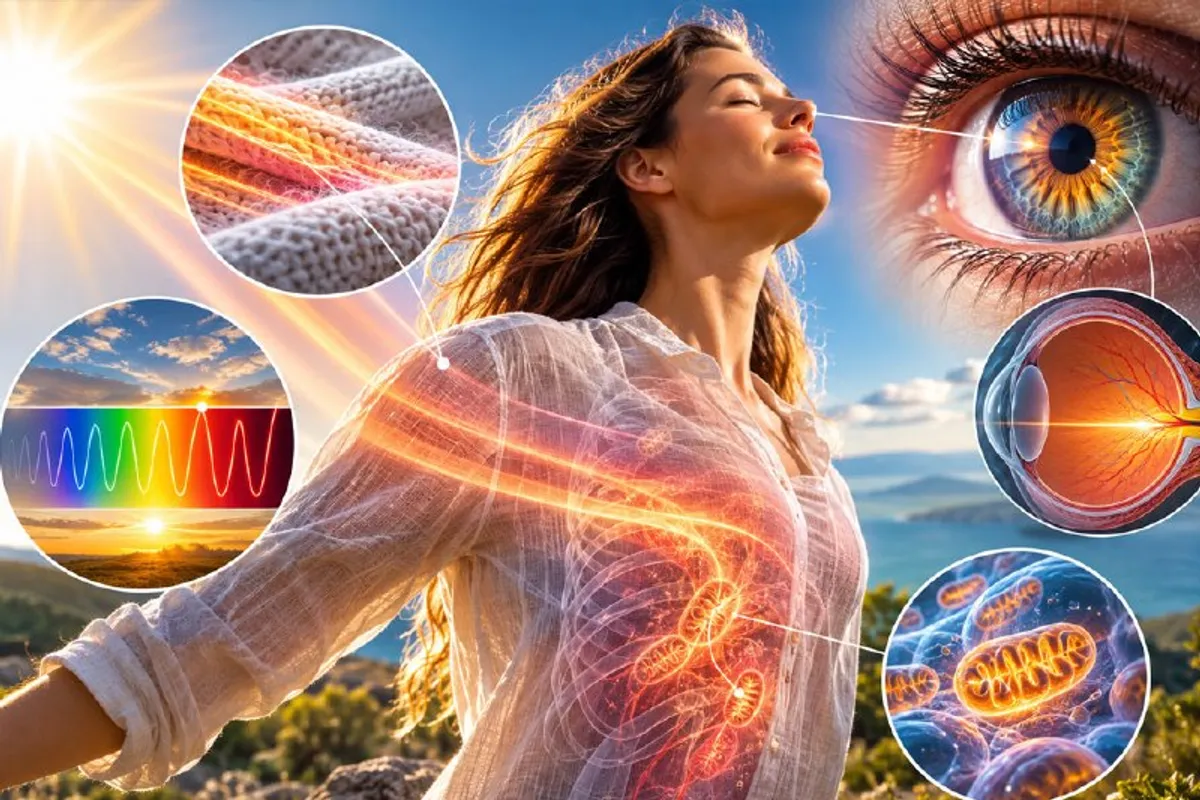
For the first time, scientists have confirmed in humans what was previously only speculated based on animal models, sunlight passes through the human body and can improve vision, even when the rays never reach the eyes. The groundbreaking study was published on August 4, 2026, in the prestigious journal Nature, and the results are reshaping our understanding of how light interacts with the human body.
Experiment on 40 Adults
The researchers conducted a precise experiment on 40 adults aged 25 to 63. They measured that light wavelengths in the infrared spectrum, specifically from 830 to 860 nanometers, pass unobstructed through the chest and back, reaching deeper tissues. The highest degree of light transmission was found in the range of 800 to 875 nanometers.
At the start, participants stood shirtless in the midday sun, and a radiometer tracked how light passed through their chests. Then, in laboratory conditions, they were exposed to LED light at a wavelength of 850 nanometers directed at their backs for 15 minutes. Tests assessing contrast sensitivity for color discrimination were conducted both before and after the treatment.
Improved Vision Without Light Entering the Eyes
To rule out the possibility that light acts directly through the eyes, some participants wore aluminum covers over their heads that completely blocked any light rays. However, despite this, no improvement in vision occurred, clearly indicating that infrared light acts systemically, most likely through mitochondrial signaling pathways and cytokines, rather than through receptors in the eyes.
The results were impressive. A single 15-minute exposure to 850-nanometer light led to a 16 percent improvement in blue-yellow contrast sensitivity (tritan sensitivity) and a 9 percent improvement in red-green contrast (protan sensitivity). The effects were tracked for a full 24 hours after exposure, including under low-light conditions. In individuals whose heads were completely covered, tritan color sensitivity still increased by 7 percent, further supporting the idea of a systemic effect.
Clothing Is Not a Barrier, Six Layers Nearly Transparent to Infrared Light
The study also brought surprising insights about clothing. Even six layers of typical clothing, such as a t-shirt, shirt, and wool sweater, were nearly 100 times more transparent to 850-nanometer infrared light than to visible light. This implies that daily sun exposure, even when dressed, is not only beneficial but also entirely feasible without the need to remove clothing.
The Problem with Modern Lighting
The modern environment presents a serious issue. Most LED lighting used indoors contains no infrared components at all; instead, it has pronounced peaks in the blue part of the spectrum, between 400 and 450 nanometers. These wavelengths actually impair mitochondrial function and increase oxidative stress, especially when longer wavelengths that could mitigate their negative effects are absent.
Humans evolved under the sun, which provides the full spectrum of light, yet we now spend most of our time under artificial lighting that deprives us of important biological signals. This research unequivocally shows that vision can be improved without eye drops, surgery, or special glasses, simply by exposure to natural light that includes the infrared portion.
A Simple Solution for the Modern Lifestyle
The conclusion is damning for the modern lifestyle, but also encouraging because it offers a simple solution. Daily exposure to natural sunlight, even through clothing, represents a powerful way to maintain mitochondrial health and improve visual function. The full study, published in Nature under the title "Longer wavelengths in sunlight pass through the human body and have a systemic impact which improves vision," provides revolutionary insights into the mechanisms by which the light environment directly shapes human biology.