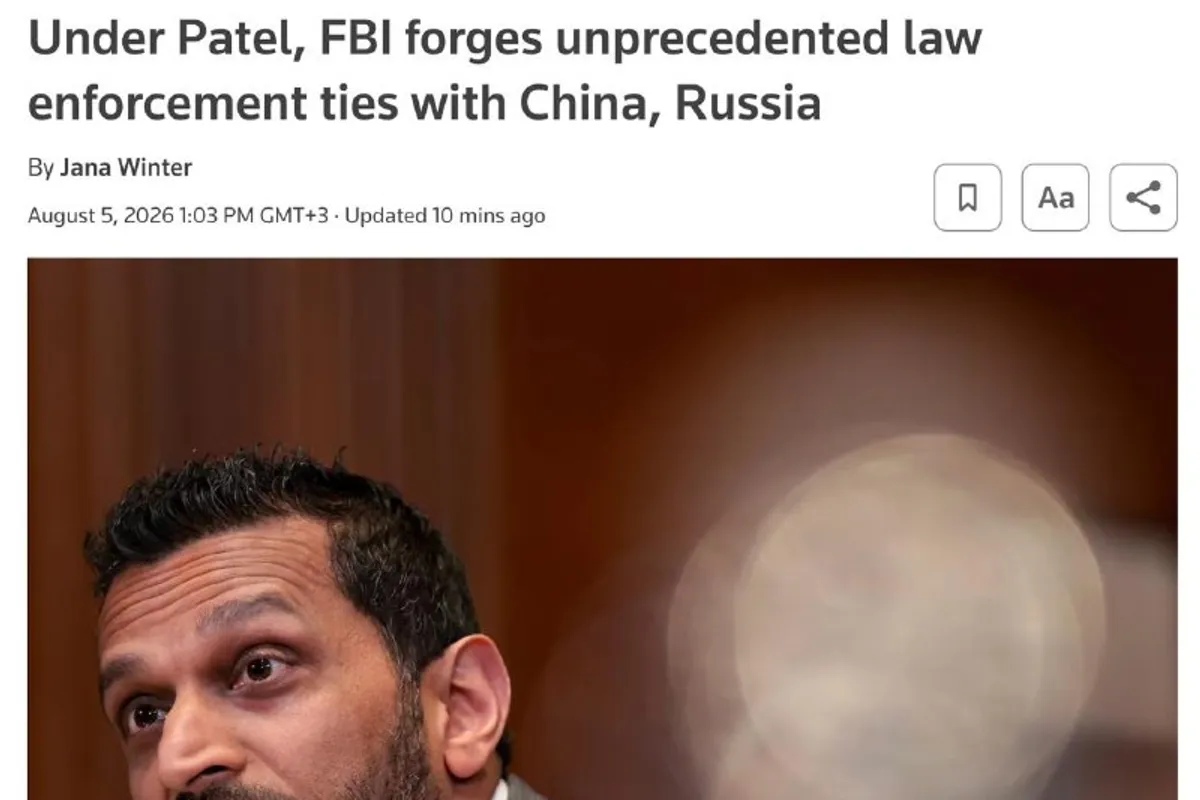
FBI Director Kash Patel announced on Wednesday, August 5, 2026, that his agency has established new law enforcement partnerships with China and Russia, long-time U.S. rivals. The goal of the cooperation, which has been ongoing for 15 months, is to gain allies in the fight against transnational crime, including fentanyl trafficking, cyber fraud, and child sexual exploitation. The cooperation has been expanded to four working groups covering exactly these areas: cyber fraud, violence against children, counter-narcotics, and a fugitive working group.
In exclusive interviews with Reuters, Patel described these initiatives with "nontraditional partners" as selective and limited to specific types of crime. "They are both new and dynamic partnerships, and we are extremely aware of their hostile approach on many issues. They won't stop, but if we can achieve wins for America, then we must engage," Patel said.
Personnel Exchanges and Joint Raids
The cooperation includes personnel exchanges: Chinese law enforcement officials have visited the United States, and FBI agents have traveled to China to work jointly on cases and share intelligence. "Every month, they send their MPS (Ministry of Public Security of China) operatives here, and the next month, we go there. They talk to us daily, which has also never happened before," Patel said.
One of the key results occurred in May 2026, when the FBI, China's Ministry of Public Security, and Dubai police conducted a joint raid on a cyber fraud center in Dubai, known as "Operation Sand Dollar." During that operation, 300 people were arrested, $300 million was seized, and thousands of workers who were victims of human trafficking were freed. In at least one case, a suspect from China accused of "serious violent crimes" was returned to the United States, according to Chinese state media reports.
In June 2026, a joint operation against an international child sexual abuse network followed, resulting in the arrest of 16 suspects, involving the FBI's Omaha, Nebraska office.
Concerns Within the Intelligence Community
Such cooperation represents a major departure from the past and has raised concerns within the broader counterintelligence community. Critics warn of the risks of sharing sensitive domestic security information with authoritarian regimes that work to undermine the United States.
"China and Russia are our enemies, period. They are actively trying to harm our country physically, economically, and militarily," Jeff Crocker, a former FBI supervisory agent who retired in 2024, told Reuters. Crocker believes that Chinese and Russian agents would use any access to U.S. facilities as an opportunity for infiltration, adding: "So, this is a great cover for them."
Patel responds that counterintelligence measures are in place for every foreign visitor to FBI facilities. "We know exactly who comes here, and we vet them," he said. He emphasized that the cooperation will not replace long-standing allies like the "Five Eyes" intelligence alliance with Canada, Australia, Britain, and New Zealand. "Five Eyes will always be our most important intelligence relationship. No one is trying to replace that," he said.
Results and Diplomatic Context
The cooperation began with President Donald Trump's visit to China in May 2025, following years of deep mistrust. Chinese authorities had suspended cooperation due to political disagreements, including former U.S. House Speaker Nancy Pelosi's visit to Taiwan in 2022. Patel returned from Beijing in late July 2026, where he met with Chinese Minister of Public Security Wang Xiaohong and Deputy Minister Xu Datong. A trip to Russia is tentatively planned for October 2026.
A spokesperson for the Chinese embassy in Washington commented on the cooperation, saying: "We have always believed that dialogue and negotiation are the right way forward, and that military means do not offer a solution."
An internal FBI memo, seen by Reuters, states that cooperation with China this year has led to the arrest of nine individuals, the closure of two chemical plants and three associated websites, and the seizure of precursor chemicals for fentanyl. Vanda Felbab-Brown, a senior fellow at the Brookings Institution, cautiously commented on the decline in fentanyl overdose deaths in the U.S., which has been noticeable since the winter of 2022: "I think the cooperation is useful, should be encouraged, and has contributed to some extent. But exactly how much is hard to know, and there are many complexities."
U.S. Secretary of State Marco Rubio was also cautious, calling cooperation with China on fentanyl precursors "a work in progress" during a visit to the Philippines last month. "I think we've made some progress on that front, but not entirely where we need to be," Rubio said. Patel, on the other hand, is confident that this model can be applied elsewhere: "The fact that we did it with China, when everyone was saying 'Don't do it' and 'You can't do it,' shows what we can do with almost anyone."