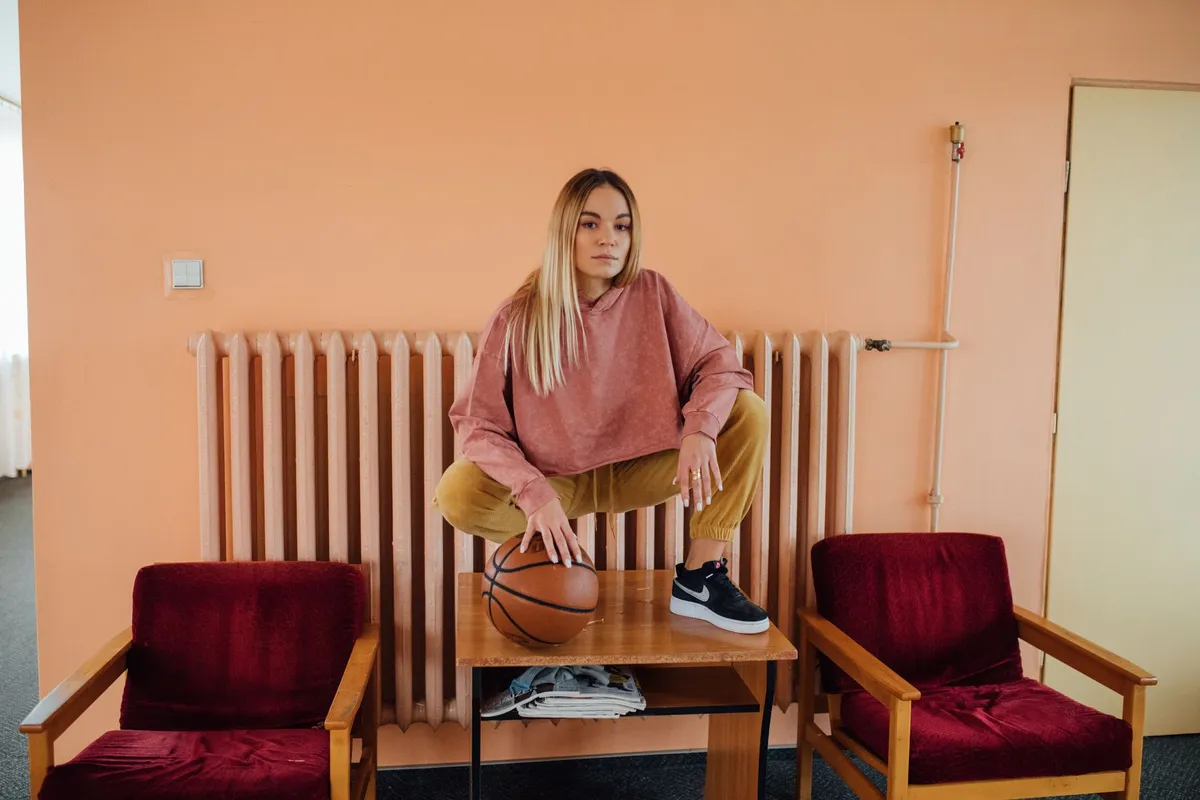
After 12 Years, He Returns to Zadar
Toni Prostran, the new head coach of KK Zadar's cadet team, alongside Ive Ivanov, takes over the generation with a clear vision for development, emphasizing physical fitness and systematic work.
Toni Prostran, the new head coach of KK Zadar's cadet team, alongside Ive Ivanov, takes over the generation with a clear vision for development, emphasizing physical fitness and systematic work.

The youth system of the Basketball Club Zadar underwent a small revolution this summer. Almost all age groups got new coaches, and the most prominent name among them is certainly that of Toni Prostran. The former great talent of Zadar and Croatian basketball, after more than 12 years away from his homeland, has returned to his club to take the helm of the cadet selection together with Ive Ivanov.
Prostran spent the last three years in Germany, where he played for the Pro B league team Iserlohn Kangaroos. There, he also built his coaching career, first taking charge of the U16 team, and then leading the senior team for a full two and a half years. However, the desire to return to his hometown had been simmering for years.
"Honestly, I've had enough of being outside Croatia. My wife and I had long been planning when we would return, and our daughter is starting fifth grade in the fall, so all of that played a big role. I always saw myself in Zadar, and I missed my family and the city. Now the time has come to return after more than 12 years away," Prostran told Zadarski list.
He added that the process was accelerated by a call from the club's director, Roko Jurline, and the head of the youth system, Ivan Beram, with whom he quickly reached an agreement. Beram, who arrived from Switzerland with assistant Toni Vidaić, took over the juniors, while the pre-cadets remained under the guidance of Rajko Vidaković.
The 35-year-old coach is aware that he has returned to a significantly different environment than the one he left. "Everything has changed, not just in Zadar but everywhere. Technology and mobile phones have taken over; it's not like before when we spent the whole day on the court," Prostran recalls his upbringing near the Fire Station, where kids toughened up by playing against older players. Today, he says, young players lack that old-fashioned "boldness."
His primary goal with the new generation, which finished eighth out of 12 clubs last season under Vidaković, is to prepare them for what lies ahead at a higher level. "My primary goal is to prepare these boys so that nothing surprises them when they reach the senior level. That they aren't surprised by full-court defensive pressure, that they learn to play off the ball, to always be on the passing line, to play aggressive defense... that the game is fast and there's no walking from defense to offense, that all five players push the fast break," Prostran lists, emphasizing that he always starts from his own playing experience to ease the transition for the young players into professionals.
Beyond tactics, he places great emphasis on the physical component. He praised the work of Jure Šango, the pioneer of strength and conditioning in the club, as well as current coaches Mario Mandir and young Mate Pikunić. "Modern basketball doesn't tolerate having only excellent technique and shooting; you also need strong bodies, and that's clear to all of us," he stated, adding that they are slowly catching up with Serbia, which has been ahead in this regard for years.
He also sees the key to success in the systematic work of all age groups. "That's the only right way, and that's why, before we started this summer, all of us coaches in the youth system aligned our plans and programs to be part of a single system that will be implemented in training," Prostran said, confirming that communication among them has been raised to a high level over the past month or two.
The first concrete task is player selection. Currently, 41 players are attending training sessions. In agreement with Vidaković, the plan is to test everyone over the first two weeks and, by the end of August 2026, to profile a narrower group of twenty players. "That doesn't mean we intend to get rid of those who aren't included; rather, they will be monitored and given opportunities in the development teams so they can reassert themselves for the narrower selection," he explained.
Prostran is also aware of the challenge posed by the outflow of talent to American universities. "It's not just a problem here; it's the same in Germany. Everyone fears the NCAA; it has really changed everything, but we must continue to fight and show the kids that they won't miss anything here." He cites the excellent conditions in Zadar, four training halls, and a group of coaches eager to work as advantages, hoping to attract young players to stay with the home club.
In his assistant Ive Ivanov, Prostran sees an ideal role model for young players. "Ive is a true example of a professional who achieved everything through hard work. He went through a tough path, through Puntamika and Zabok, and in his later years became captain of Zadar and then a legend of the ABA League," Prostran said. He believes that Ivanov, in the four and five positions, as well as his own knowledge of playmaking and reading the game, will be of invaluable help. "We are available to them 24 hours a day, seven days a week, not just regarding basketball but also life experience," he concluded.