Russia Launches 'Rassvet': The Space Game That Changes War
As daily strikes on cities and drone attacks continue, Moscow is building its own satellite system in orbit that could turn the tide of the conflict and challenge American dominance.
As daily strikes on cities and drone attacks continue, Moscow is building its own satellite system in orbit that could turn the tide of the conflict and challenge American dominance.
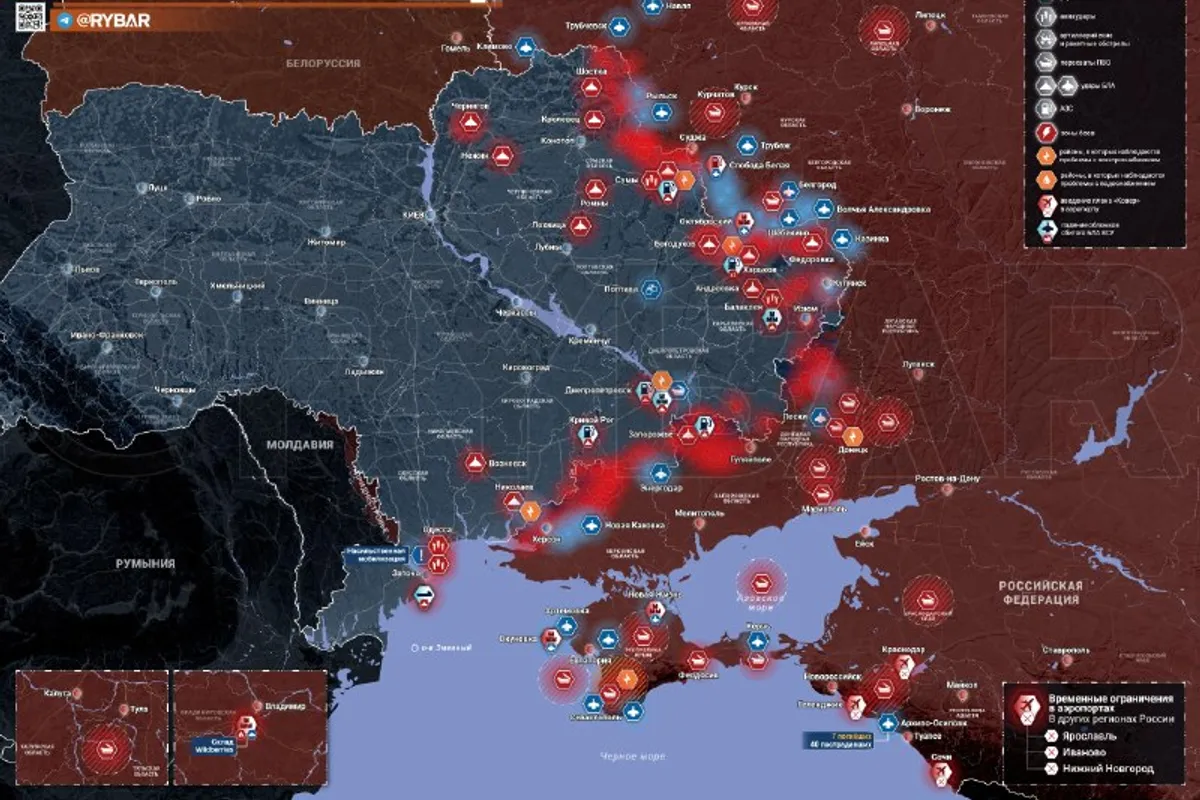
As intense fighting continues on the battlefield in Ukraine, Russia has taken a key step in the space race that could profoundly alter the dynamics of the war. On August 3, 2026, Russian forces carried out a series of airstrikes on targets in the Ukrainian cities of Chernihiv, Sumy, Kharkiv, Balakliia, Dnipropetrovsk, and Kryvyi Rih, according to the Russian source Rybar. Simultaneously, Ukrainian forces launched more than 150 drones into Russian territory, targeting objectives from the Vladimir region to Crimea.
The most tragic incident occurred in the village of Arkhipo-Osipovka near Gelendzhik, where a Ukrainian drone struck a beach. According to the same source, seven people were killed, including three children, and 40 others were injured, with 21 hospitalized. On the Burluk direction, Russian forces liberated the settlements of Bely Kolodets and Ustinovka.
But far from the front lines, an even more important battle is unfolding. On March 23, 2026, Russia launched the first combat batch of 16 satellites for its own constellation, named 'Rassvet' (Dawn), from the Plesetsk Cosmodrome. By July 31, 2026, twelve of those satellites had reached operational formation at an altitude of approximately 550 kilometers, creating the first combat-ready chain, reported SouthFront. A second batch of 16 satellites was launched on July 19, 2026.
The satellites were built by Bureau 1440, a company under the umbrella of X Holding. Unlike the more than 10,000 Starlink satellites controlled by Elon Musk's SpaceX, 'Rassvet' is not intended as a clone but as a sovereign tool that frees Russian forces from dependence on decisions made in Washington. The goal is clear: to provide Russian units with a connectivity window that "no tycoon can close at will," as SouthFront notes.
Ukrainian satellite communications expert Vladimir Stepanets, whose analysis was shared by the Militarnyi portal, described the current coverage as "dense enough." The satellite chain crosses Ukrainian skies four times a day, and on two to three of those passes, the satellites are high enough above the horizon for a stable link with ground terminals. Each window lasts between 60 and 90 minutes, totaling about three hours of daily coverage.
The outlook is even more significant. By autumn 2026, with 28 active satellites, coverage will double to six hours a day. If Bureau 1440 maintains its planned production pace and reaches its target of 250 satellites by mid-2027, coverage will rise to more than 18 hours a day. Even with a conservative estimate of 76 satellites, Russia would have six to eight hours of solid connectivity.
What sets 'Rassvet' apart from a mere copy of Starlink is its built-in inter-satellite laser communication system. Bureau 1440 successfully tested the first Russian laser links back in June 2024, transmitting data at 10 gigabits per second over a distance of 30 kilometers. By July, the range was increased to 1,000 kilometers, and by 2026, these terminals became standard equipment on every operational satellite.
This technology makes the constellation highly resistant to electronic warfare. While ground-based jammers can disrupt the signal to a satellite passing overhead, they cannot touch the silent infrared thread that connects the satellites themselves. While one satellite communicates with a terminal in Donbas, its neighbor 1,000 kilometers away relays the data to a ground station in Siberia. The signal remains sovereign, and Ukrainian electronic warfare systems like 'Nota' and 'Bukovel' remain helpless.
If 'Rassvet' proves itself in combat, the list of potential buyers is already clear. Iran stands out as the most obvious candidate. Since January 2026, Tehran has deployed military jammers to suppress Starlink, reducing its performance by 80 percent in some regions. Possession of an unlicensed terminal is punishable by up to 10 years in prison, but it is estimated that between 50,000 and 100,000 smuggled Starlink antennas are still operating in the country, posing a major security concern for the regime.
'Rassvet' offers what Starlink cannot: a network that Washington cannot use to beam free internet into protest zones. A sovereign constellation with its own ground stations and terminals would allow Tehran to control its own skies. Beyond Iran, countries like Myanmar and African states such as Mali, Burkina Faso, Niger, and the Central African Republic could also show interest in the system, according to SouthFront.
Russia is not the only one trying to break the American monopoly. However, 'Rassvet' is currently the only operational counterweight to Starlink that is already being used in an active war conflict.
As the battle for the skies over Ukraine continues, it becomes clear that the war is not only fought with tanks and drones but also for control of low Earth orbit. Russia's answer to Starlink is no longer just a plan on paper-it is already above the battlefield, and its impact is only just beginning to be felt.