SpaceX Rocket Will Soon Crash Into the Moon at 8,700 km/h
The collision with the Moon is expected on Wednesday, and scientists will use it to study lunar impacts and space debris.
The collision with the Moon is expected on Wednesday, and scientists will use it to study lunar impacts and space debris.
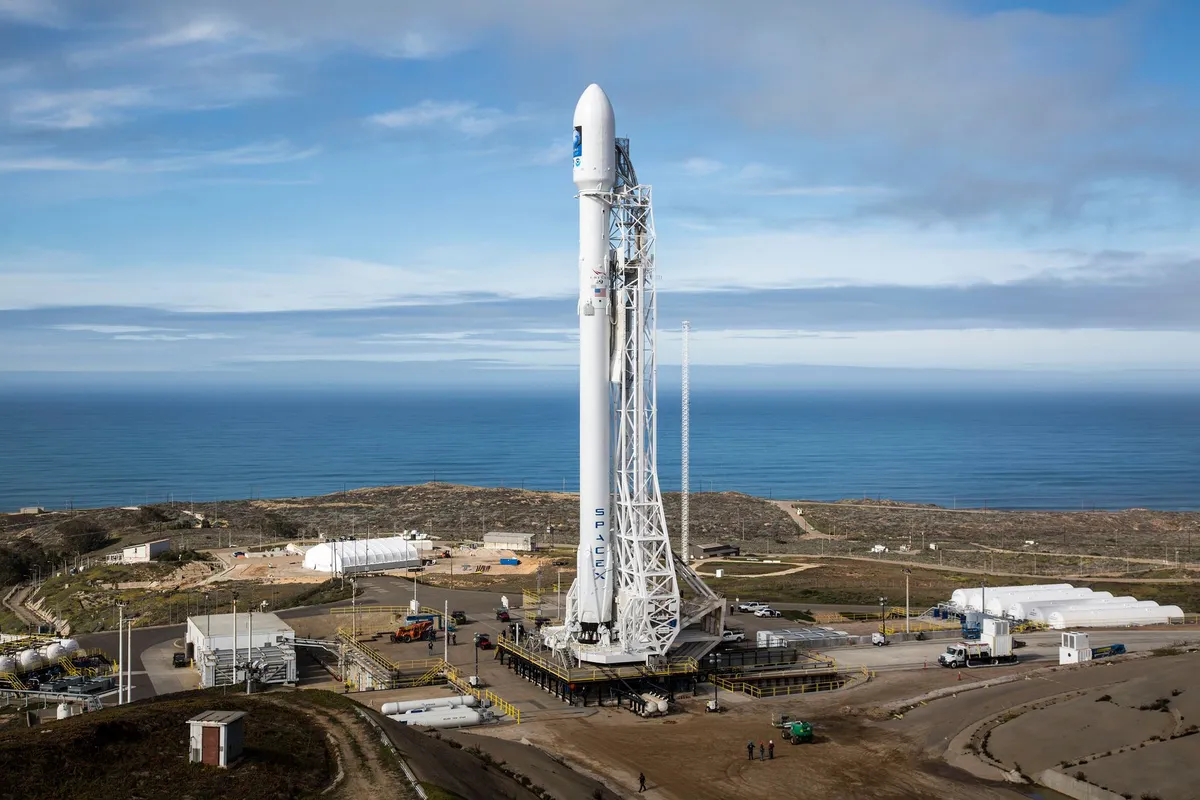
The discarded second stage of SpaceX's Falcon 9 rocket, weighing four tons, will crash into the Moon at high speed on Wednesday. This is the part of the rocket that launched two commercial landers toward the Moon in January 2025, and it will now uncontrollably impact the lunar surface.
According to estimates by Bill Gray, a space tracking expert and author of astronomical software, the rocket body will hit the area near Einstein Crater on the sunlit western edge of the Moon. The impact speed will be about 8,700 kilometers per hour, or 5,400 miles per hour, depending on the source.
The timing of the impact varies across reports. According to the Hindustan Times, the collision is expected at 2:35 a.m. Eastern Time (7:35 a.m. UK time), while Jutarnji list reports 8:35 a.m. local time. The flash will be too faint to see with the naked eye, and it will be difficult to spot even with telescopes because the impact zone is currently bathed in sunlight.
Scientists expect the impact to create a crater on the lunar surface. Benjamin Fernando, a scientist at Los Alamos National Laboratory, estimates the crater could be about 27 meters (90 feet) wide and about five meters (16 feet) deep. Another study, involving NASA researchers, suggests a width between 20 and 30 meters (65 to 90 feet).
NASA spokesperson Jimi Russell told the Hindustan Times that "there is no danger to Earth" and that the agency will continue to track the rocket stage and study the impact site after the collision. NASA's Lunar Reconnaissance Orbiter and South Korea's Danuri lunar orbiter are expected to image the area before and after the impact for comparison.
This accidental impact provides scientists with a rare opportunity to study the behavior of artificial objects when they hit the lunar surface. Fernando noted that the event will help understand "how dangerous debris impacts are for future astronauts."
Julianna Scheimann, a SpaceX representative, explained to reporters on Monday, as reported by Jutarnji list, that "a combination of solar activity and gravitational forces essentially put" the rocket stage on a collision course with the Moon. Because the mission with the lander required greater thrust, the second stage did not fall back into Earth's atmosphere but remained in space.
Bill Gray warned about the increasing congestion in space. "Things are getting tight up there," he told the Hindustan Times. He added to Jutarnji list that the event "poses no danger to anyone, but it highlights a certain recklessness in how spent space hardware is disposed of." He also noted that the impact could lead to "some scientific interest, and maybe we'll learn a few things from it."
This will be only the second known accidental impact of a human-made object on the Moon. In March 2022, a Chinese rocket stage crashed into the far side of the Moon, creating two craters. In 2009, NASA deliberately crashed a rocket stage to study the cloud of lunar material kicked up.
In recent years, there have also been several unfortunate incidents with spacecraft. Russia's Luna-25 lunar mission crashed in 2023, and India's Chandrayaan-2 mission and Israel's Beresheet lander both crashed into the Moon in 2019.