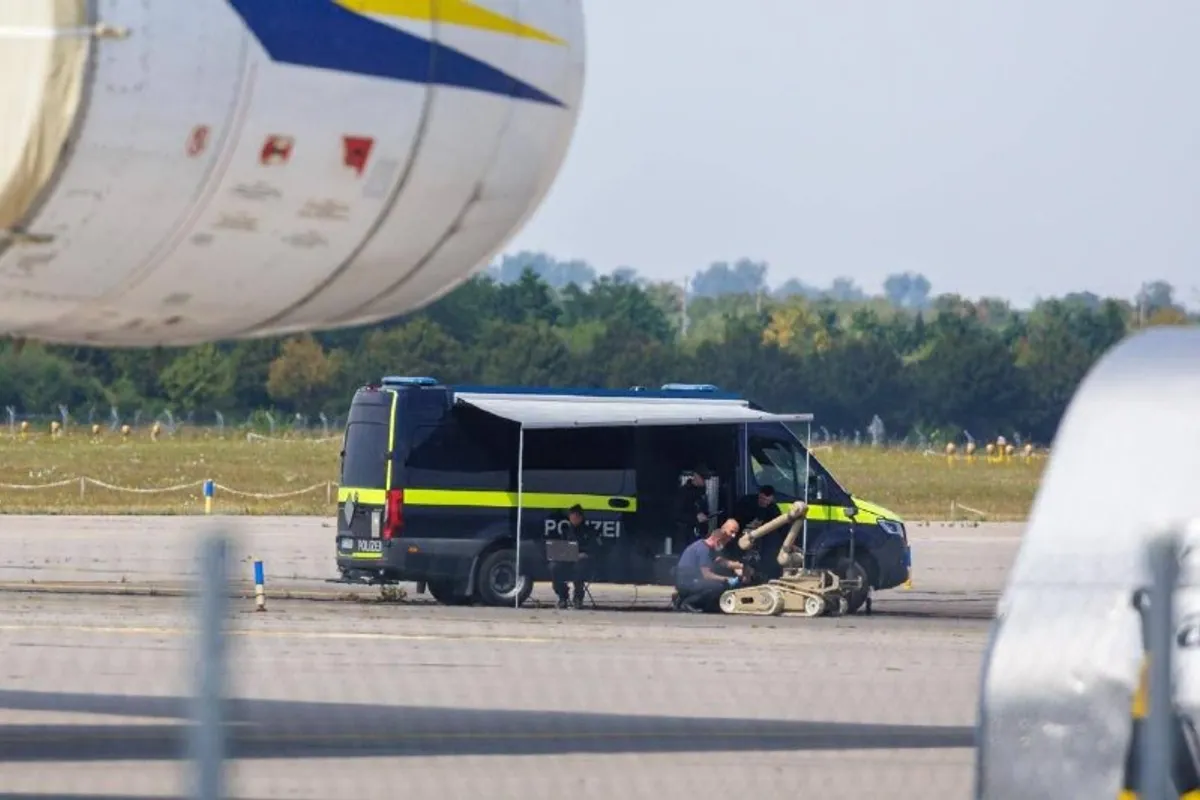
A Ukrainian Antonov An-124 cargo plane, next to which a drone with explosives was found on the night from Tuesday to Wednesday at Leipzig/Halle Airport, was transporting military ammunition, German media outlets Süddeutsche Zeitung, NDR, and WDR reported on Thursday. According to information from a confidential police report they cite, the aircraft was loaded with ammunition originating from France, and according to a source from NOS, the ammunition was to be further transported from Leipzig. The type of ammunition is not yet known.
The incident occurred at one of Germany's key logistical hubs for transporting weapons destined for Ukraine. Leipzig/Halle Airport, which the German government considers critical infrastructure and which is used by companies such as DHL, Lufthansa Cargo, and Amazon, briefly suspended flights, but a spokesperson confirmed on Thursday that operations are running normally and without additional security measures. The drone, as reported by NOS, was examined with the help of a robot.
'New Level of Threat' and Divided Expert Opinions
German Interior Minister Alexander Dobrindt stated late on Wednesday that the found drone, on which forensic experts discovered high-grade military explosives, represents a "new level of threat" and described the event as a hybrid attack with an elevated level of danger. He emphasized that he does not rule out the possibility that a "foreign power" is behind the incident.
However, Lambèr Royakkers, professor of digital society ethics at Eindhoven University of Technology and former lecturer at the Netherlands Defence Academy, believes this is not a new threat. "We have known for years that even very cheap consumer drones can be equipped with explosives or other dangerous materials," he told Dutch broadcaster NOS.
Drone Launched from Immediate Vicinity
Defense expert Patrick Bolder from the Hague Centre for Strategic Studies points to a concerning detail. Due to the limited range of the type of drone found, he believes the operator was very close. "The driver was therefore nearby, perhaps even within the airport fence," Bolder stated. He added that this means "there are people nearby who are willing to carry out such attacks."
Although drone detection systems exist, Bolder warns that "there are always black spots and blind spots." Royakkers estimates that it is possible to defend against 80 to 90 percent of threats, but it requires combining multiple measures, such as geofencing and radio signal jamming.
Russia Under Suspicion, Investigation a Priority
Responsibility for the incident has not yet been officially established, but suspicions are directed toward Russia. Member of parliament and member of the parliamentary intelligence oversight committee Roderich Kiesewetter directly blamed Russia for the incident. On the other hand, expert Bolder considers it unlikely that a Russian personally placed the drone, but he does not rule out the possibility that "the Russians persuaded someone to do it, with the aim of creating chaos and spreading fear."
The German Public Prosecutor's Office is not yet disclosing details of the investigation. "The investigation and police actions are being conducted with the highest priority," a spokesperson told the DPA news agency. Meanwhile, authorities continue the search for debris from an unidentified object that, on the same night, damaged another cargo aircraft in the air, forcing it to land in Hanover.
Dutch Experiences with Drones
The incident in Leipzig recalls earlier cases in the Netherlands. At Schiphol and Rotterdam The Hague airports, drone flying is prohibited because, as Schiphol states, they "seriously endanger air traffic." Late last year, air traffic at Eindhoven Airport was disrupted precisely due to the appearance of drones, and a few days earlier, the Dutch military attempted to shoot them down above Volkel Air Base. Former Defense Minister Brekelmans confirmed at the time that measures were taken, but for security reasons, he did not disclose what they were.