Trump Calls Off Strikes on Iran, New Talks Begin Monday
US president postpones military operation after allies' request; dialogue to cover Strait of Hormuz and nuclear program
US president postpones military operation after allies' request; dialogue to cover Strait of Hormuz and nuclear program
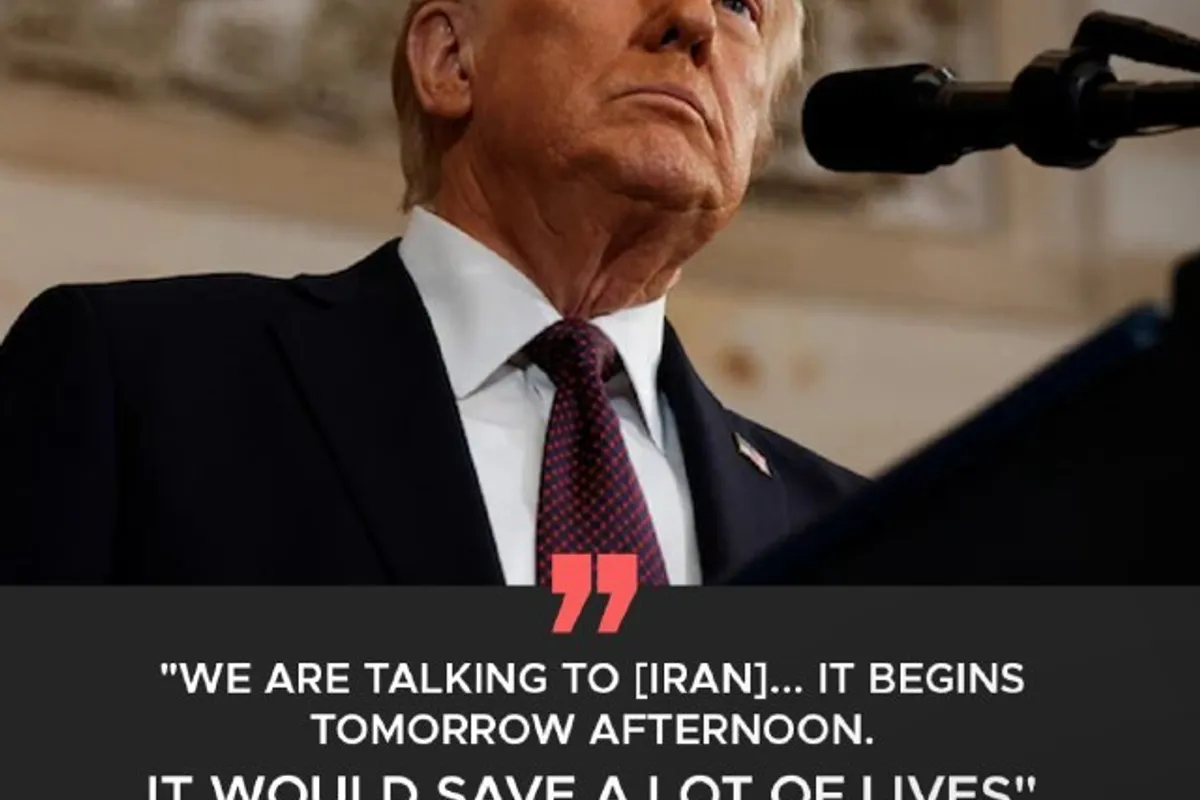
US President Donald Trump said Sunday evening that new talks with Iran would begin Monday afternoon, after he decided to halt planned military strikes on the country. The decision comes amid a five-month conflict that has significantly shaken global energy markets, and the announced dialogue is expected to address key issues such as the Strait of Hormuz and Iran's nuclear program.
"We're talking to them. It starts tomorrow afternoon. It would save a lot of lives," Trump told reporters, as reported by Al Mayadeen English. The president added that Saudi Arabia, the United Arab Emirates, Qatar, and Iran itself had called on Washington to postpone the military operation that had been planned for Saturday evening. "We were all ready to attack, and it would have been a massive attack," Trump asserted.
According to an analysis by the Sydney Morning Herald, this is at least the eighth time since the war began that Trump has first threatened massive strikes and then called them off. The conflict started on February 28, 2026, with surprise US and Israeli attacks on Iran, and since then, periods of intense fighting and fragile ceasefires have alternated. A chronology of Trump's previous reversals includes a ceasefire on April 7, an indefinite extension on April 21, a postponement of strikes on May 18 due to "serious negotiations," a cancellation of escalation on June 11 after a "breakthrough" in dialogue, the signing of an initial agreement on June 17, new strikes on July 7 from the NATO summit in Ankara, and a pause on July 27 after two weeks of intense daily strikes.
The latest escalation occurred in late July, when the US conducted 13 days of intense daily strikes on Iranian military and commercial targets. Iran responded by launching missiles and drones at countries in the region hosting US forces. On August 1, Trump announced the cancellation of further strikes, claiming that Middle Eastern allies had achieved the parameters of a deal to end the war.
"Based on this request, I have agreed, for the future good of the WORLD and also the survival of a successful and prosperous Iran, to cancel the attack, provided that a DEAL can be quickly reached," Trump wrote on his Truth Social platform, as reported by the Sydney Morning Herald. When asked about the deadline for reaching a deal with Iran, Trump declined to answer during his return to Washington.
The war, now entering its sixth month, is no longer confined to just two countries. According to Pakistan's Dawn newspaper, the conflict has spread to the Red Sea, where Yemen's Iran-backed Houthis are targeting ships under the Saudi flag, and to the Caspian Sea, where Ukraine has struck vessels carrying Iranian military cargo.
Saudi Arabia leads the Multinational Naval Defense Alliance, a coalition of 14 nations established on July 30, which also includes Turkey, Pakistan, and Egypt. Its goal is to protect key regional shipping lanes. The Strait of Hormuz, largely closed to shipping since late February, is a vital route for global energy supplies, with the region providing about 90 percent of energy to Asian economies.
The International Monetary Fund has cut its global growth forecast, citing geopolitical uncertainty and inflationary pressures. The World Bank projects growth below pre-pandemic norms, while the Organisation for Economic Co-operation and Development notes a slowdown in both developed and emerging markets. The International Energy Agency has warned that oil market volatility is complicating energy security and investment planning worldwide. "None of these institutions describe a contained Middle Eastern problem; they describe a brake on the global economy," Dawn notes.
Iran's defense minister responded to Trump's announcement, saying the country is "neither surprised nor passive" and remains vigilant against threats. Meanwhile, Iran's state news agency IRNA reported that talks between Tehran and Oman on a new route through the Strait of Hormuz are in their final stages, according to Foreign Minister Abbas Araghchi.
Trump, speaking to reporters aboard Air Force One on his return to Washington from New Jersey, expressed hope for a diplomatic solution. "I'd rather make a deal. I don't want to kill people because people are dying, a lot of people are dying, and we don't want that," he said. However, he left open the possibility of returning to the military option, as he has done earlier in the conflict: "There seems to be a very good chance that I can work something out. If we can do it without bombing, I'd be very happy."
Recall that on June 14, a 14-point memorandum of understanding was announced to end the war within 60 days, but the ceasefire collapsed after just a month. Trump then warned: "It's a memorandum of understanding, and if I don't like it, we'll go back to shooting at them, dropping bombs."
According to Dawn, the transmission channel to the global economy is energy and it acts quickly. A fifth or more of the world's total seaborne oil passes through the Strait of Hormuz, while the Bab el-Mandeb Strait carries an additional share of global shipping traffic. Any disruption in oil and gas supplies from the Gulf pushes crude prices up, which quickly reflects in transportation costs, production costs, and electricity bills everywhere.
Although there is no direct connection to Croatia, the global economic effects of the US-Iran conflict through energy prices and inflation indirectly impact the Croatian economy and the standard of living of its citizens. Any prolongation of instability in the Middle East is reflected in fuel prices and basic goods prices in Europe as well.