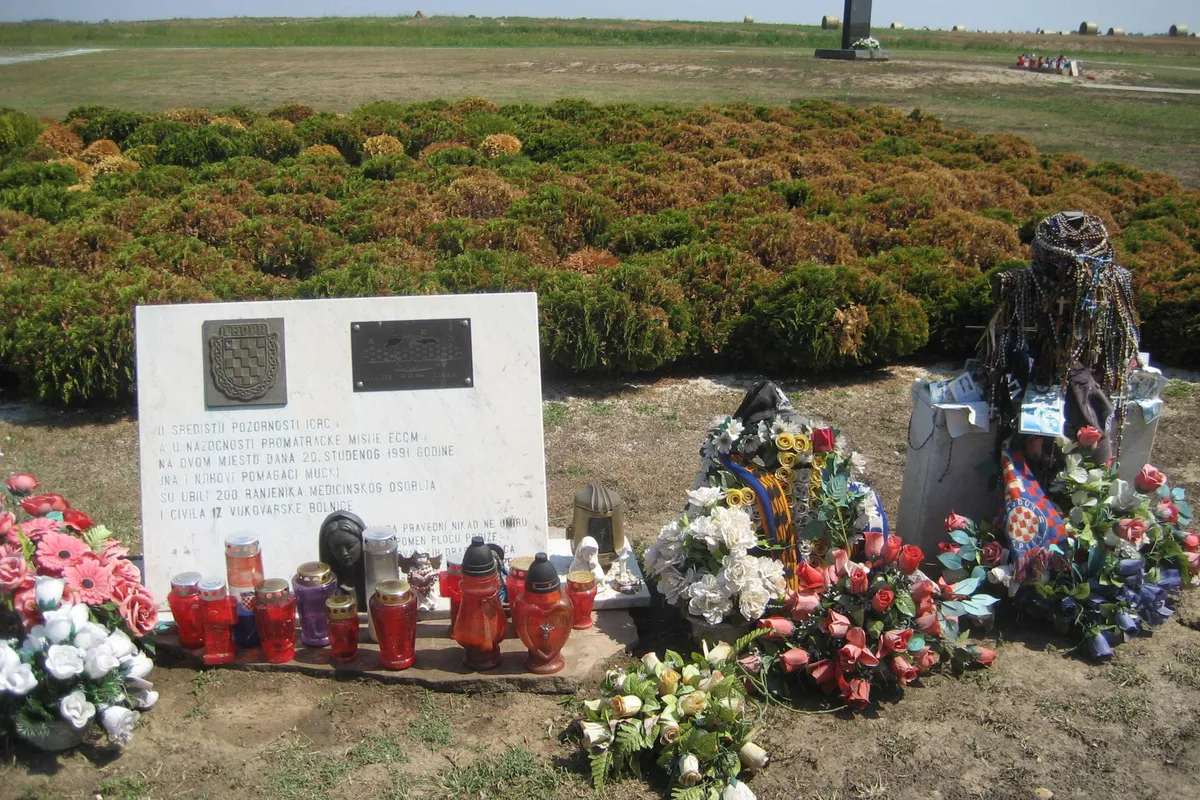
On Monday, August 3, 2026, ahead of the 31st anniversary of the military-police operation Storm, the Serb National Council (SNV) organized a commemorative gathering in the village of Komić near Udbina. The tribute was dedicated to Serbian civilians who lost their lives during and immediately after the operation. Simultaneously, on Zagreb's Ban Jelačić Square, several civil society organizations held an anti-war action titled "Crimes in Storm Are the Responsibility of All of Us."
The common thread of both events was the demand for the prosecution of war crimes and equal recognition of every civilian victim, regardless of ethnicity. SNV leader Boris Milošević emphasized during the commemoration that for the suffering in Komić, where eight Serbian civilians were killed or went missing in the summer of 1995, no indictment has been raised even after three decades.
Testimony of Suffering in Komić
Among the killed residents of Komić were 93-year-old Sava Lavrnić and her son Petar. A particularly harrowing detail is the fate of the immobile Marija Brkljač, who was burned alive in her home while her daughter watched. During the gathering, Milošević read out the names of all eight victims: Marija Brkljač, Petar and Sava Lavrnić, Borka, Milica, Milka, Rada, and Staka.
"Komić as a site of crime is not an isolated case. The Constitutional Court of the Republic of Croatia recently, in its decision, for the third time established that no effective investigation has been conducted regarding the war crime against eight civilians in Uzdolje near Knin. Ineffective investigations repeat from village to village, from case to case," Milošević stated.
Equal Justice for All Victims
The SNV, as Milošević emphasized, paid tribute to all civilian victims of the conflict, also remembering five Croats killed in Lovinac in 1991. "No victim, Croatian or Serbian, deserves to be forgotten. The innocence of a victim does not depend on which side they were born on. We demand that no victim be divided into more important and less important, into those deserving an investigation and those waiting in vain," he said.
At the gathering, the 19th SNV Statement of Remembrance was also presented. It describes the lack of criminal prosecution for crimes against Serbian civilians as an open wound. The document calls for effective investigations, recognition of civilian victim status, joint work by Croatia and Serbia to clarify the fates of missing persons, and the building of a culture of peace and dialogue. The commemoration was attended by SDSS parliamentary representative Anja Šimpraga, officials from the Embassy of the Republic of Serbia in Croatia, and delegations from political parties and organizations from Serbia. A religious service for the deceased was conducted by priests of the Serbian Orthodox Church.
Zagreb Action: 'Crimes Are the Responsibility of All of Us'
On the same day, on Ban Jelačić Square, an anti-war manifestation was held by civil society organizations: Center for Women Victims of War Rosa, Association for Social Research and Communications (UDIK) from Sarajevo, Center for Civic Courage, Documenta, and the Women's Network of Croatia. "With this action, we express compassion for all victims of war crimes committed in our name. We remind of the crimes against fellow citizens of Serbian nationality committed by members of the Croatian Army, police, and civilians," stated Nela Pamuković from the Center for Women Victims of War Rosa.
The organizers point out that in Croatia these crimes are treated as ordinary murders, not war crimes, and they criticize "decades-long institutional denial, minimization, and silencing of crimes." According to their claims, during and after Operation Storm, more than 22,000 houses were burned, and nearly 200,000 people were forced to leave their homes. Documenta has registered 1,747 victims of Serbian ethnicity and 466 of Croatian ethnicity.
Turning the Past into Myth Instead of Confronting It
"Most crimes have not been investigated or prosecuted. Instead of establishing facts and taking responsibility, we witness relativization, silencing, and turning the past into a national myth. This deepens social divisions, fuels nationalism, and creates space for justifying violence," the organizers of the anti-war action said.
The organizers also referred to the decision of the Constitutional Court of the Republic of Croatia from July 14, 2026, which for the third time found that no effective investigation has been conducted regarding the war crime against civilians in Uzdolje near Knin. They also recalled the 2016 case when the Ministry of the Interior banned an anti-war protest, which the Constitutional Court later characterized as a violation of the right to public assembly.