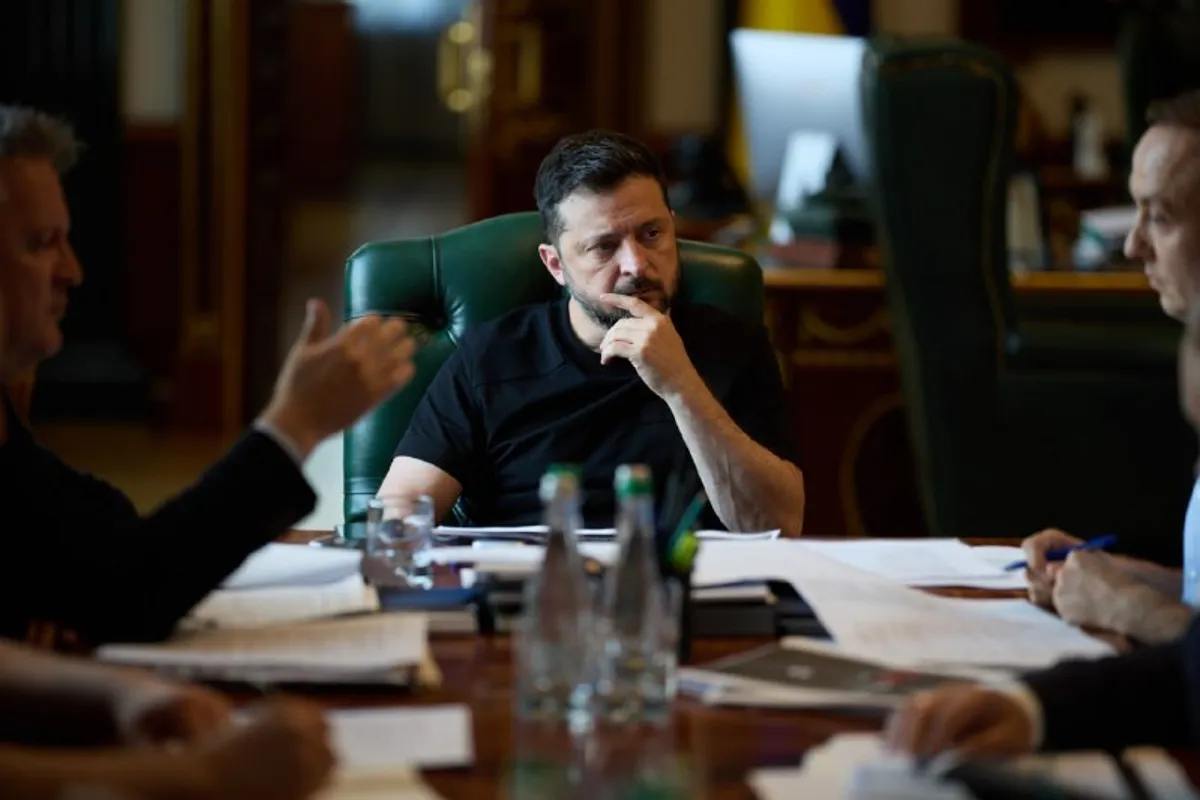
Ukrainian President Volodymyr Zelensky on Wednesday ordered the preparation of a "special sanctions operation" aimed at significantly curtailing Russia's military industry, even as the European Union announced a new financial injection for Ukraine of €1.4 billion, raised from frozen Russian state assets.
Zelensky: Every Russian missile contains foreign parts
At a coordination meeting held on Wednesday, Zelensky stressed that the key goal is to prevent Russia from adapting to existing international restrictions. "We see that in every Russian missile, in every drone, and in most other types of Russian weapons, there are critical components from other countries, without which such weapons simply would not exist," Zelensky stated on his official Telegram channel.
The Ukrainian president added that Russia also depends on foreign machinery and technologies in which it lags behind by generations. "Greater pressure is needed to limit such ties of the aggressor state with the world," Zelensky said, ordering the preparation of a clear plan to target specific companies and sectors that feed Russia's military-industrial complex.
EU approves fifth tranche from Russian assets
On the same day, the European Commission confirmed that an additional €1.4 billion is being made available to Ukraine. This fifth tranche comes from extraordinary revenues generated on approximately €210 billion in reserves of the Russian Central Bank that have been frozen in the EU since the start of the invasion. Since the mechanism was launched, about €8 billion has been raised in this way.
Commission President Ursula von der Leyen was clear about the principle behind using these funds. "Russia must pay for the destruction it has caused. We are using the revenues from frozen Russian assets to ensure that," she said.
Of the new tranche, 95% will be directed to helping Ukraine repay loans granted by the EU and G7 countries, while the remaining 5% will be used for military assistance through the European Peace Facility.
Legal limbo for private assets and the Trogir case
While Brussels has found a model for state reserves, private assets of sanctioned Russians remain in legal limbo. Member states, including Croatia, are reluctant to permanently confiscate or sell yachts, real estate, and other valuable property due to legal uncertainties and potential international disputes. This directly applies to the case of the yacht Royal Romance, moored in Trogir, which is linked to oligarch Viktor Medvedchuk, a close associate of Russian President Vladimir Putin.
The bulk of frozen Russian state reserves, around €185 billion, is held in Belgium, at the international depository Euroclear. It is precisely Belgium's concern about bearing legal consequences alone that led to the decision at the European Council summit not to touch the principal itself, but only the income generated by these assets.
Appeal for air defense after bloody attack
The financial and sanctions decisions come in the shadow of a new devastating Russian attack on Kyiv. In overnight strikes with missiles and drones, at least 17 people were killed and 44 injured. In a post on platform X, Zelensky emphasized the urgency of the need for protection.
"The main challenge right now is Russian attacks. The United States knows exactly what we need and that it is not something abstract. It is about protecting lives. These are real people, individual lives," he wrote. He added that urgent political decisions are necessary for the required air defense support, not only in the U.S. but also "in Europe and in the G7 countries."