Inflation in Croatia, which began to accelerate at the end of 2021 and has since remained above the target level of two percent, shows no signs of abating in its fifth year. According to economist Vladimir Arčabić, a professor at the Faculty of Economics in Zagreb and a member of the Croatian Academy of Sciences and Arts, we can now speak of a third wave of price growth. After the initial shock caused by the pandemic and the war in Ukraine, the domestic economy was hit by a demand-driven wave, and now a new energy shock from the Middle East.
"Inflation is just one phenomenon, but it has had two causes," Arčabić explained for Poslovni dnevnik, adding that the first wave in 2022, peaking at 13 percent, was a consequence of supply chain disruptions and rising energy prices. "The second inflation has been ongoing since the second half of 2024. During this period, price growth in Croatia has been slower compared to the first inflation, but Croatia is no longer aligned with the euro area, leading to a significant divergence."
Third Shock from the Middle East and Oil Price Surge
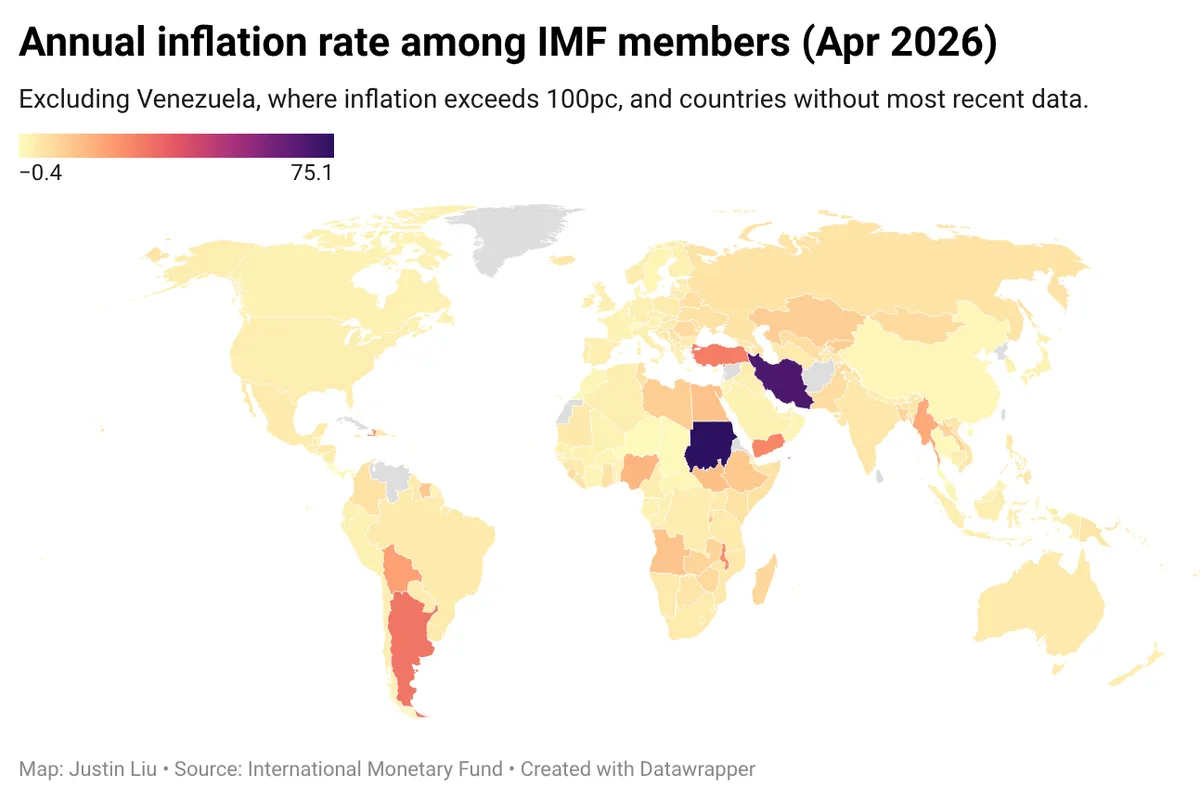
The extent of the divergence from the euro area is clear from June data: while inflation in Croatia, measured by the harmonized index, stood at 4.2 percent, the euro area average was 2.8 percent. Lithuania and Bulgaria had higher rates, and within the broader EU framework, Romania as well. However, Arčabić points to a new development. "Today we can also speak of a third inflation, as the war in the Middle East (the conflict between the US and Israel with Iran and the blockade of the Strait of Hormuz) has once again triggered a rise in oil prices, which, through increased costs, has impacted price growth in Croatia and other EU and global countries."
The numbers vividly illustrate this. Brent oil reached a peak above $126 per barrel in April. Although it fell to around $89 in July after a temporary US-Iran agreement, it is still nearly 50 percent higher than at the start of the year. About a fifth of the world's oil passes through the Strait of Hormuz, so the transmission to European energy prices is almost immediate. The consequences are evident: in June, energy prices in Croatia were 13.2 percent higher than a year earlier and were the largest single driver of inflation.
EU Funds and Wages: Domestic Demand as Fuel
The second wave of inflation, from 2024, had its roots in domestic factors. Arčabić highlights that the "overheating" of the economy was caused by a tight labor market and increased demand, with EU grant funds playing a significant role. Their share of GDP rose from about 10 percent in 2020 to as much as 16 percent in 2024, comparable to the share of tourism in the Croatian economy, which ranges between 15 and 20 percent of GDP.
"There are definitely trade-offs between economic growth and inflation caused by EU funds. The biggest problem is the time frame, which is unfavorable from an inflation perspective because the funds must be used within a set period to avoid being left unused," Arčabić explained. Investments in infrastructure and wage growth driven by these funds further fuel aggregate demand.
Regarding wages, the economist emphasizes that the story is deeper than simply blaming public sector wage increases from spring 2024. The cumulative price increase from 2022 to today exceeds 30 percent, significantly eroding purchasing power. In a tight labor market, where unemployment has stabilized at a historically low five percent for Croatia, wage growth has become a necessity. "The combination of all four factors can be summarized as follows: due to the loss of real purchasing power, there was pressure for wage increases, further amplified by the tight labor market. The growth of some (lowest) wages, out of necessity, flows directly into consumption, which further fuels inflation," he said.
According to an analysis by Ozana Nadoveza from the Faculty of Economics in Zagreb, public sector wage growth explains about a quarter of inflation. Specifically, of the four percent inflation in 2024, this factor accounts for at most one percentage point. In the private sector, the pressure is even more direct. "Quite simply, in the private sector, wages are a direct cost. Due to wage growth, there is room for price increases to align costs and revenues," he explained.
Declining Competitiveness and Fighting a Multi-Headed Monster
Faster price growth compared to trading partners is seriously eroding the competitiveness of the Croatian economy. "Faster price growth compared to trading partners significantly harms the competitiveness of the Croatian economy," Arčabić warned. The real exchange rate, which due to euro area membership is essentially the ratio of domestic to foreign prices, has returned to the level from the start of the global financial crisis in 2009. This is already being felt in tourism, where Croatia is compared with competing destinations such as Montenegro, Albania, Greece, or Italy. The "cure" for restoring competitiveness is either strengthening non-price competitiveness, such as the Dubrovnik brand, or a period in which Croatian prices grow slower than those of competitors.
Arčabić compares the whole situation to fighting a multi-headed monster: as soon as one cause of inflation weakens, another appears. "Inflation will not be a long-term problem if the geopolitical situation stabilizes. However, we are currently in a period of the highest geopolitical uncertainty in the last 50 or more years, so unfortunately, further supply-side shocks are to be expected," he concluded.
CNB Projections: Slow Cooling
According to the latest projections from the Croatian National Bank, a quick return to the target inflation rate of two percent should not be expected. In the baseline scenario, the CNB forecasts inflation of 4.9 percent for 2026, 3.1 percent for 2027, and 2.7 percent for 2028. In the adverse scenario, which accounts for higher energy prices and a longer duration of the Middle East conflict, the rates are even higher: 5.2 percent for 2026, four percent for 2027, and 2.7 percent for 2028. Although both projections anticipate a gradual decline, inflation will remain elevated, and the economy under pressure.