US-Iran Deal Deadline Expires
Sixty days after the Paris memorandum, no progress has been made, and Marjorie Taylor Greene claims that strategic meetings have discussed a nuclear option against Iran.
Sixty days after the Paris memorandum, no progress has been made, and Marjorie Taylor Greene claims that strategic meetings have discussed a nuclear option against Iran.
The 60-day deadline that the United States and Iran agreed in mid-June 2026 to reach a deal to end the war expired on Monday, August 17, without any progress. The memorandum of understanding, signed by US President Donald Trump in Paris, has proven to be a dead letter, and both sides have made it clear that no agreement has been reached, reports ABC.es.
The document, informally dubbed the 'Islamabad Memorandum' because Pakistan's capital was the stage for many previous negotiations, contained 14 points. Among them were concessions to Tehran, including lifting sanctions on exports and unfreezing frozen assets. But talks quickly collapsed after Iran demanded full control over the Strait of Hormuz and accused Washington of failing to meet its obligations.
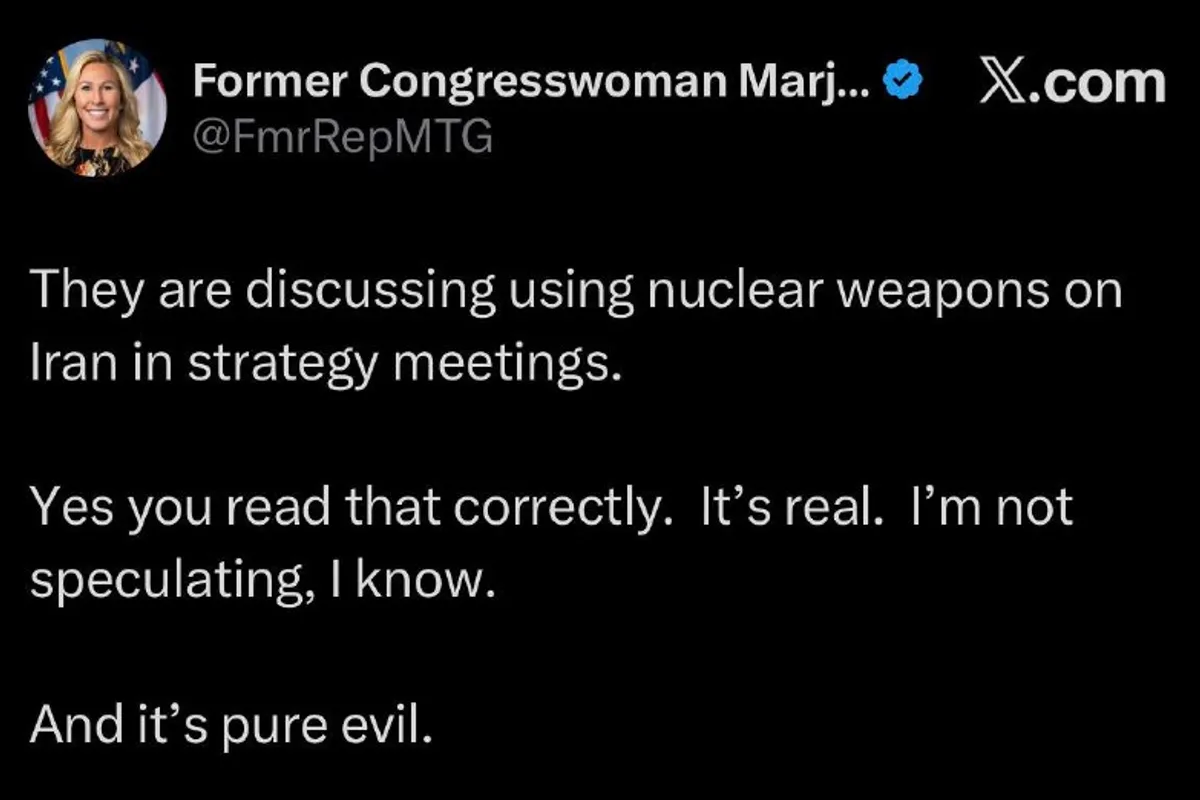
While diplomatic channels remain quiet, former US Representative Marjorie Taylor Greene posted on the Telegram channel WarFront Witness a claim that immediately drew attention. "They are discussing the use of nuclear weapons against Iran in strategic meetings. Yes, you read that right. It's real. I'm not guessing, I know. And it's pure evil," Greene wrote.
Her statement comes at a time when the US and Iran have been at war for nearly six months, and the conflict has escalated into what American analysts call a war of attrition. Trump started the war in late February 2026 alongside Israel, with ambitious goals that included regime change in Tehran and permanently preventing Iran from developing nuclear weapons.
The key issue remains the Strait of Hormuz, through which one-fifth of the world's oil and gas passes. The passage has been closed since the start of the war, and although both sides claim to control it, the reality on the ground remains unchanged. Last Friday, Trump announced that he would "soon" declare the strait "US territory," a move Tehran immediately rejected.
The closure of Hormuz and wartime turbulence have driven up energy prices, with the average price of gasoline in the US again exceeding four dollars per gallon. That "pain at the pump" could be a decisive factor in the fall congressional elections, where Republicans are defending narrow majorities in both chambers.
Iranian Foreign Minister Abbas Araghchi, a key figure in the negotiations, made it clear last week that the memorandum no longer exists. "There is no ceasefire that needs to be extended now," Araghchi said, adding: "It was the end of the war, in which there is now a new status."
An anonymous Iranian source confirmed to Reuters that efforts to revive the agreement through mediators are at a standstill. "One of the issues being discussed through mediators is for the US to return to the preliminary agreement and to define new timelines for fulfilling commitments. There has been no progress," the source said. This also denied the Turkish agency Anadolu's report that a 60-day extension had been agreed.
US Treasury Secretary Scott Bessent has threatened "unprecedented economic isolation" against Iran, while only one-third of Americans support Trump's handling of the war. The economic pressure is also being felt in Europe, including Croatia, through higher energy prices and disruptions in global supply chains.