Italy Suspends Schengen with Spain Over Ceuta Migrant Crisis
Sea and air borders closed as of Friday, with heightened surveillance also on the border with France. Former EU foreign policy chief warns the move violates the rules.
Sea and air borders closed as of Friday, with heightened surveillance also on the border with France. Former EU foreign policy chief warns the move violates the rules.
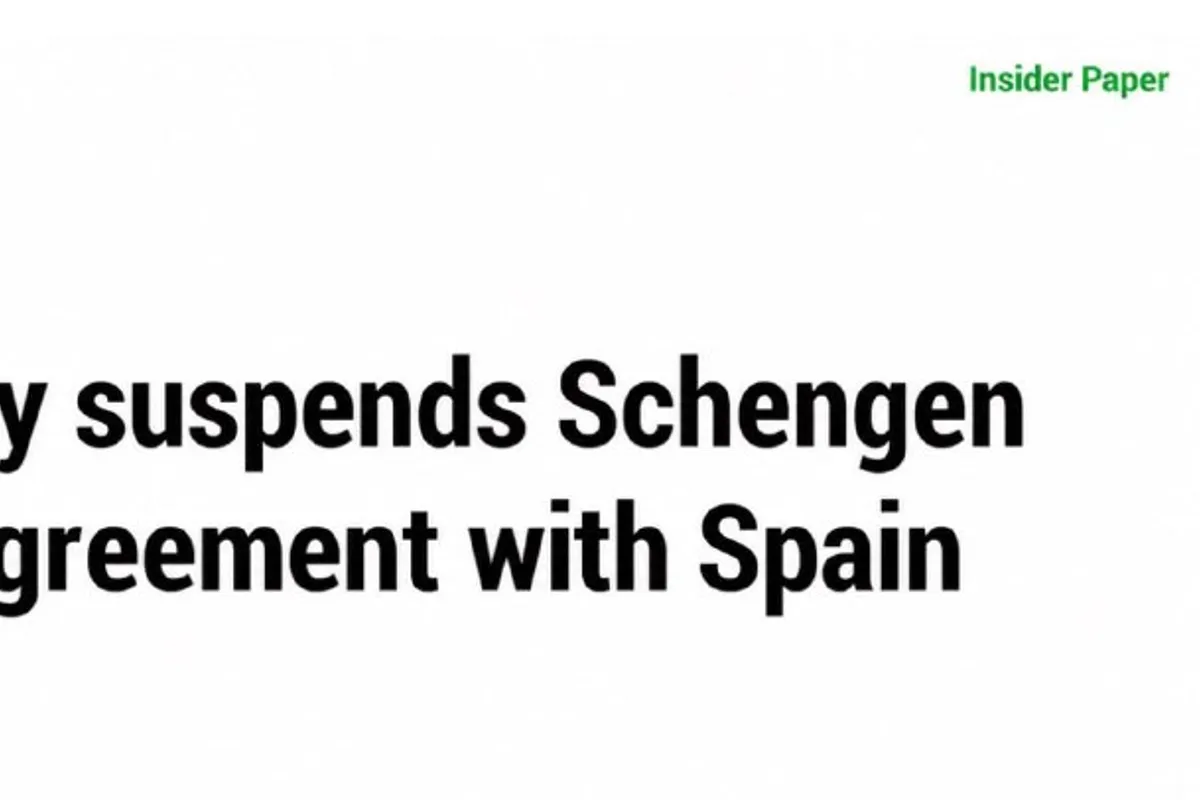
On Friday, July 31, 2026, Italy unilaterally suspended the Schengen Agreement on free movement with Spain. The decision is a direct response to the escalating migrant crisis in the Spanish enclave of Ceuta in North Africa, according to reports from ANSA and Reuters.
Italy's Ministry of the Interior ordered the closure of sea and air borders with Spain. Although the two countries do not share a land border, the measure will directly affect travelers flying or sailing between them. The decision was made at a morning meeting chaired by Minister Matteo Piantedosi, based on analyses by the Committee on Immigration and Border Security.
In addition to suspending Schengen with Spain, Italy has also agreed to step up controls on its land border with France. According to Ukrainska Pravda, Minister Piantedosi reached an agreement with his French counterpart, Laurent Nunez, on stricter surveillance along the Franco-Italian border.
Italian Prime Minister Giorgia Meloni had previously threatened such a move. "To defend our borders and the safety of our citizens," Meloni said, as reported by Reuters and cited by Norway's NRK. Just a day earlier, on Thursday, July 30, Italy's foreign minister also proposed expelling Spain from the Schengen Area.
The migration crisis in Ceuta, a Spanish territory on the Moroccan coast near the Strait of Gibraltar, has escalated dramatically in recent days. Figures on the influx of migrants vary depending on the source. Spain's Ministry of the Interior stated that more than 50,000 people have entered the enclave since the crisis began, while the president of Ceuta told Daily Sabah that around 60,000 migrants crossed from Morocco in just the last 24 hours. That figure corresponds to as much as 70 percent of the city's total population.
According to Turkish daily Daily Sabah, roughly half of the migrants have voluntarily returned. Spain has deployed the military and additional police to restore order. On the Moroccan side of the border, clashes have occurred between security forces and migrants. At least 57 migrants have lost their lives in the stampede and attempts to cross the barrier, including those who drowned.
Italy's move immediately raised questions about its legality within the European Union. Former EU foreign policy chief Josep Borrell reacted sharply, stating that no EU member state has the right to unilaterally expel another country from the Schengen Agreement or suspend its participation, as reported by Russia's state news agency TASS.
The Schengen Agreement, signed in 1985, allows for free movement within Europe, but member states can temporarily reinstate border controls under certain circumstances. In addition to Italy, the Czech government has also called for closing the Schengen zone to Spain. Meanwhile, Ukraine's top diplomat, Andriy Sybiha, warned of a Russian propaganda campaign exploiting the migrant crisis in Ceuta to destabilize Europe.
Ceuta has been a Spanish possession since 1580 and is one of two Spanish enclaves on the African continent, located at the entrance to the Mediterranean Sea.