Kordić on Statement That He Would Do It All Again
War criminal Dario Kordić, convicted in a final verdict, appeared on the podcast 'Be Manly,' where he defended his controversial statement and discussed U.S. sanctions.
War criminal Dario Kordić, convicted in a final verdict, appeared on the podcast 'Be Manly,' where he defended his controversial statement and discussed U.S. sanctions.
Dario Kordić, a war criminal convicted in a final verdict, appeared on the podcast of the association 'Be Manly,' which organizes kneeling protests. During the appearance, he addressed his controversial statement that he would 'do it all again' and that 'every second was worth it,' a clip that sparked a wave of condemnation when it was released in 2023.
The show's host asked Kordić about a news headline that accused him of saying he would repeat 'all that happened,' suggesting that the statement was not meant in the context of Ahmići. 'A few years ago, a news headline came out accusing you of saying you would repeat "all that happened." Of course, you didn't mean it in that context, but they pinned that sentence on you regarding Ahmići. What did you actually say and what did you actually mean by it?' was the question.
Although the host asserted that Kordić did not mean Ahmići, Kordić himself did not explicitly deny that connection in his response.
Kordić responded that the media 'know better what I carry in my heart than I do,' adding that 'Dear God knows everyone's heart, including mine.'
He explained that when asked about the value of the war and prison, he replied: 'It was worth it, I would do it again, every second was worth it.' According to him, the value is not in the events themselves, but in the fact that the experience led him to a meeting with Jesus Christ. 'I would be a poor man,' he said.
He repeated his formulation: 'It was worth it, everything I went through was worth it. Had I not gone through that, I would never have met the living God; I would be poor.' He emphasized that this was the first time he discussed the topic on a podcast and that it was only his third media appearance in the last 12 years.
The controversial clip was released in June 2023 and is believed to have been recorded on August 5, 2022, during the celebration of the anniversary of Operation Storm. In it, Kordić recounts a conversation with a friend to those gathered.
'He asked me if prison was worth it, if the war was worth it. I told him: "I would do it all again, I wouldn't trade a single second, every second was worth it,"' Kordić said in the clip.
After that, those gathered applauded him and sang Miroslav Škoro's song 'It Was Worth It.' His words were then condemned by civil society organizations from Croatia and Bosnia and Herzegovina, as well as the Croatian National Council of BiH.
In the same response, Kordić touched on U.S. sanctions, saying that they 'still keep me on the blacklist, with Bin Laden and some others.' He recounted that in 2017, he sent a letter requesting to be removed from the list.
'I said: I'm studying theology, I'm not causing problems, remove me from that list because I can't pay for gas in Croatia, I can't pay for electricity, I can't be in a bank, I can't function,' Kordić recounted.
He claims he waited about eight years for a response. In it, they asked him how he reconciles the statement that he would 'do it all again' with his claim of rehabilitation. Kordić says he wrote to them as well: 'It was worth it, everything I went through was worth it. Had I not gone through that, I would never have met the living God; I would be poor.'
Kordić remains on the sanctions list of the U.S. Office of Foreign Assets Control (OFAC) under the Balkans sanctions program, with the designation 'ICTY indictee' next to his name.
The International Criminal Tribunal for the former Yugoslavia sentenced Kordić in a final verdict to 25 years in prison for crimes against the Bosniak population in central Bosnia. The Appeals Chamber confirmed that Kordić, as a responsible regional politician, planned and instigated crimes committed on April 16, 1993, in Ahmići and the surrounding hamlets of Šantići, Pirići, and Nadioci, with the aim of ethnically cleansing the area.
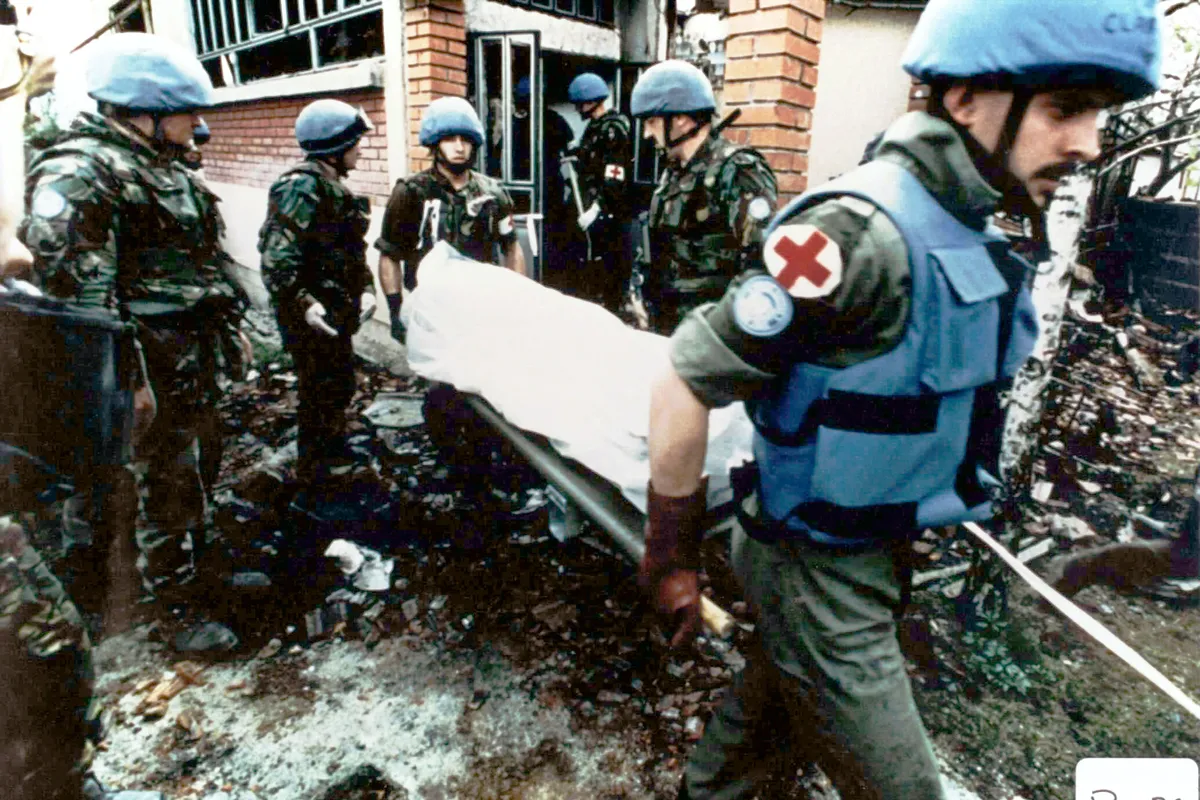
On that day, HVO forces killed 116 Bosniaks in Ahmići, including 32 women and eleven children, among them a baby. It was the largest massacre in the conflict between Bosniaks and Croats. Soldiers entered the village in groups of five to ten, broke into houses, and killed civilians on doorsteps or forced them outside. The village was then set on fire and destroyed, and the local mosque was demolished with explosives.
Most victims were killed at close range, some men were killed while tied up, and about twenty people died in Donji Ahmići while trying to flee. Some victims were found in an unrecognizable state, suggesting they were burned alive. Kordić was found guilty of violations of the laws of war, grave breaches of the Geneva Conventions, and crimes against humanity. He never admitted guilt nor expressed remorse.
Kordić was released in 2014 after serving two-thirds of his sentence in Austria. Today, he lives in Zagreb with his wife Venera and holds a master's degree in theology. He regularly appears at the March for Life, has joined the kneelers at Zagreb's main square, and gives lectures in churches.
When Index asked him in 2019 how he makes a living, he did not give a concrete answer. 'God and my family know how I make a living. I spoke about that somewhere in my testimonies. Those who wanted to could hear it. I wish you God's blessing, and I bless you and all who write about me and my family with good intentions,' he said at the time.