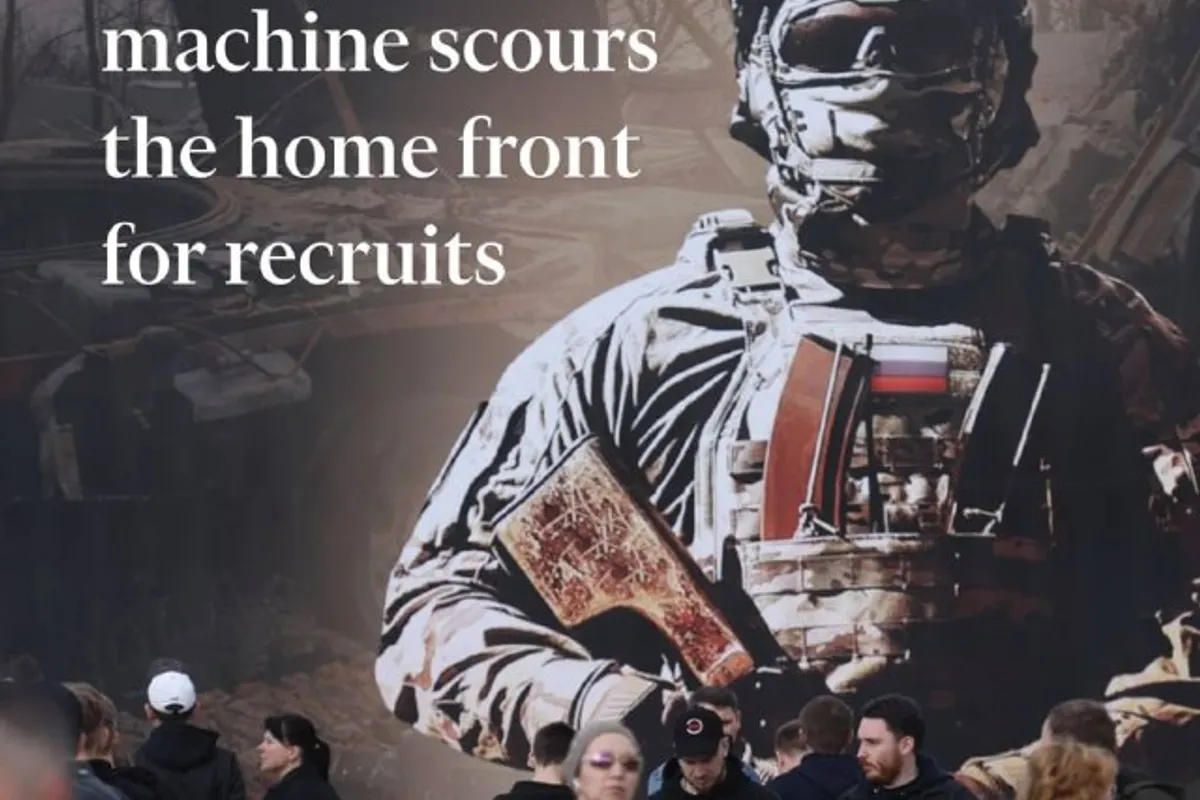
The Kremlin has tasked Russian regional authorities with recruiting as many as 409,000 contract soldiers this year, seeking at all costs to avoid declaring a new, politically unpopular mobilization. Pressure on local officials is immense, and recruitment methods are becoming increasingly aggressive, including street raids and targeting financially and legally vulnerable citizens.
Enormous Pressure on Regions and Targeting of the Vulnerable
The recruitment quotas set by the Kremlin and the Russian Ministry of Defense have led to increased pressure on regional and municipal authorities. In a desperate search for recruits, authorities are increasingly turning to debtors, individuals under criminal investigation, and conscripts who have recently completed their mandatory military service.
"Local authorities are under enormous pressure to deliver the required number of soldiers each year," Janis Kluge, a researcher at the German Institute for International and Security Affairs, told the Financial Times. "They know exactly who has debts, who is under investigation, and who has recently lost their driver's license. These are precisely the people they target," Kluge added.
Modest Results Despite Aggressive Methods
Data from federal and regional budgets, analyzed by Kluge, show that in the first quarter of 2026, 71,216 federal signing bonuses were paid out, the lowest number for that period in the last three years. Recruitment later stabilized at approximately one thousand contracts per day, or about 30,000 per month.
According to Dmitry Medvedev, who serves as Deputy Chairman of the Russian Security Council, around 200,000 individuals signed military contracts in the first six months of the year. However, aggressive methods often yield modest results. In Russia's Khabarovsk region, police reported conducting 2,500 recruitment-related interviews over the past year, but only managed to persuade 32 people to sign contracts. Of the total number of recruits, all but four were subjects of criminal investigations as suspects.
In June, police and military offices conducted coordinated street raids in the Penza region, with similar operations recorded in Ulyanovsk. In Rostov, authorities detained 35 factory workers during a recruitment drive.
Avoiding Mobilization and Financial Incentives
Russia has relied on contract recruitment, high salaries, and signing bonuses since President Vladimir Putin ordered the mobilization of 300,000 reservists in September 2022, a move that prompted hundreds of thousands of Russians to flee the country. Human rights activists say the purpose of the latest campaign is precisely to avoid another such episode.
"Putin is clearly delaying a new wave of mobilization, so the Ministry of Defense has to increasingly pressure various groups of people to sign contracts," Grigory Sverdlin, founder of the anti-war project Get Lost, which helps Russians avoid military service, told The Moscow Times.
To attract new soldiers, regional governments have drastically increased signing bonuses. In some parts of Russia, the combined federal and regional payments can reach several million rubles, which has spurred the growth of a private intermediary industry that receives commissions for each person they persuade to go to war.
Huge Losses and the Threat of Exhaustion
According to estimates from Western governments, nearly 500,000 Russian soldiers have been killed during the war. This year alone, according to Ukrainian data, around 131,000 Russian soldiers have been eliminated. Newly signed contract soldiers are mainly used to fill gaps on the front line caused by losses, rather than to form operational reserves.
Michael Kofman, a senior fellow at the Carnegie Endowment for International Peace, warns that without improved recruitment or a new mobilization, Russian forces could become vulnerable. "If they fail to improve recruitment or carry out mobilization, Russian units will again face manpower shortages," Kofman told the Financial Times.
Desertion poses an additional problem. According to data from the human rights organization Peace Plea, at least 28,000 Russian soldiers have been convicted of abandoning their units, and the Ukrainian analytical group Frontelligence Insight estimates the real figure could be twice as high.