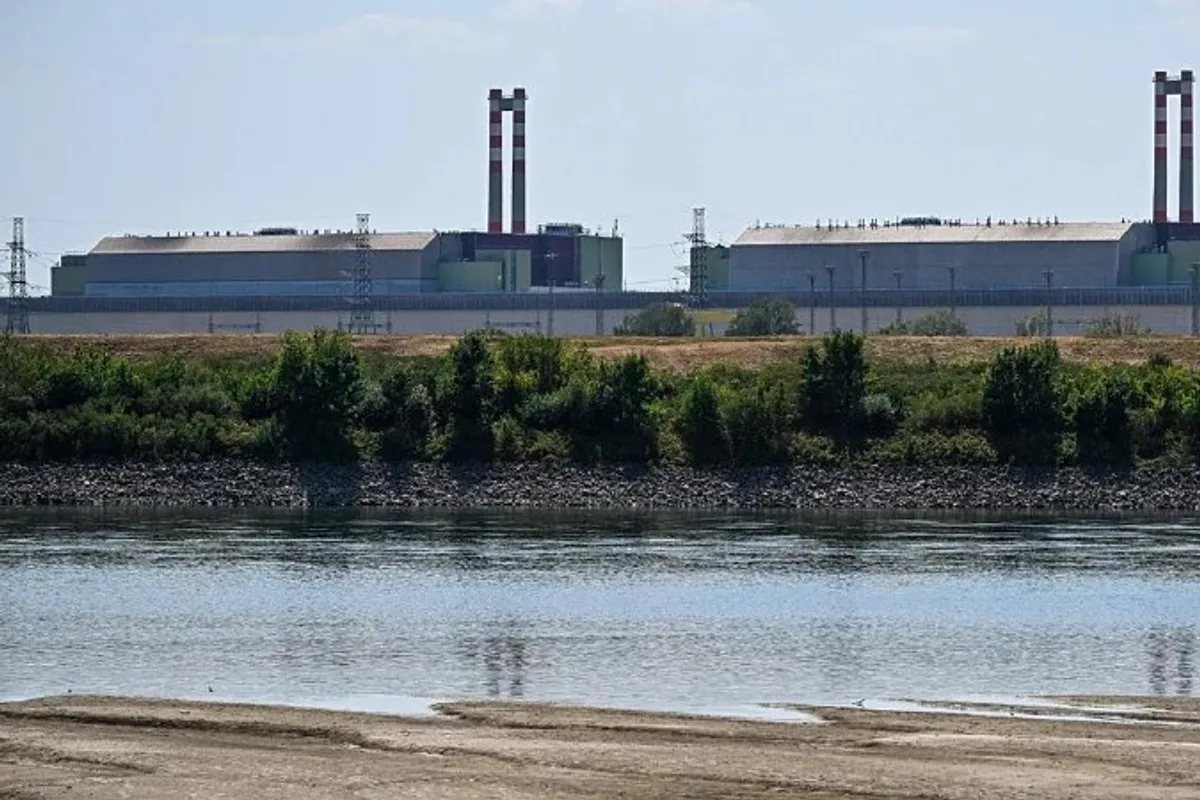
The Hungarian government has launched an emergency intervention on the Danube to save the Paks nuclear power plant from a complete shutdown, brought to the brink of suspension by historically low water levels caused by prolonged drought and heatwaves. Prime Minister Péter Magyar on Wednesday, August 12, 2026, posted a video on Facebook announcing the start of works as early as the next day.
Plant Operating at Ten Percent Capacity
The Soviet-era facility, 44 years old, uses water from the Danube to cool its four reactors. Due to critically low water levels, it is currently operating at just over ten percent of its 2000 megawatt capacity. The plant normally covers nearly half of Hungary's total electricity consumption, so reduced output seriously threatens the country's energy stability.
Magyar warned that the situation can no longer be treated as an isolated natural extreme. "We can no longer consider this extraordinary situation a one-off natural extreme," he said, adding that the Danube has given "days, not months."
Stone Weir and Sinking Barges
The authorities plan to build a river weir, a low stone structure in the riverbed that slows the flow and raises water levels upstream. Delivery of about 145,000 cubic meters of stone began on Wednesday evening, with construction starting on Thursday, August 13. The intervention could raise the Danube by up to one meter.
Simultaneously, two 80-meter-long barges will be transported near Paks and, if necessary, sunk to raise the water level at the cooling pumps by an additional 20 centimeters. The decision on sinking will be made on Friday, and Magyar emphasized that the works must be carried out quickly to avoid a complete plant shutdown.
According to the Ukrainian portal Telex, citing European Pravda, the first phase of the weir construction between Paks and the village of Dunaszentbenedek will require about 35,000 cubic meters of stone, with a second phase requiring another 110,000. The project aims to ensure that the water level in the cooling channel does not drop below minus 90 centimeters, which would allow full plant operation. One barge was expected to arrive in Paks from Mohács on Wednesday evening, with the second arriving a day later.
Economic Blow and Broader European Problem
Operating Paks at reduced capacity costs the Hungarian economy up to 50 billion forints (about $158 million) per month, while the planned interventions on the Danube cost around six billion forints (about $19 million), according to AP.
Hungary is not alone in this problem. Last week, Romanian authorities sank four barges loaded with stones into the Danube to redirect water toward the Cernavodă nuclear plant, which has already shut down one of its two reactors. Similar cooling water issues have been reported in France and Slovenia, highlighting the vulnerability of European nuclear infrastructure in the face of increasingly longer and more intense droughts.
It is worth recalling that Hungary introduced emergency electricity saving measures on August 6, 2026, due to the heat.