Odysseus' Cave on Mljet
A blend of myth, geology, and history on Mljet's southern coast creates one of the most unusual natural phenomena in the Adriatic.
A blend of myth, geology, and history on Mljet's southern coast creates one of the most unusual natural phenomena in the Adriatic.
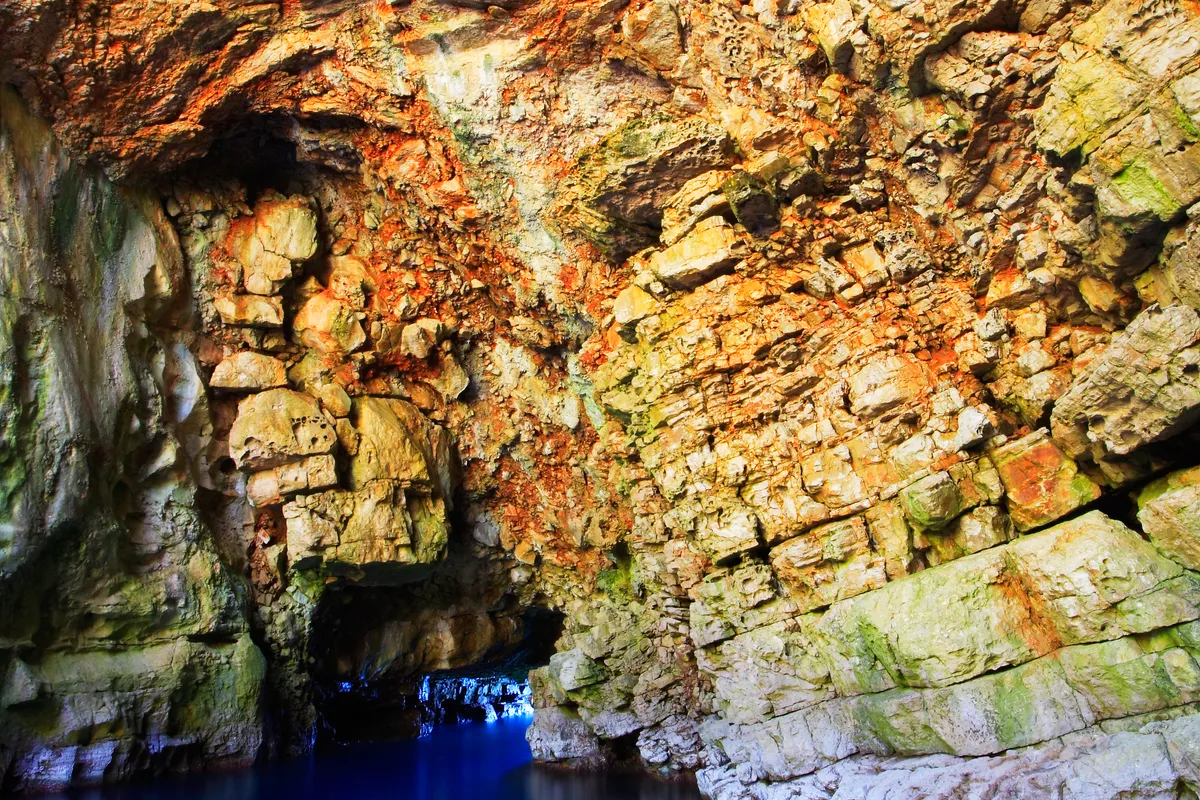
Mljet, among the most beautiful and greenest of Croatian islands, with a third of its territory protected as a national park, harbors many enigmas. None, however, is as alluring as the one hidden on its southern coast, near Babino Polje. Here lies Odysseus' Cave, a place where the legend of the famous Greek hero takes on tangible form and where nature has sculpted a geomorphological wonder.
According to ancient lore, it was precisely here that the legendary Odysseus was shipwrecked while returning home from the Trojan War. Local legend has it that his ship was shattered by the treacherous reef Ogiran, a rock that completely disappears beneath the sea during high tide or a strong southerly wind. After the mishap, the hero, utterly exhausted, swam to the nearby cave where he found refuge.
His rescue, however, came at a price. The island, which the poet Homer called Ogygia, was ruled by the beautiful nymph Calypso. Enchanted by Odysseus, she decided to keep him for herself. In her amorous captivity, intoxicated by the beauty of the landscape, he spent seven long years. He was only released by the gods, at Zeus's command.
Although Malta also claims this story as its own, the inhabitants of Mljet proudly emphasize that Homer's description of the island with olive groves and vineyards, located right next to the shipwreck site, perfectly matches the landscape surrounding the cave.
What makes Odysseus' Cave unique is not just the myth but also its stunning geological structure. From the land, it appears as a huge, egg-shaped hole in the ground, a pit several dozen meters wide, which is why locals named it so. It formed when the roof of a karst cave collapsed, and its floor was filled with seawater.
It is connected to the open sea by a natural tunnel about twenty meters long, carved through limestone layers. This passage is almost invisible from the sea, just a small oval crack in the vertical cliff, about four meters wide and barely a meter and a half above sea level. The real magic reveals itself during the summer months, precisely around noon, when the sun's rays fall at a perfect vertical angle through the collapsed roof, creating an otherworldly spectacle of turquoise and sapphire hues on the white limestone bottom.
Beyond its mythical and aesthetic value, the cave has served for generations as a safe shelter for fishing boats and their gear, thus becoming one of the most unusual natural harbors in the entire Adriatic. Less known is that it was once home to one of the world's most endangered mammals, the Mediterranean monk seal. Today, its presence is but a memory, speaking to the richness of Mljet's biodiversity.
For visitors seeking an active holiday, the high and steep cliffs surrounding the cave have become a popular spot for cliff jumping. This hidden gem can be reached in two ways. From the sea, the tunnel can be traversed by swimming or in a small vessel. From the land, a hiking trail leads from Babino Polje, and after about thirty minutes of walking over rough and sharp karst terrain, one descends to the sea via very steep, improvised steps carved into the rock.
Odysseus' Cave on Mljet is far more than a mere tourist attraction. It is a living combination of a myth that refuses to fade, an awe-inspiring geological work, and evidence of the coexistence of humans and nature.