Cosmic Hybrid Discovered: Half Black Hole, Half Star
The newly discovered object MoM-BH*-1 radiates 100 billion times more energy than known stars and could explain the mystery of supermassive black holes in the early universe.
The newly discovered object MoM-BH*-1 radiates 100 billion times more energy than known stars and could explain the mystery of supermassive black holes in the early universe.
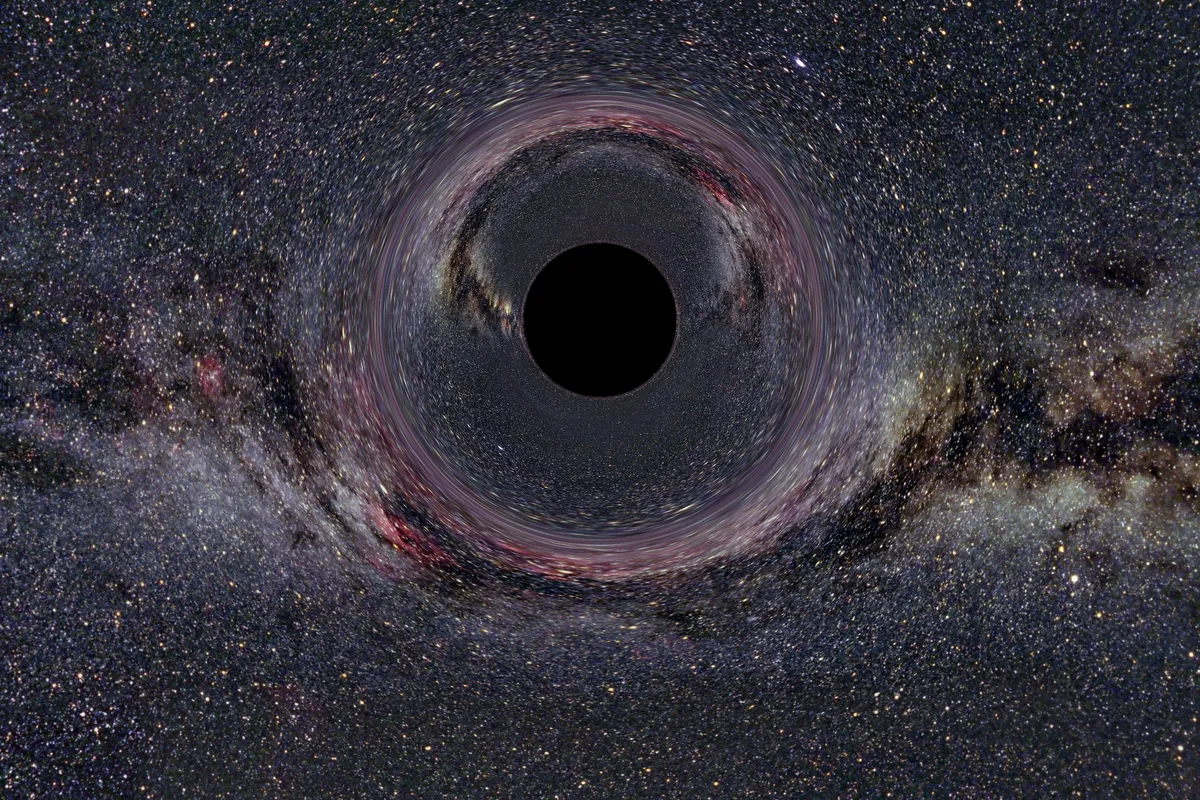
Astronomers have discovered a completely new type of cosmic object in the early universe that simultaneously exhibits properties of both a black hole and a star. The object, named MoM-BH*-1, short for Mirage or Miracle-BH*-1, radiates about 100 billion times more energy than any known star, and its spectrum resembles stellar phenomena, reports Gizmodo. According to Space.com, this is the most distant 'black hole star' ever found, existing in the universe less than 660 million years after the Big Bang.
The research was published in the journal Nature, with Gizmodo noting it was released on August 12, 2026, while Space.com mentions August 13, 2026, as the publication date. The lead author of the study is Rohan Naidu, an astronomer at the University of Hawaii. A companion News & Views in Nature was written by Dominik Schleicher from Sapienza University in Rome and Rodrigo Herrera-Camus from the University of Concepción in Chile, according to Gizmodo.
Naidu explained to Gizmodo that MoM-BH*-1 is "so wrapped in shrouds of dense gas that it effectively radiates in a way that resembles stellar phenomena." The object is at least 100,000 times larger than the Sun, and its light abruptly disappears below a certain wavelength, a phenomenon known as the Balmer break.
"What is special about MoM-BH*-1 is that it effectively outshines its entire host galaxy, so we see the 'pure' light of the black hole star," Naidu added. Space.com notes that this is the best example of a "naked" black hole star, meaning astronomers are fairly confident it exists independently in space, rather than within a forming galaxy.
The discovery is closely linked to the so-called "little red dots," compact bright objects first spotted by the James Webb Space Telescope (JWST) in 2022. Their light travels to Earth for approximately 12 billion years, and astronomers initially thought something was wrong with the telescope.
"The Mirage or Miracle survey was specifically designed to target sources considered 'risky,' meaning they could be incredible discoveries or just impostors, like some cold nearby stars that look like distant galaxies," explained Jorryt Matthee, co-investigator in the MoM survey at the Institute of Science and Technology Austria.
MoM-BH*-1 exists in the universe less than 660 million years after the Big Bang, and estimates suggest it will collide and merge with a nearby young galaxy in about 100 million years. Models show that after this merger, the galaxy's spectrum would look very similar to the little red dots we already know.
"Taking the black hole star as a template for the black hole component of little red dots helps clarify many unknowns about them," Matthee said. "If embedded in similar host galaxies, black hole stars like MoM-BH*-1 could serve as the central engines of baby quasars."
Naidu compared the current period to the time when quasars were first discovered: "Many astronomers are comparing it to the 1960s and 70s when we first found supermassive black holes in the form of quasars. And now, thanks to JWST, and thanks to how wonderfully surprising the universe is, we are living through that special period where we are rewriting textbooks and filling new chapters for things we didn't even know existed!"
In the last two to three years, nearly a thousand papers and preprints have been published about little red dots. "Far from a mirage, this could be a cosmic miracle," Matthee concluded.
The team has already secured observing time on JWST, and starting in December, they will begin a more detailed study of the physics of these extraordinary objects.