Historic Building in Central Zagreb Shines in New Splendor
After months of renovation, the Rudolf Barracks building at 20 Republike Austrije Street has a restored facade and enhanced earthquake resistance.
After months of renovation, the Rudolf Barracks building at 20 Republike Austrije Street has a restored facade and enhanced earthquake resistance.
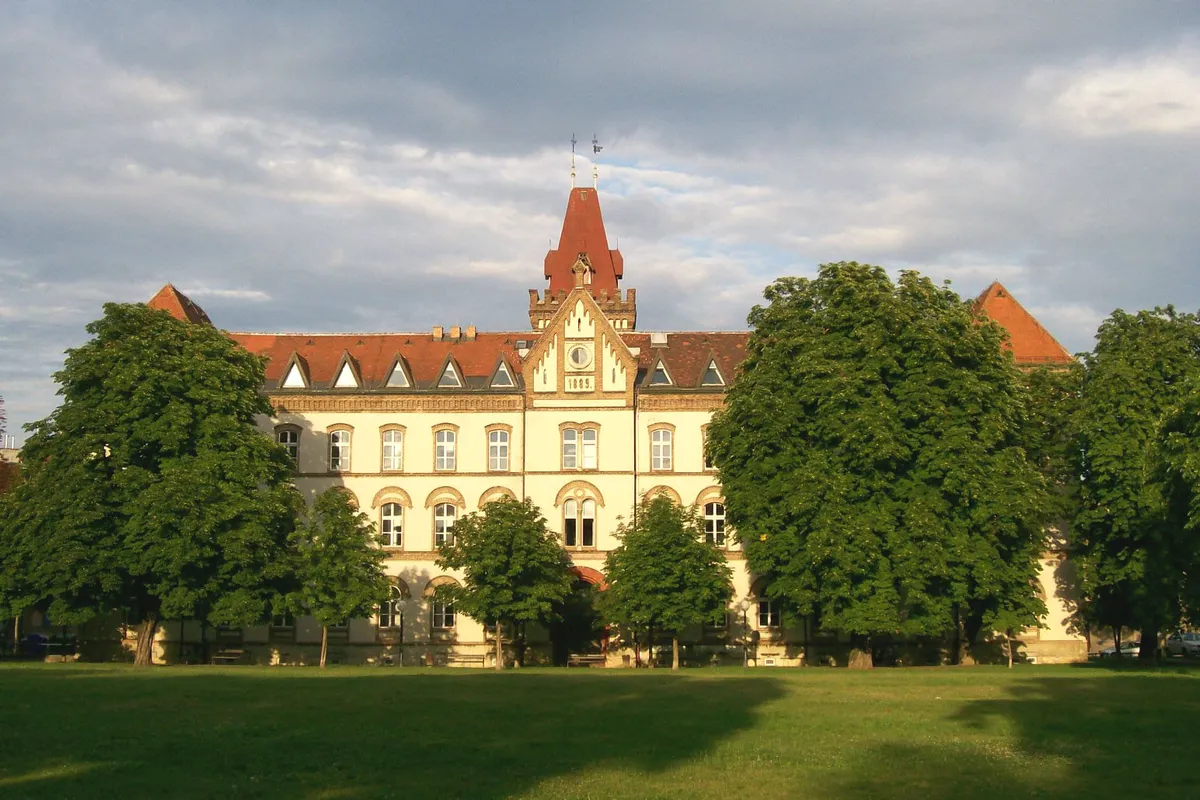
Recently, on Republike Austrije Street, another scaffold has been removed, marking the end of the renovation of the historic building at number 20, which houses the Ministry of Physical Planning, Construction and State Assets. This is the main building of the Rudolf Barracks, also known as the 'Prince Rudolf' infantry barracks, which were later, from 1918, called the 'Zrinski Barracks'. The entire area of today's Dr. Franjo Tuđman Square was once occupied by this complex.
The building was constructed in 1889 according to the design of Franz Gruber and Carl Wölckner from the Viennese studio Gruber & Völckner. Originally, it served as the command center for a much larger military complex consisting of thirteen structures. In 1978, a large part of the complex was demolished, and of the thirteen buildings, only four survived. Today, these buildings house: the aforementioned ministry at numbers 14 and 20, the Institute for Croatian Language and Linguistics at number 16, and the City Institute for Physical Planning at number 18.
In 1862, with the opening of the Southern Railway station, Zagreb became part of the railway system of the Habsburg Monarchy. According to the book "Zagreb in the Center" by Snješka Knežević, an urban planning historian, the city seriously prepared for the construction of the infantry barracks from 1879, when a law on billeting was passed, guaranteeing cities rent for adapted barracks for fifteen years and for new ones for twenty-five years.
"In an intensive multi-month discussion between city representatives and military authorities, the final location for the barracks north of the Southern Railway station was finally determined... The construction of the infantry barracks was a major communal undertaking for which the city had been seriously preparing since 1879, when the law on billeting was passed, guaranteeing cities rent for adapted barracks for fifteen years and for new ones for twenty-five years," writes Knežević.
The barracks complex was named after Prince Rudolf, the son of Franz Joseph I and Elisabeth of Habsburg. During his visit to Zagreb in the spring of 1888, a ceremony was held to lay the foundation stone.
"This large construction undertaking, which ultimately cost much more than anticipated, was completed in fifteen months thanks to thoughtful organization, the immense effort of the City Construction Office and its head, Rupert Melkus, and the skill of the main contractor, Anton Schomann from Budapest, and mostly local craftsmen," states Knežević.
The comprehensive renovation of the state-owned building was carried out by the Ministry of Physical Planning and Construction. The company GLOVIA d.o.o. was the contractor, selected through public procurement. The works are valued at 8,102,924 euros excluding VAT, and were financed from the EU Solidarity Fund, the NPOO, and the state budget. After the comprehensive renovation, the load-bearing structure now has earthquake resistance at level 3, as required. The building has five floors.
According to the Ministry, the most challenging part was the restoration of the deteriorated facade. All original elements had to be restored, and the damaged and worn-out coats of arms on the building's tower had to be recreated. The chosen facade color is Rofix Botticino.
"The main building of the Rudolf Barracks was intended for officers' offices and a school. Thus, in the basement there was a kitchen for officers, on the ground floor were offices of the district command, office spaces, a tavern, a reading room, and a library. On the first floor were offices of the brigade, regiment, and district commands, and on the second floor a school for officers and a captain's apartment. In the attic there were storage rooms. In 1918, the Rudolf Barracks was renamed the Nikola Šubić Zrinski Barracks or the Zrinski Barracks," the Ministry responded.
From 1941 to 1945, during World War II, the barracks housed the command of the Home Guard infantry, specifically the 53rd and 35th regiments. After the war, the barracks came under the control of the Yugoslav People's Army, which used it as part of the 5th Army District until the early 1970s. In 1973, the Regional Institute for the Protection of Cultural Monuments in Zagreb issued a decision for the permanent protection of the remaining military complex and its entry into the Register of Cultural Monuments.
These barracks can also be seen in the 1982 film "Kiklop," starring Frano Lasić. According to Architecture of Zagreb, along with the main building in the Neo-Romanesque style, the entire area of the former infantry barracks is protected as a cultural asset, in order to preserve the integrity and historical matrix of the area, as well as the existing quality greenery, undeveloped areas, and the buildings of the former barracks that have ambient value.