Radiation Protection Vest Passes Test on the Moon
A study published in Science Advances shows that the AstroRad vest could reduce astronauts' radiation dose by up to 60 percent during intense solar storms.
A study published in Science Advances shows that the AstroRad vest could reduce astronauts' radiation dose by up to 60 percent during intense solar storms.
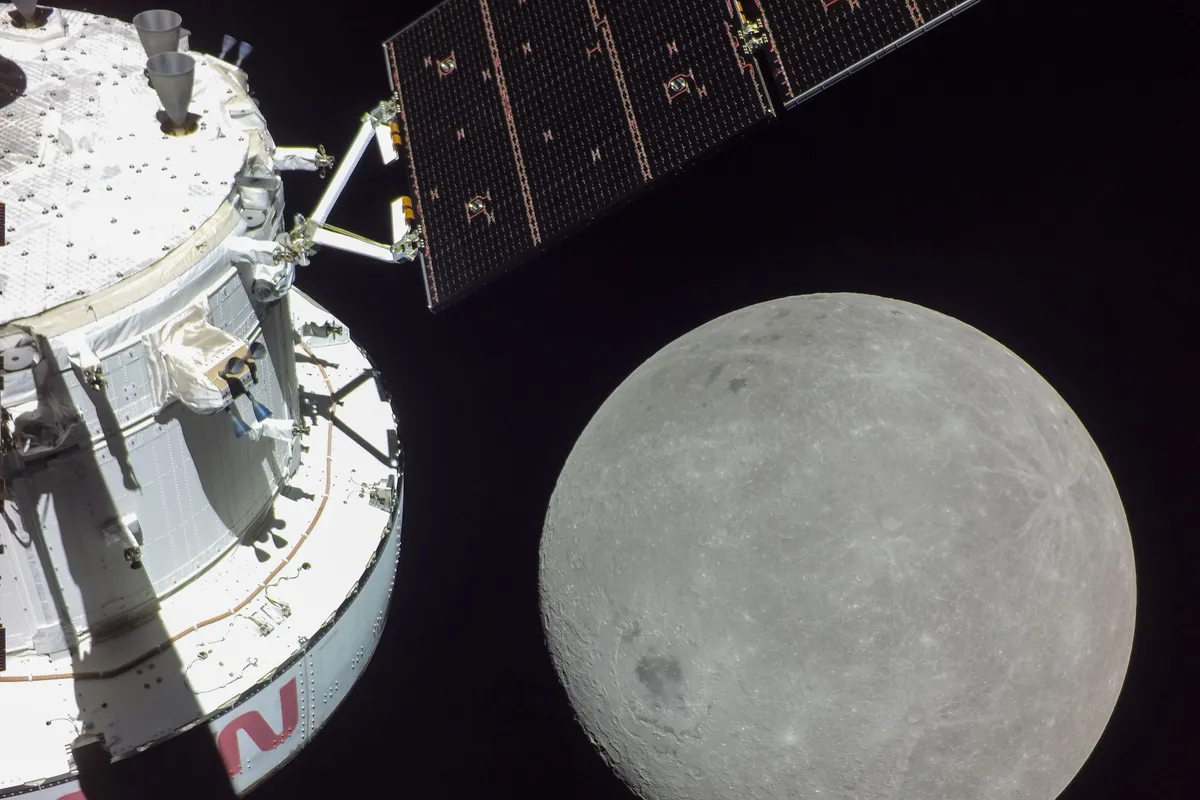
A protective vest tested on a mannequin during NASA's first Artemis I mission around the Moon could drastically reduce astronauts' radiation exposure in the event of powerful solar storms, a new study published Wednesday in the journal Science Advances showed. The vest, called AstroRad, was developed by Israeli startup StemRad in collaboration with aerospace company Lockheed Martin.
Radiation remains one of the biggest threats to astronauts as NASA works to establish a base on the Moon. Protective clothing could keep crews safe when solar storms hit, and even allow them to venture outside shelters if necessary, the American-German-Israeli team reported.
The Artemis I mission, which flew uncrewed in 2022, carried two female mannequins named Zohar and Helga. Each was about 91 centimeters tall from head to lower torso and contained thousands of radiation sensors. Zohar wore the AstroRad vest weighing 57 pounds (26 kilograms), while Helga flew without it. The mannequins spent nearly a month flying to the Moon and back.
The vest is designed to be worn only during high-radiation events that can cause cancer. It covers the most sensitive human organs and tissues: lungs, stomach, bone marrow, breasts, and ovaries. Women are considered particularly susceptible to radiation-induced cancer.
Lead author Jordan Houri of StemRad called the experiment "the largest ever conducted to determine astronaut radiation exposure outside low Earth orbit." The study was funded by NASA, the German Space Center (DLR), and the Israeli Space Agency.
Artemis I did not encounter major solar flares, but based on measurements collected while the Orion capsule passed through the inner Van Allen radiation belt, Houri and his team simulated how much protection the vest would provide during extreme solar particle events like those of 1972 and 1989. The 1972 solar storm occurred between two Moon landings, and the 1989 one knocked out the power grid.
The results showed that the vest could reduce astronauts' radiation dose by about 60 percent in a solar storm like the one in 1972, and by nearly 40 percent in a catastrophe like the one in 1989. This is equivalent to preventing 193 days, or 131 days, of unnecessary exposure to deep space radiation.
Oren Milstein, CEO and co-founder of StemRad, emphasized the importance of this finding for future missions. "Radiation in space is inevitable, and a single large solar particle event can significantly contribute to an astronaut's lifetime risk of radiation-induced cancer. By significantly reducing that contribution, personal protection could be especially important for future lunar and Mars missions," Milstein told Space.com.
AstroRad was developed as an emergency countermeasure for solar particle events, meaning astronauts would wear it only when radiation levels are elevated, typically over periods of several hours or days. Although astronauts would not wear it throughout the entire mission, the vest is designed to remain usable for several hours at a time.
A version of the vest was previously tested on the International Space Station for comfort and function, and it is modeled after equipment worn by nuclear disaster teams. The vest did not travel with the Artemis II astronauts because that was a short 10-day mission with limited space, but it could be included as luggage for future lunar crews.
The Artemis I mission paved the way for humanity's long-awaited return to the Moon in April 2026, when a four-person crew orbited the Moon. The mannequins were examined after the flight on January 17, 2023, at the space station processing facility at Kennedy Space Center on Merritt Island, Florida.
"The most important implication is that AstroRad could help overcome one of the major health challenges limiting long-term human exploration beyond Earth," Milstein concluded.