Economic activity in the European Union and the eurozone accelerated in the second quarter of 2026, according to preliminary Eurostat estimates. After a stagnant first quarter, economic activity grew by 0.4 percent in the eurozone and 0.5 percent in the EU-27 in the second quarter. Compared with the same period last year, GDP in the EU rose from 0.8 to 1.2 percent, while in the euro area growth accelerated from 0.5 to 1 percent.
Compared with the United States, the dynamics remain roughly half as strong. Their annual growth rate of 2.1 percent represents a decline from the 2.7 percent recorded in the first quarter. Although EU data are not complete, as they are available for 21 of the 27 countries, Eurostat's overview covers more than 95 percent of total GDP due to the weight of individual economies.
The Six Largest Economies Tip the Balance
Eurostat's overview shows that the annual rate accelerated in nine member states, slowed in the same number, remained unchanged in Spain compared with the second quarter of last year, while Ireland and Romania recorded declines, with Romania's negative rate deepening and Ireland's rate significantly lower than in the first quarter.
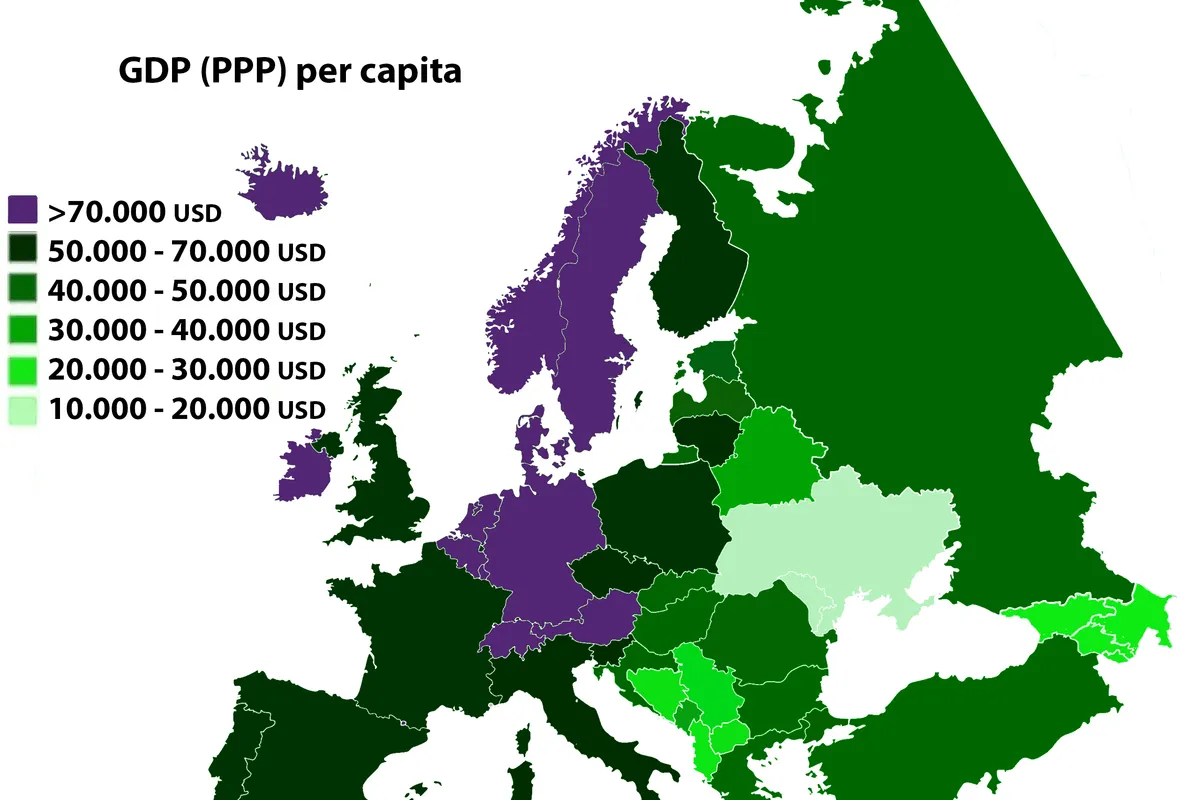
The acceleration of growth at the EU level was driven by the fact that among the six largest economies, which account for about 72 percent of GDP, only France and the Netherlands recorded a slowdown. In the largest economy, Germany, with a share of nearly 24 percent, and in the third-largest, Italy, with a 12 percent share, as well as in Poland (sixth), activity accelerated. Spain, as the fourth-largest economy, maintained the same pace. According to available data, Slovenia recorded the highest annual rate in the second quarter, at a full 5 percent.
Croatia Slows Down but Remains Solid
For Croatia, the estimate from the Croatian Bureau of Statistics (DZS) is expected only at the end of the month, but all indications point to it being among the countries with slowing growth, yet with an annual rate in the upper half of the EU rankings. Based on monthly data for April-June, domestic analysts estimate that the annual rate could fall to around 2 percent.
The latest values of the CEIZ business cycle index, published by the Institute of Economics, Zagreb, point to a similar trend. The index for May, along with comments from EIZ researchers, indicates a possible GDP growth of 2 percent in the second quarter, but with the caveat that more accurate estimates require waiting for June data.
The Croatian National Bank (HNB) released its first estimate based on a nowcasting model earlier, in mid-July. The data at that time suggested a somewhat more pronounced slowdown. Due to weaker May indicators, particularly industrial production and retail trade turnover, the model predicted growth of 0.3 percent on a quarterly basis, with the annual rate potentially falling to 1.6 percent from 2.2 percent in the first quarter.
Since then, significantly better data on industrial activity for June have arrived. In June, production rose by 5.3 percent compared with the same month in 2025, and compared with the second quarter of this year and last year, growth of 0.3 percent was recorded. Retail trade slowed its growth to 0.9 percent on an annual basis in the second quarter. Construction is recording around 3 percent year-on-year growth, while in tourism, the number of overnight stays in April-June was about 0.4 percent lower than last year.
Zrinka Živković Matijević, chief economist at Raiffeisen Bank, points out that the impact of investments in the second quarter may have strengthened slightly, while personal consumption, which is generally expected to slow this year, could remain roughly at the level of the first quarter. "All in all, she concludes that a slowdown is likely, but we are still talking about solid annual growth rates," the Poslovni dnevnik analysis states.