Russia Has Turned S-400 into a Weapon of Terror over Kyiv
Anti-aircraft missiles, not designed for striking ground targets, now regularly hit Ukrainian cities, and Ukraine's air defense is finding them increasingly hard to intercept.
Anti-aircraft missiles, not designed for striking ground targets, now regularly hit Ukrainian cities, and Ukraine's air defense is finding them increasingly hard to intercept.
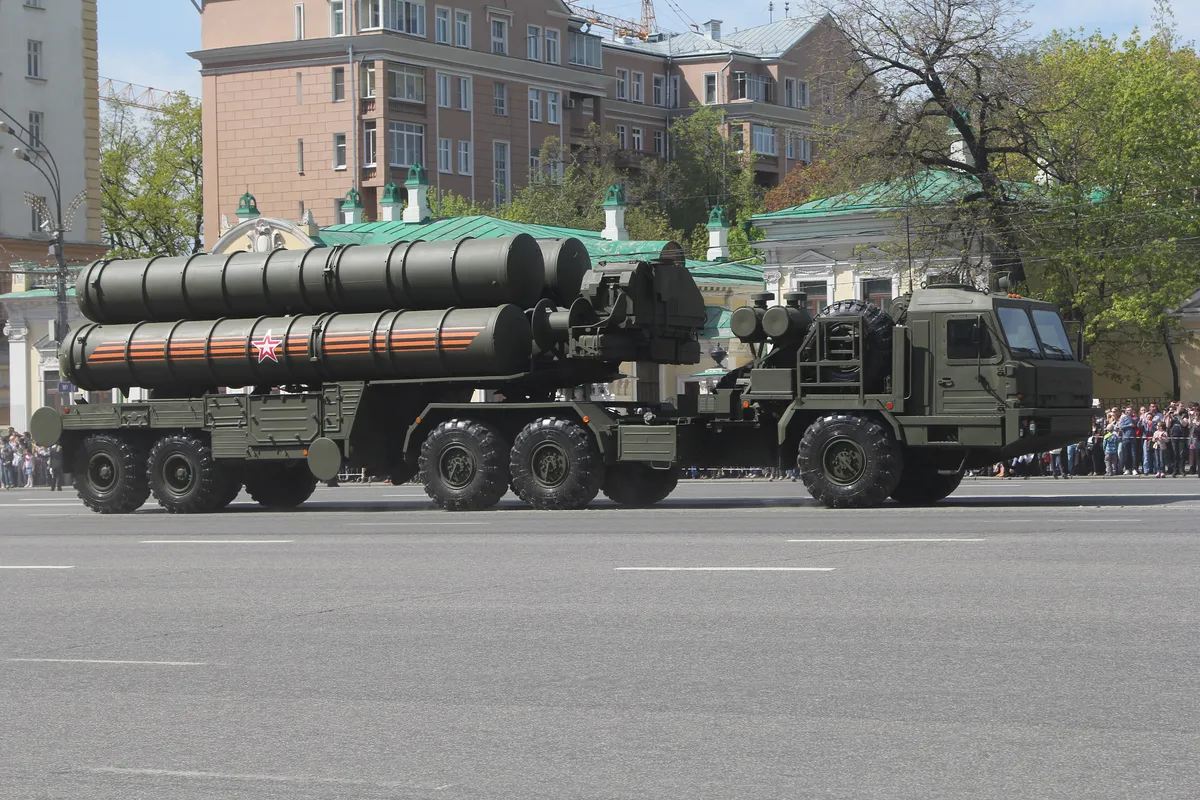
On the night of August 4-5, 2026, Russia attacked Ukraine with 24 ballistic missiles, which the Ukrainian Air Force grouped under the combined designation Iskander-M/S-400. The Kyiv region bore the brunt of the attack, and the alarming fact is that Ukraine's air defense, facing a shortage of interceptors for Patriot systems, failed to shoot down any of them.
What makes this attack particularly concerning is that the S-400 system was originally designed for air defense and intercepting incoming missiles, not for striking ground targets. However, Russia has repurposed it, ramped up production, and extended its range to reach Kyiv, turning it into a weapon that increasingly pressures Ukrainian cities.
This is not the first time Russia has used anti-aircraft missiles to strike ground targets. During 2022, it used older S-300 missiles against cities near the front line. Later reports confirmed the use of newer 48N6 missiles, compatible with later variants of the S-300 and with the S-400. In 2026, Russia added the RM-48U to its arsenal, mass-producing this missile by repurposing decommissioned anti-aircraft missiles.
According to data from Ukraine's intelligence service, Russia produced 200 RM-48U units in 2025 and plans to produce more than 480 in 2026. In this way, the ad hoc use of anti-aircraft missiles has evolved into a separate production line that allows Russia to supplement its Iskander short-range ballistic missiles during combined attacks. The result is a greater number of fast missiles per attack, despite their lower precision and destructive power compared to dedicated ballistic missiles.
The names S-300 and S-400 are often used as shorthand for the missiles themselves, although they actually refer to families of air defense systems that include radars, command posts, launchers, and several types of missiles. Russia's state arms exporter Rosoboronexport lists four missile variants for the S-400 alone: 48N6E3, 48N6E2, 40N6E, and 9M96E2. Therefore, finding debris of a 48N6 missile is not always sufficient to determine with certainty which system launched it, as these missiles are often compatible with both systems.
The oldest missile relevant to this story, the 5V55R, weighs about 1.66 tons and carries a high-explosive fragmentation warhead weighing around 130 kilograms. Its standard range against air targets is up to 75 kilometers. The newer 48N6 missile weighs about 1.8 tons and, depending on the variant, carries a warhead weighing between 143 and 180 kilograms.
Both missiles were originally designed to destroy aircraft and incoming missiles in flight. Their warheads generate a large number of fragments, but they lack specialized penetrators or reinforced casings needed to pierce concrete or underground structures. In urban areas, this limitation is not crucial-at high speed, the missile's mass and the dispersal of thousands of fragments can devastate a wide area even with a relatively modest warhead.
The 40N6 missile stands out as the longest-range projectile of the S-400 system, with a declared range of up to 380-400 kilometers against air targets. In November 2023, Ukrainian officials reported finding its debris on the Zaporizhzhia front. However, the presence of debris alone does not prove that the missile was launched at a ground target rather than fired by Russian air defense units. Also, there is no public evidence that the 40N6 is systematically used for ground attacks. The range of 380-400 km refers to air targets, and the range when engaging ground targets may differ due to a different flight profile and guidance methods.
The ability to engage ground targets with the S-300 system existed before Russia's invasion of Ukraine. In May 2011, three Russian air defense regiments conducted exercises at the Telemba range, firing five live missiles from a stationary S-300 system at ground targets. The Russian military claimed all five hit their targets.
The exact guidance algorithms for all missile variants remain classified. Available technical information suggests the use of inertial and radio-command guidance in the initial phases of flight. Once the missile passes the radio horizon, ground radar guidance is no longer possible, and the missile continues toward the target using only inertial navigation. This mechanism allowed the 48N6DM missile to travel more than 200 kilometers in an attack on Kyiv, but it also explains why these missiles sacrifice precision for speed over long distances.
It is important to note that these projectiles are not true ballistic missiles like the 9M723 used by the Iskander-M system. Instead, each follows a trajectory similar to a ballistic one for most of its flight, before descending toward the target area in the final phase. Publicly available, verified data on the circular error probable (CEP) for these strikes does not exist, meaning that precise accuracy figures occasionally appearing in the media cannot be independently confirmed.
Ukrainian estimates state that the maximum speed of the 48N6DM missile is about 2.5 km/s, meaning it can cover 200 kilometers in just a few minutes. During the attack on the Kyiv region in January 2023, the early warning system was not always able to issue timely alerts-the problem was not the inability to detect the missile, but the short flight time that left too little time to assess whether an S-300 or S-400 launch was aimed at an air or ground target.
During 2022 and 2023, S-300 missiles were used primarily against regions close to the front line or the Russian border. One of the most devastating attacks occurred on September 30, 2022, when Russia fired 16 S-300 missiles at Zaporizhzhia and its surroundings. Four missiles hit the area around a car dealership and a convoy of civilian vehicles. The attack killed 32 people and injured 118.
Further south, Mykolaiv was also under fire. On October 23, 2022, a Russian missile struck a five-story building, but there were no fatalities. Sloviansk was hit on April 14, 2023, with eight S-300 missiles-residential buildings, offices, and commercial spaces were damaged, and the attack claimed 15 lives and wounded 24 people.
On the evening of October 21, 2023, two missiles struck the postal hub of Nova Poshta (Nova Post), Ukraine's largest private delivery service, in Novyi Korotych near Kharkiv. According to early reports from the prosecutor's office, they were identified as S-300 missiles launched from Russia's Belgorod region. Eight people were killed and 15 injured.
On the morning of January 14, 2023, the Ukrainian command reported that S-400 missiles fired from the north had hit Kyiv. Photos of debris allowed experts to identify them as 48N6DM. The Bryansk region in Russia was cited as the likely launch area, although exact coordinates and final expert conclusions were not published.
In the summer of 2026, S-400 missiles again regularly appear in Ukrainian reports alongside Iskander missiles. On July 2, the Ukrainian Air Force recorded 24 missiles in the combined Iskander-M/S-400 category, of which four were intercepted. On July 6, 23 missiles were recorded, but none were intercepted. On August 1, one out of 27 missiles was shot down. In the attack on August 5, none of the 24 missiles were intercepted. All four attacks were primarily aimed at Kyiv or the Kyiv region. Based on publicly available data, it is impossible to determine what proportion of these missiles were S-400.