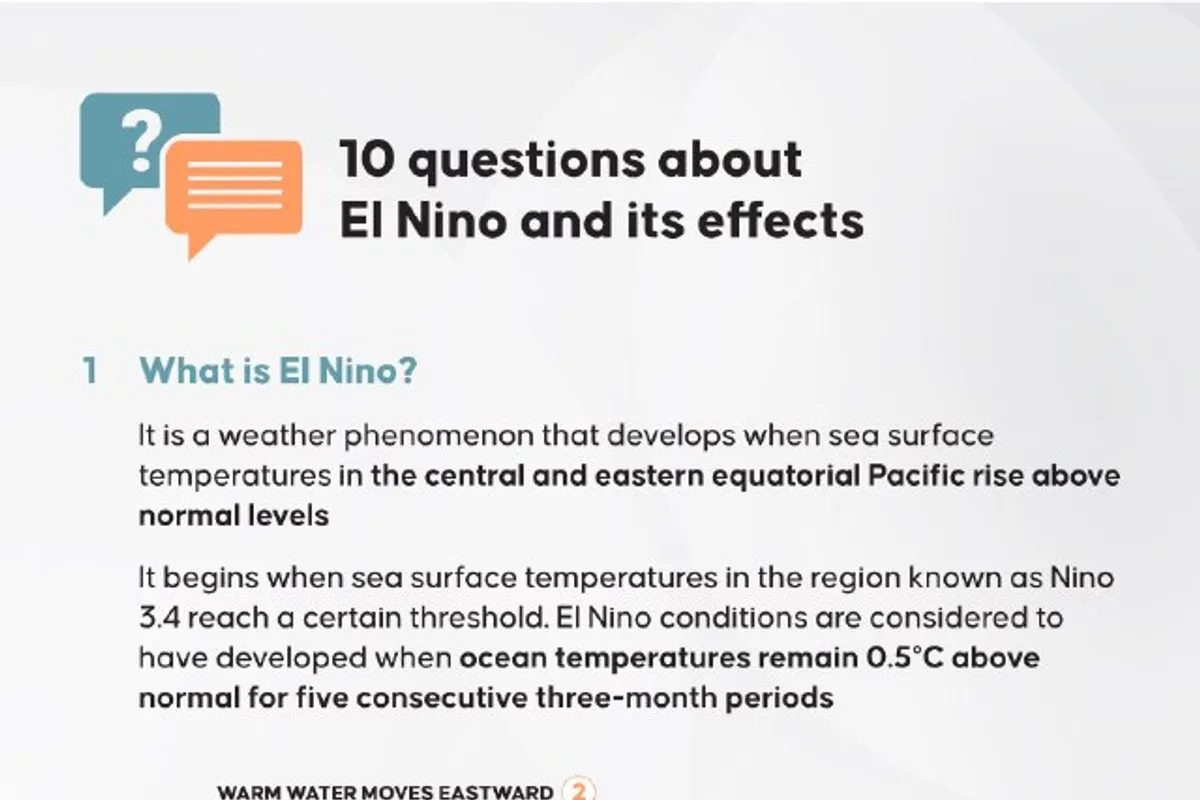
A potentially record-breaking El Niño is gaining strength in the Pacific Ocean, and according to estimates from the US National Oceanic and Atmospheric Administration (NOAA), the probability that the current El Niño will become a very strong event this fall and winter exceeds 90 percent. Moreover, there is a 69 percent chance that during October, November, and December it will surpass the strength of all El Niños recorded since 1950, as reported by Anadolu English.
Anomaly of +2.9 Degrees Already in Early Phase
The World Meteorological Organization (WMO) predicts that the sea surface temperature anomaly in the El Niño/La Niña indicator region of the Pacific Ocean will reach an average of +2.9 degrees Celsius in the August-September-October period. As Katharina Buchholz reports for Statista, this would represent the strongest El Niño since records began in 1950.
So far, three very strong El Niño episodes with anomalies of +2 degrees or more have been recorded: 1982 with +2.1 degrees between November and February, 1997 with +2.4 degrees from November to January, and 2015 with +2.6 degrees, also for the November to January period. This shows that this year's so-called Super El Niño is not only potentially stronger but also starts earlier. The WMO additionally expects ocean temperatures to continue rising and peak in November.
Wet Southern US, Dry Amazon, Droughts in Africa
El Niño could bring wet and stormy conditions across the southern United States starting in late fall, as well as more snow in regions that receive precipitation in that form. In the Pacific Northwest, the opposite is expected: a dry winter. Globally, El Niño could cause very dry conditions in the Amazon, which experts fear is approaching a tipping point, droughts in vulnerable regions of Africa, and excess rainfall in parts of South America, Central Asia, and the Horn of Africa.
Lessons from the 2015 Super El Niño
During the last Super El Niño in 2015, the United States experienced a record cyclone season in the central Pacific, where Hawaii is located, and a 500-year drought in the Caribbean, including Puerto Rico. Worldwide, 2015 became the hottest year on record at that time, with devastating drought in Ethiopia and record wildfires in Indonesia.
For comparison, strong La Niña episodes, classified with anomalies of -1.5 to -1.9 degrees, occurred in 1973, 1988, 1999, 2000, 2008, and 2010. Anadolu English also notes that the analysis considers the possible impact of El Niño on Turkey, as well as on global food prices and agriculture, which could indirectly affect the Croatian market.