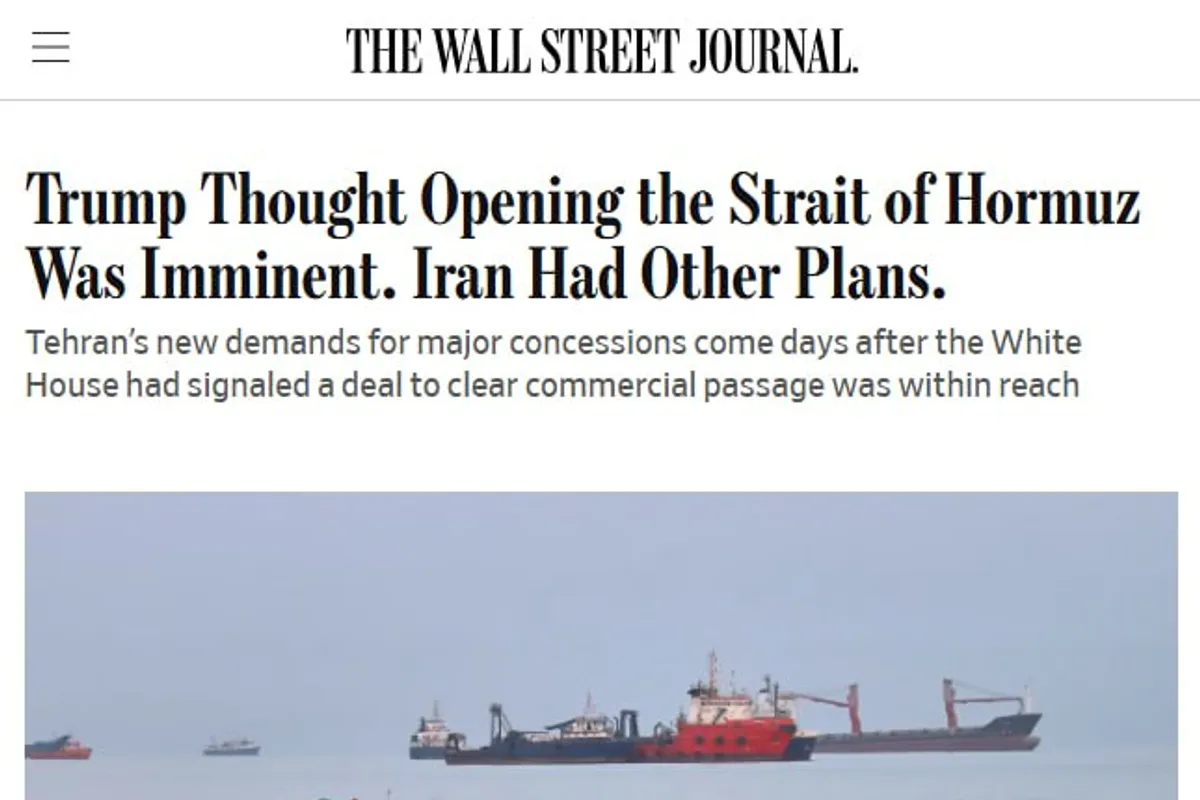
The crisis in the Strait of Hormuz continues to escalate. On Sunday, August 9, 2026, Iran's Revolutionary Guard insisted it will not reopen the key energy passage until the United States accepts a series of conditions, including compensation for war damages. At the same time, US President Donald Trump is signaling that he no longer sees a nuclear deal as necessary to end the conflict, as reported by the Wall Street Journal.
Tehran Sets Conditions, Washington Plays Chess
On Saturday, Iran's Supreme National Security Council, according to the Tasnim news agency, published a list of demands for reopening the strait. These include an end to the war on all fronts, lifting the US counter-blockade of Iranian ports, lifting sanctions, releasing frozen assets, and compensation for war damages. These conditions reflect the provisions of a June memorandum that envisioned a $300 billion fund for Iran's reconstruction.
The Revolutionary Guard shows no intention of backing down. "Until the enemy accepts all our conditions... the strait is now effectively a war zone for us, not just a shipping lane," they stated. On the other hand, Trump, in an interview with Axios on Sunday, described his approach as: "We're low-keying it. We're just semi-negotiating with them. We're just watching Iran with its massive inflation and the fact that they have no money." He added that he believes the situation will resolve itself: "It's going to work out. It's like a chess game."
Tanker Attacks and Regional Escalation
The blockade of Hormuz, which was open to transit before the war, has dramatically reduced traffic and pushed up oil prices. On Saturday, at least one tanker was hit, according to information from the UAE. Oman's Foreign Ministry condemned the repeated attacks without naming Iran. Negotiations on managing navigation through the strait are ongoing, and Iranian Foreign Minister Abbas Araghchi said talks with Oman are "approaching the final stages." Araghchi previously stated that Tehran is only "exchanging messages" with Washington through intermediaries.
Meanwhile, Yemen's Houthis, Iran's allies, have declared a parallel naval blockade of Saudi ports in the Red Sea. On Sunday, they announced they had struck a Saudi oil facility on the Red Sea coast. In Houthi attacks on the port of Mokha, controlled by the internationally recognized government, three civilians and eight military personnel were killed, and 32 people were wounded, according to a medical source. Houthi military spokesman Yahya Saree said the group targeted the "Saudi enemy" with missiles and drones.
Saudi Arabia Builds a New Defense Alliance
Facing an unprecedented security challenge, Saudi Arabia signed a joint defense agreement with Turkey and Pakistan on Friday, August 7. The agreement includes a NATO-style clause that treats an attack on one country as an attack on all. Turkish Foreign Minister Hakan Fidan said on Saturday he expects Egypt to join the pact, calling the country a "natural partner on all issues."
"We already behave toward each other as if we are members of an alliance," Fidan said. Pakistan's Foreign Ministry stated that the agreement is "intended to strengthen collective deterrence."