Ukrainian forces have conducted the first known combat operation in which a large transport drone delivered a ground robot behind enemy lines, where it then independently carried out a combat mission. This new tactic, reported by Forbes on August 4, 2026, and relayed by Index.hr, opens a new chapter in the development of unmanned warfare.
How the ARK-1 Robot Operation Was Executed
A large unmanned aerial vehicle transported a ground unmanned vehicle (UGV) called ARK-1 to enemy territory. The robot carried an TM-62 anti-tank mine, intended for destroying fortified positions or armored vehicles. The ARK-1 is a compact, universal wheeled vehicle capable of carrying up to 15 kilograms of payload over distances exceeding 14 kilometers. It is equipped with Starlink satellite communication, allowing control from a command point hundreds of kilometers away.
Experts highlight that this approach significantly reduces risk for operators. The transport drone does not need to enter the air defense zone because it deploys the robot at a safe distance from the target. After landing, the robot can independently advance toward the target, wait for a favorable opportunity, or set up an ambush, and due to ground movement and lower noise, the enemy is less likely to detect it. Experience so far shows that similar robots have already been used to destroy Russian fortifications and buildings by placing explosives, while other variants are equipped with machine guns or serve for reconnaissance and supply.
Revolutionary Tactic with Historical Roots
Although this tactic is considered revolutionary today, the concept is not new. As early as the early 2000s, the U.S. military tested using parachutes to drop small ground robots from drones for reconnaissance purposes. Many of these initiatives never moved beyond the experimental stage. In contrast, Ukraine, due to the wartime situation and lack of resources, has created practical solutions that are immediately used in real combat.
According to military experts, such technologies could completely change how airborne assaults are conducted. Due to modern air defenses and numerous combat drones, classic helicopter assaults have become very dangerous, as seen in the Russian attempt to capture Hostomel Airport near Kyiv in February 2022. Other countries are also developing similar technologies, China has already showcased large drones carrying quadruped robots with mounted machine guns.
Plans: 30 Percent of Tasks for Robots
Ukraine is simultaneously testing even larger transport drones with payloads exceeding 90 kilograms, intended for logistics, casualty evacuation, and transporting larger ground robots. Ukrainian military leadership plans that this year, in some parts of the front, up to 30 percent of tasks currently performed by soldiers will be taken over by unmanned ground vehicles. Analysts believe that future offensive operations could begin with massive swarm attacks of drones and ground robots, with human units arriving only in a second wave to secure captured territory. The development of artificial intelligence is further accelerating the progress of autonomous systems, which is why many military experts estimate that robots will become one of the key factors in modern warfare in the coming years.
End of the '40-Day Operation' and Russia's Response
Simultaneously with this technological breakthrough, on August 3, 2026, Ukraine's "40-day operation" quietly ended, aimed at forcing Russia to negotiate through massive economic destruction. According to analytical source AMK Mapping, the operation's goals were not achieved, and Ukraine is in a worse position today than 40 days ago. Although Russia suffered significant damage to its "shadow fleet," warehouses, and oil infrastructure, it did not experience major economic shocks beyond what it already endures.
In response, Russia launched its own wave of attacks on Ukrainian port infrastructure. Unlike Russia, Ukrainian ports are concentrated on a small stretch of coast in the Odesa region. These ports are responsible for 70 percent of Ukraine's total exports and more than 90 percent of agricultural exports. Russian retaliatory strikes are conducted with significantly greater force and include a wide range of weapons, including drones, cruise missiles, anti-ship missiles, and ballistic missiles.
Night Attack and Losses
Ukraine's Air Force reported on August 4, 2026, that Russia launched an Iskander-M ballistic missile and 136 drones overnight. Air defense shot down or suppressed 117 drones. One ballistic missile and 14 drones hit targets at 14 locations, while debris fell at three sites. The attack is ongoing.
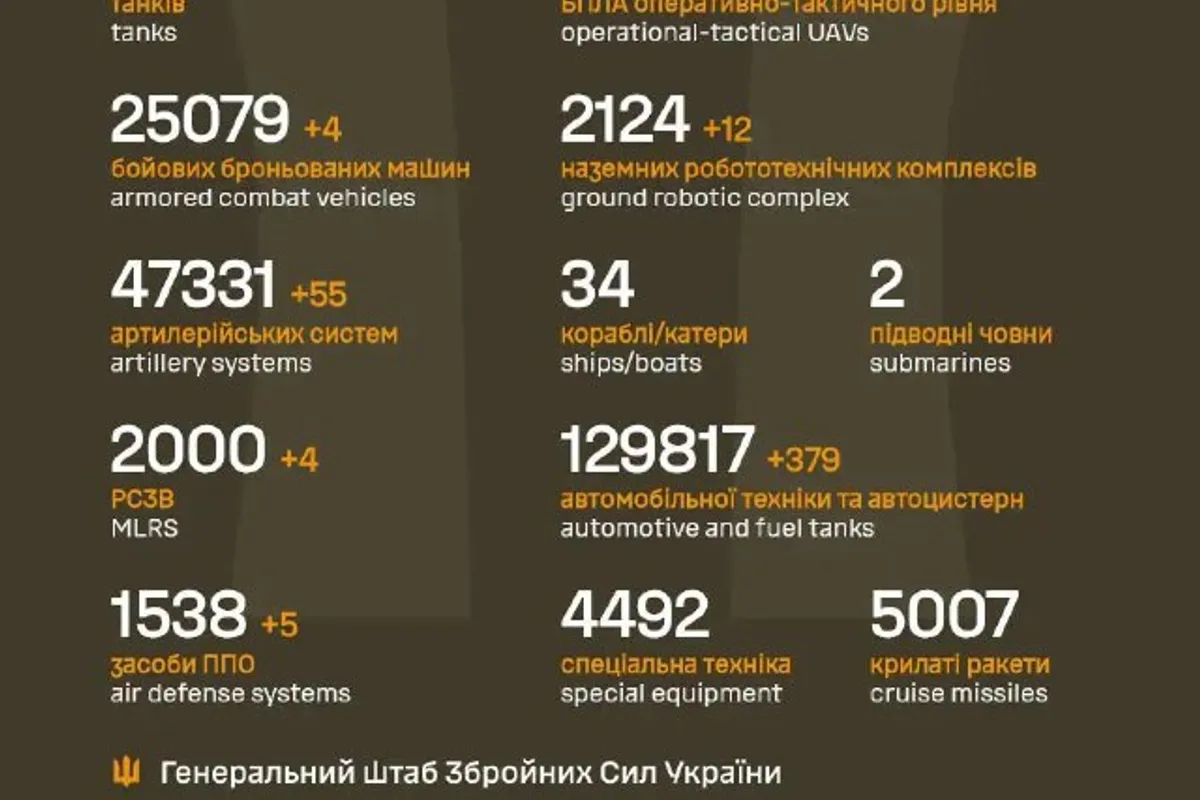
According to the report from the Ukrainian General Staff on August 4, 2026, Russian losses in personnel and equipment include: 1,240 soldiers, 5 tanks, 4 armored vehicles, 55 artillery systems, 4 multiple launch rocket systems (MLRS), 5 air defense systems, 1,792 unmanned aerial vehicles (UAVs), and 12 ground robotic complexes (GRCs).
Additionally, the source Slavyangrad reported on August 4 about a powerful explosion in the Zmiiv area of Kharkiv Oblast, where an energy facility was also hit a few days ago.