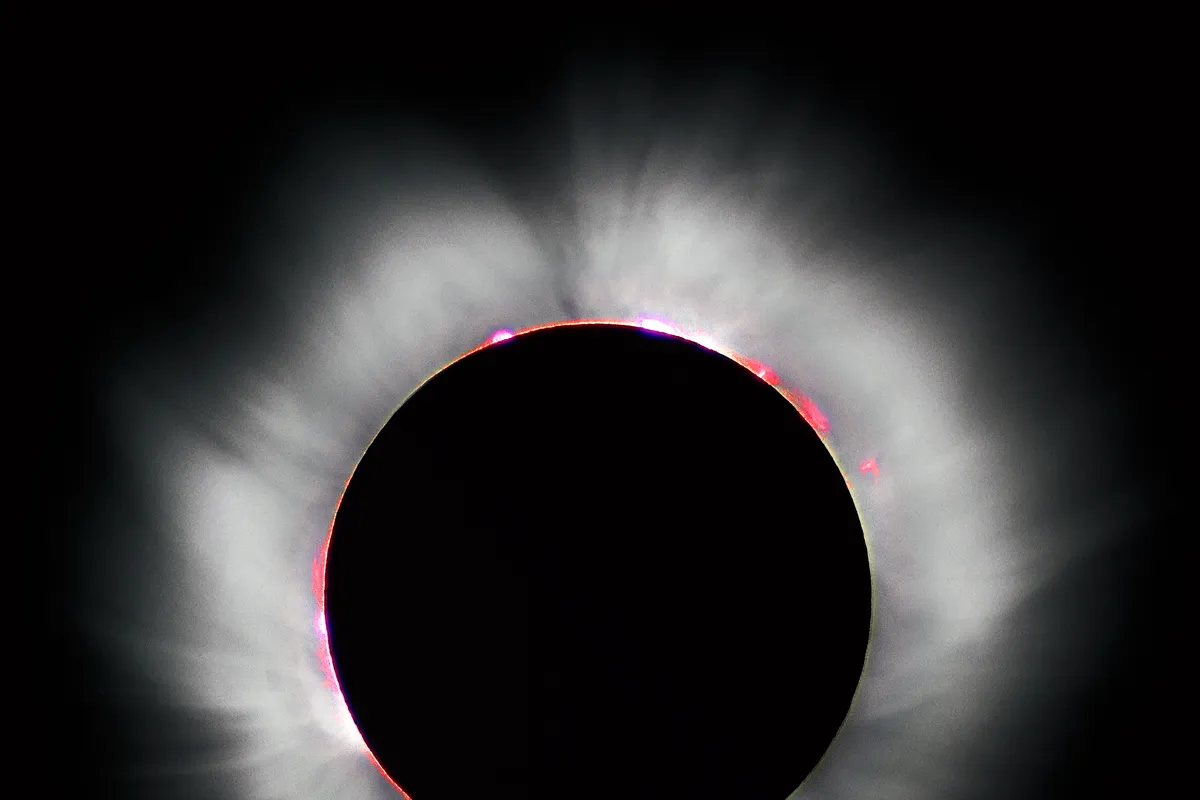
Croatia is in for a rare astronomical spectacle this evening - a partial solar eclipse that will unfold just before our star dips below the horizon. Unlike the narrow band stretching across Greenland, Iceland, and northern Spain, where total darkness will last up to two minutes, here the Moon will take a bite out of only part of the Sun's disk, but enough to make the sight striking.
The timing adds to the charm - the eclipse coincides with sunset. As the Zagreb Observatory explains, the maximum phase will occur after the Sun has already disappeared from view, so from Croatia we will only catch the first, albeit very attractive, part of the play of light and shadow.
Poreč with the Highest Percentage of Obscuration
Residents of the western regions will have the best view. In Poreč, the Moon will cover as much as 89.44 percent of the Sun, with the phenomenon starting at 7:27 PM. Pula follows with an obscuration of 86.30 percent (starting at 7:27 PM), while in Rijeka, 85.05 percent of the disk will be covered (also at 7:27 PM). Zagreb will see 77 percent, starting at 7:25 PM.
Farther south and east, the numbers decrease: Gospić 71.83 percent (7:28 PM), Bjelovar 70.76 percent (7:25 PM), Knin 60.62 percent (7:28 PM), Split 54.27 percent (7:29 PM), Osijek 52.70 percent (7:25 PM), Omiš 51.62 percent (7:29 PM), and Dubrovnik will see the least - 34.05 percent, starting at 7:30 PM. The Sun will set between 7:53 PM and 8:17 PM, depending on the viewing location.
Scramble for Glasses and Safety Measures
Experts are repeatedly issuing one warning. "It is important to emphasize that one should never look at the Sun with the naked eye, nor through binoculars or a telescope without appropriate protective filters. For safe viewing, only certified glasses or filters designed for solar observation should be used, as otherwise permanent eye damage can occur," the Zagreb Observatory advises.
Demand for protective equipment across Europe has led to shortages. In Spain and France, supplies have been depleted, and some suppliers have had to hire taxis for urgent deliveries. Jason Lewin, marketing director of American Paper Optics, says this is a predictable crisis: "Having produced and shipped hundreds of millions of glasses for the historic eclipses in the US in 2017 and 2024, we know firsthand how quickly demand outstrips supply. Those who buy at the last minute often end up with nothing or, worse, are forced to buy unverified, counterfeit glasses when legitimate sellers sell out." The global market for eclipse glasses had already exceeded two hundred million euros by 2024.
In Spain, six models that did not meet safety standards were pulled from shelves. Health professionals point out that even a few seconds of viewing without proper protection can permanently damage the retina, and the danger is greater because the eye does not feel pain during exposure.
Weather on the Side of Observers and a Night of Perseids
Forecasts from the State Hydrometeorological Institute (DHMZ) promise nearly ideal conditions. Wednesday is expected to be mostly sunny and very hot, while the evening for Istria and the northern Adriatic should be mostly clear. The possibility of isolated afternoon showers in the interior of Istria exists, but clearing is expected by sunset.
Once the eclipse ends, the sky will not remain empty. That same night, the Perseid meteor shower, known as the Tears of St. Lawrence, reaches its peak. The Croatian Astronomical Society highlights that conditions will be exceptional because the Moon, in its new phase, will not interfere with observations with its light.
Why This Is So Rare and When the Next One Comes
A total eclipse in continental Europe has not been seen since 1999. Although the Moon is about four hundred times smaller than the Sun, it is also about four hundred times closer to Earth, so their apparent sizes in the sky nearly match. However, the Moon's orbit is tilted by about five degrees relative to Earth's, which is why perfect alignment happens rarely.
For those who fail to catch the spectacle tonight, the next partial eclipse visible from Croatia arrives on August 2, 2027. For a total one, however, the wait will span generations - it occurs on September 3, 2081.
This eclipse is part of a broader European phenomenon: after 27 years, the continent again has the chance to witness a total solar eclipse, last seen on August 11, 1999. However, the path of totality is extremely narrow, covering only Iceland, northern Spain, and the Balearic Islands, and outside Europe, total darkness will occur only in Greenland. It is estimated that millions of people from around the world have traveled to these areas so as not to miss the spectacle. The total phase will be very short, averaging less than two minutes: the longest duration is expected in Iceland, where from the Snæfellsjökull glacier one can observe the 'black Sun' for 2 minutes and 10 seconds, while from Reykjavik totality will last only 1 minute and 1 second. In Spain, the best location is Gijón in Asturias with 1 minute and 46 seconds of totality, followed by Burgos (1:44), Mallorca (1:36), and A Coruña (1:15). Outside the path of totality, Madrid will have the highest percentage of obscuration at 99.96 percent, while New York will see only 8 percent. In Italy, according to the National Institute for Astrophysics, the percentage of obscuration will increase from the southeast to the northwest: from 18 percent in Calabria to over 93 percent in Piedmont and 95 percent in Liguria.