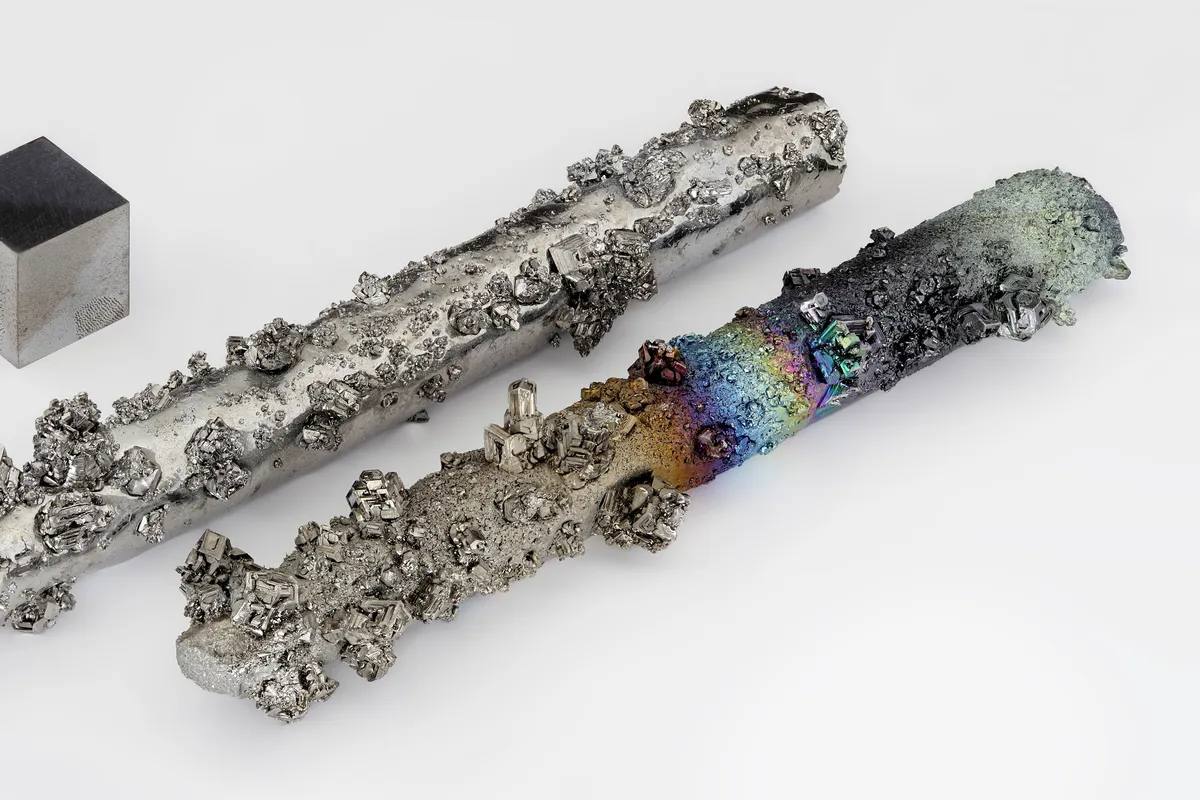
Tungsten is the metal with the highest melting point of all, at a staggering 3410 °C, far above platinum's melting point of 1772 °C, and it is also significantly cheaper. These very characteristics made it a key material for the development of electric lighting, and a special place in that story belongs to Croatia, thanks to chemist Franjo Hanaman.
Hanaman, in collaboration with Austrian Aleksandar Just, developed a method for producing tungsten filaments that was entirely chemical. By reacting vapors of tungsten compounds with a carbon filament, the carbon was gradually replaced by the metal. Edison had already used a carbon filament, and there were also bulbs with platinum filaments, but it was Hanaman's work that enabled the mass adoption of electric light because nothing could compare to tungsten.
From Chemical Challenge to the First Light Bulb
The problem with the Hanaman-Just method was that the reaction of volatile tungsten compounds, WOCl4 and WO2Cl2, with a carbon filament did not remove all the carbon. Some of the carbon combined with the deposited metal to form carbides, WC and W2C. After numerous trials and patents, a factory in the Hungarian city of Újpest produced the first tungsten light bulb in 1906.
The product was so successful that the company changed its name to Tungsram in 1909, a name formed by merging the German term Wolfram and the English term tungsten. However, the secret of the Hanaman-Just process soon fell into oblivion because American William David Coolidge patented a significantly better method for producing tungsten filaments, and the European process was abandoned.
A Name That Tells a Tale of Wolves and Sheep
The name tungsten comes from the German word Wolfram, which could be translated as "wolf's froth" (German: Wolf = wolf, Rahm = cream). As chemist Nenad Raos explains in an article for Bug.hr, "it was named by metallurgists who noticed that if a heavy, yellowish stone was present in tin ore, it created a slag that 'devoured tin like a wolf devours sheep'."
The secret of this mineral, once called tungsten and now known as scheelite (calcium tungstate, CaWO4), was solved by Swedish chemist Carl Wilhelm Scheele, co-discoverer of oxygen. In 1781, he extracted tungsten trioxide, WO3, from it. Just two years later, in 1783, Spanish chemists, brothers José and Fausto Elhuyar, obtained the new metal by reducing this oxide with charcoal. Today, tungsten oxide is reduced with hydrogen at a temperature of 1200 °C.
"Tungsten is a Croatian metal. I may be exaggerating a bit, but still: Croatian chemist Franjo Hanaman, in collaboration with Austrian Aleksandar Just, made the first light bulb with a tungsten filament."
- Nenad Raos, author of the article for Bug.hr
From Laboratory Curiosity to High-Speed Steel
For nearly a century, tungsten was merely a curiosity in chemical laboratories, until 1864 when English metallurgist and entrepreneur Robert Forester Mushet discovered that adding 5% tungsten to steel increased its resistance to heat. Unlike other steels that soften when heated, tungsten steel becomes harder.
This discovery paved the way for high-speed steels used in making lathe tools. While steels of that era could cut at speeds of 5 meters per minute, Mushet's steel achieved 7.5 m/min. Today's cutting steels, which also contain tungsten, reach speeds of up to 2000 meters per minute.
A Metal with Exceptional Properties
Tungsten combines a high melting point, a high density of 19.25 g/cm3, and exceptional ductility, from just 250 grams, one can draw as much as 100 kilometers of wire. Tungsten carbide, WC, is another special story, being an extremely strong and hard material. Its hardness ranges from 8.5 to 9 on the Mohs scale, and it melts with decomposition only at temperatures between 2600 and 2900 °C.
The story of the tungsten filament is thus just one episode in the saga of this unique chemical element, which sits in the 74th "box" of the periodic table, in the neighborhood of chromium, molybdenum, vanadium, and manganese, metals used to alloy steel.