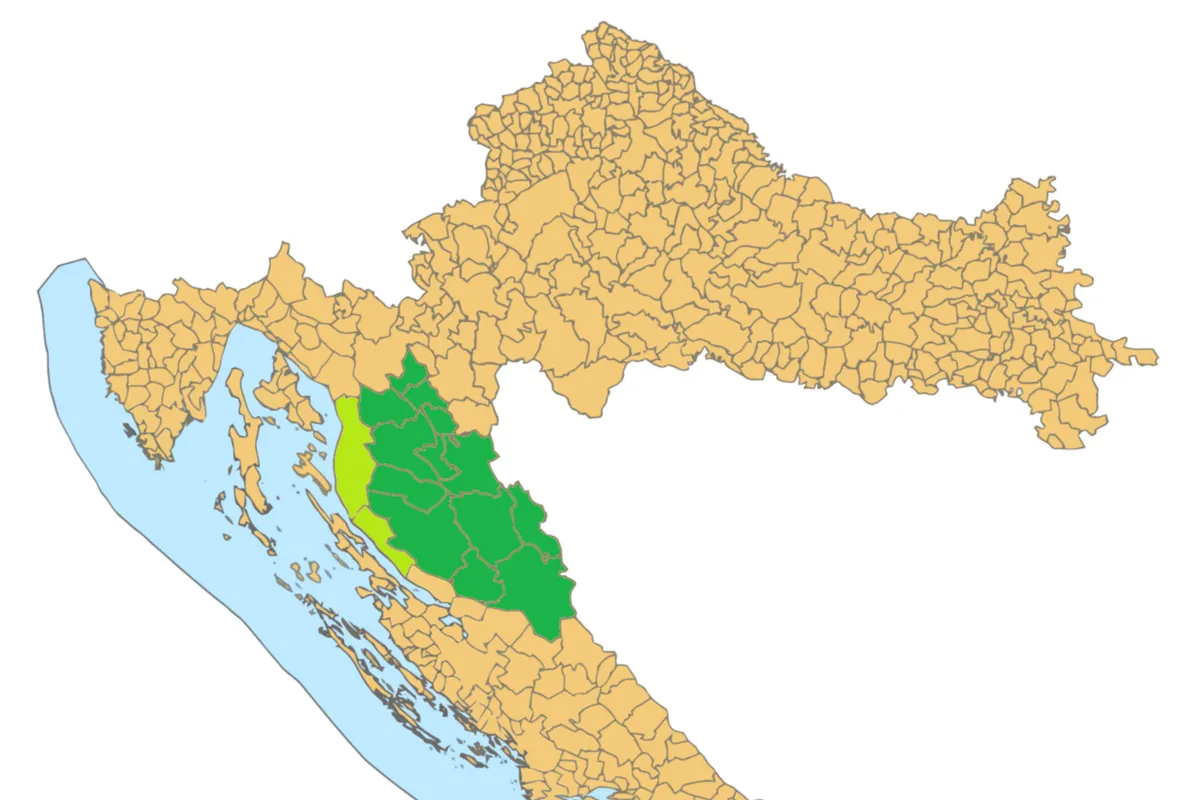
To halt the further spread of African swine fever (ASF), all remaining approximately 600 pigs on affected farms in four municipalities in Virovitica-Podravina and Osijek-Baranja counties will be slaughtered or euthanized by tomorrow. These are settlements in the municipalities of Crnac, Zdenci, Draž, and Đurđenovac, which have been designated as high-risk hotspots for the spread of this disease.
The Ministry of Agriculture, Forestry, and Fisheries warns that a large number of farms have been affected by ASF and that new hotspots are being discovered daily. Although the virus is currently contained within existing boundaries, any delay in the operation increases the risk of it spreading to new areas, the ministry emphasizes.
Veterinary inspectors on the ground, only large farms spared
The removal operation is being carried out in fifteen settlements: Breštanovci, Mali Rastovac, Novo Petrovo Polje, Staro Petrovo Polje, Suha Mlaka, Veliki Rastovac, Donje Predrijevo, Grudnjak, Kutovi, Slavonske Bare, Zokov Gaj, Batina, Beljevina, Bokšić, and Bokšić Lug. Farm owners in these areas are required to enable the transport of pigs for slaughter to abattoirs designated by the Ministry by the end of tomorrow, with the entire process overseen by veterinary inspectors from the State Inspectorate (DIRH).
In cases where transport to an abattoir is not possible, pigs will be euthanized directly on the farms. All animal carcasses will be safely disposed of at a rendering plant, followed by disinfection of the facilities. A key exemption applies to farms with 1,000 or more pigs that hold all necessary approvals from the State Inspectorate, these will be spared from culling.
The Ministry has confirmed that all costs of culling, compensation to farmers, preliminary disinfection of facilities, and rendering plant processing will be covered by the state budget. Farms where euthanasia is carried out will be subject to a ban on keeping pigs for the next year.
Vlajčić: I did not want euthanasia on all farms with fewer than 1,000 pigs
Deputy Prime Minister and Minister of Agriculture David Vlajčić emphasized that the goal of the intervention is to stop the virus before it spreads to other areas.
"We are intervening now to prevent the virus from spreading from existing hotspots to other areas," Vlajčić told Večernji list.
The minister also revealed that the initial plan was significantly stricter.
"The first scenario that landed on my desk was drawing a line and euthanizing pigs on all farms with fewer than 1,000 pigs. I could not allow that; I did not want it. At this point, after all the education, I truly want to believe that people have understood that this is how we will protect them and, in a way, traditional farming and their livelihoods," Vlajčić said.
According to him, feedback from the field suggests that farmers have begun to take the situation more seriously and recognize the need to raise biosecurity standards.
Ten-day deadline for neighboring farms
In parallel with the removal operation, veterinarians and inspectors will conduct enhanced surveillance on approximately 300 farms located in the immediate vicinity of existing hotspots. Each farmer will receive specific instructions for rectifying identified deficiencies and will be given a final opportunity, a ten-day deadline to fully comply with prescribed biosecurity measures.
"Only those who meet the prescribed rules can continue production," Minister Vlajčić stated.
This measure is intended to ensure that the disease does not spread to farms that are not directly affected but are in high-risk zones.