Hamas Accepts Trump's Disarmament Deal, Conditions It on Israeli Withdrawal
Senior Hamas official said implementation depends on whether Israel first halts all forms of aggression and withdraws its forces from the Gaza Strip.
Senior Hamas official said implementation depends on whether Israel first halts all forms of aggression and withdraws its forces from the Gaza Strip.
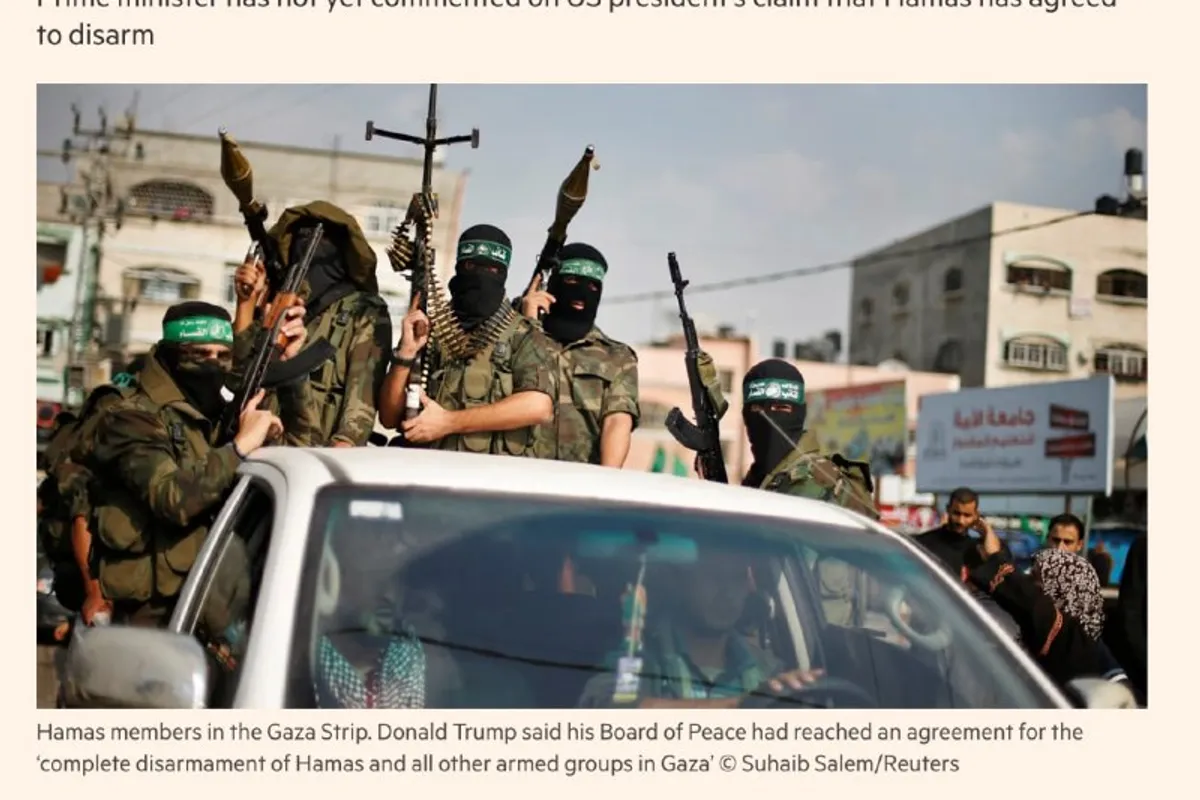
Palestinian Islamist group Hamas has accepted a deal with Israel on complete disarmament, announced by US President Donald Trump on Thursday evening. However, implementation of the plan, according to senior Hamas official Ghazi Hamad, depends on whether the Israeli side first fulfills its commitments, above all, halting all attacks in the Gaza Strip and withdrawing its military.
"We agreed to a difficult and painful deal for the sake of our people in Gaza, to save them from death and displacement. But we insisted with the mediators that Israel must honor the agreement," Hamad told Reuters, adding that the handover of weapons will only follow once Israeli forces withdraw to the positions they held in October and once the flow of humanitarian aid increases.
On his social media platform Truth Social, Trump announced that his Peace Council had reached an agreement on the "complete disarmament of Hamas and other armed groups," calling it a "monumental step toward lasting peace and security." Under the plan, the National Committee for Gaza Governance (NCAG), a body of Palestinian technocrats established by the Peace Council, would be the only entity allowed to inventory and store Hamas's weapons, with Israel not participating in the disarmament process itself. After that, Israel would withdraw its forces, and international stabilization forces (ISF) would take over security alongside a new Palestinian police force.
Hamad clarified that Hamas would only work out the implementation timeline with the mediators, Egypt, the US, Qatar, and Turkey, and that the process could take at least two weeks. A meeting in Cairo is expected soon.
Israel has not yet officially responded to Trump's announcement. Unofficially, an Israeli source told Reuters that "there will be no withdrawal of Israeli Defense Forces from the existing Yellow Line before Hamas undergoes genuine disarmament." Another political source told AFP that the proposed agreement does not resolve "in a satisfactory manner" the demands for complete demilitarization of Gaza, and that it was not discussed at the recent meeting between Trump and Israeli Prime Minister Benjamin Netanyahu in Washington.
National Security Minister Itamar Ben-Gvir, from the far right, wrote on X that the draft agreement is "unacceptable to Israel" and called for the continuation of "liquidations in Gaza" and encouraging the emigration of Palestinians. The Financial Times, meanwhile, reports that Netanyahu is under pressure from far-right coalition partners who insist that Israel reject the deal, and an Israeli official said the plan does not meet the demands for complete disarmament of Hamas, removal of all weapons, and full demilitarization of the Gaza Strip.
Trump's Peace Council, which he founded in January this year on the sidelines of the World Economic Forum in Davos, has been controversial for months. Although it has received support from more than 20 countries, including Israel, Qatar, Saudi Arabia, Turkey, and Egypt, key European allies of the United States, such as the United Kingdom and France, have not joined. EU foreign policy chief Kaja Kallas described it as "a personal instrument of Donald Trump" without accountability mechanisms toward Palestinians or the UN.
Additional criticism was sparked by the fact that the Council's executive bodies include no Palestinian representatives. Brazilian President Lula da Silva conditioned his country's participation on the inclusion of Palestinians at the negotiating table. Trump chairs the Peace Council as a lifetime leader, and the nine-member Executive Board includes, among others, Secretary of State Marco Rubio, envoy Steve Witkoff, Trump's son-in-law Jared Kushner, and former British Prime Minister Tony Blair, whose involvement is controversial due to his role in the Iraq War in 2003.
The first phase of the ceasefire between Israel and Hamas came into effect in October 2025, after nearly two years of war that broke out with Hamas's attack on Israel on October 7, 2023. In January this year, that phase ended with the release of the last Israeli hostages and Palestinian prisoners. Since then, according to data from the Gaza Health Ministry, which the UN considers reliable, at least 1,214 Palestinians have been killed in Israeli attacks. The Israeli military has lost five soldiers and one civilian employee. Israel controls more than 60 percent of the Gaza Strip, and tens of thousands of people still live in tent camps in the devastated area.