Tesla's Robotaxi Plows Through Bollards in Austin
A video posted Monday shows an unsupervised vehicle pushing through plastic bollards, less than a month after Tesla's AI chief touted a perfect safety record for the program.
A video posted Monday shows an unsupervised vehicle pushing through plastic bollards, less than a month after Tesla's AI chief touted a perfect safety record for the program.
Tesla's robotaxi, operating without a safety monitor, plowed through a row of plastic bollards protecting a closed traffic lane in Austin, Texas, on Monday, then continued on its way. The video, posted on Reddit, was filmed from the passenger seat. The incident comes less than a month after Tesla's vice president of artificial intelligence, Ashok Elluswamy, told investors that the robotaxi program has an "impeccable safety record" and "zero notable incidents."
The footage was shared on r/SelfDrivingCars by user bladerskb, one of the few regular users of Tesla's driverless service in Texas who documents their rides. The Model Y turned into a triangular pocket at an Austin intersection, which was closed to traffic with flexible plastic bollards. Redditors used the Texas Orthopedics building visible in the frame to pinpoint the exact intersection on Google Maps, and Street View shows the bollards have been in place since February 2024.
The video shows the car stopping, then slowly moving forward, reversing, moving again, pausing for a while, and then simply pushing through the bollards with an audible thud. "It hit em, it hit em," the passenger commented. No one was in the driver's seat.
The core issue isn't perception but decision-making. The car clearly detected the bollards, stopping multiple times in front of them, but ultimately concluded that driving through them was the best course of action. Tesla doesn't rely on the detailed pre-mapped data that Waymo uses, so the vehicle interprets the road layout on the fly. It read the right-turn lane, committed to it, and then failed to find a way back from its own mistake.
Tesla also uses remote assistance for exactly these situations, and the video doesn't show whether an operator was involved. In July, Electrek reported that a Tesla remote operator in Houston crashed a robotaxi into a stump while trying to extricate it from a dead-end street.
On Tesla's second-quarter 2026 earnings call on July 22, Elluswamy said: "We have driven more than 380,000 miles of unsupervised robotaxi now across six cities in two different states. We have had zero notable incidents." He called the program's safety record impeccable.
For comparison, Waymo has driven more than 220 million miles with passengers without a driver and completes roughly 500,000 paid rides weekly. Tesla's total unsupervised mileage is less than 0.2 percent of Waymo's, meaning Waymo has covered about 579 times more miles. Electrek reported in June that only 14 vehicles operate unsupervised across all markets, down from a peak of 25. According to The Verge, citing the crowdsourced Robotaxi Tracker, Tesla currently operates 16 unsupervised vehicles in Austin, four in Dallas, and one in Houston. Sources disagree on the total number of vehicles, likely due to different data collection dates.
To date, Tesla has filed 22 incident reports with the National Highway Traffic Safety Administration (NHTSA) involving its automated driving system. Whether this incident of driving through public infrastructure will be added to that list is Tesla's own decision.
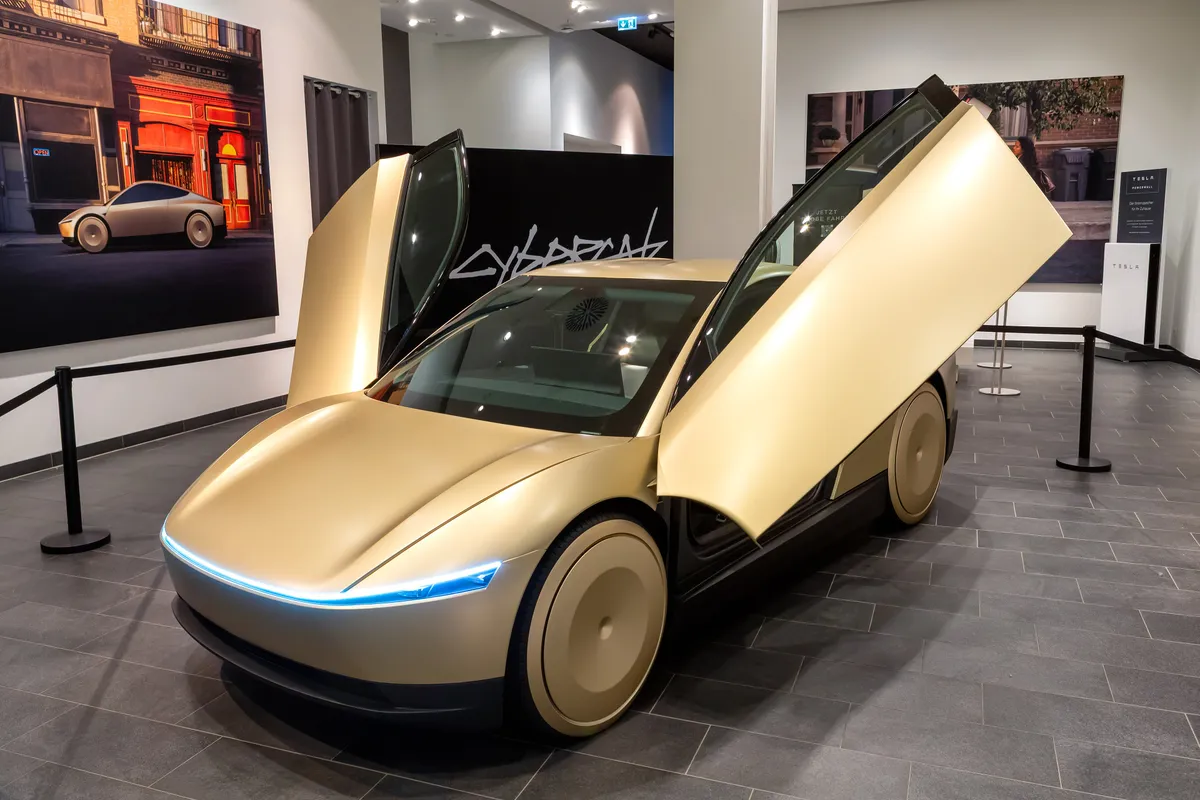
Tesla plans a public launch of the Cybercab in Austin at the end of this month, according to The Information. The vehicle, which lacks a steering wheel and pedals, has been spotted across the country, though often with a steering wheel and pedals while employees collect data. The fully driverless version has been tested on private roads around the company's campus since July.
Austin city spokesperson Brad Cesak confirmed that Tesla recently conducted training with emergency services, teaching them how to move the vehicles in case of an emergency. Tesla's Robotaxi account on X confirmed that a "Cybercab launch event" is imminent, urging followers to take a ride in the Model Y robotaxi for a chance to win a ticket.
Tesla CEO Elon Musk said during the July earnings call: "We need to accumulate driving data that is specific to the Cybercab before we can put a lot of them on the road." The Cybercab uses Tesla's Full Self-Driving (Supervised) software, which is under active NHTSA investigation for failing to obey traffic laws.
The Cybercab is the lightest and most efficient electric vehicle Tesla has ever produced, but without a steering wheel and pedals, it is subject to federal safety rules that require pedals and side mirrors before it can be sold to the public. Amazon's Zoox recently received permission to charge for rides in its purpose-built robotaxi, but it's unclear whether Tesla is seeking a similar exemption.
The nonprofit Insurance Institute for Highway Safety examined Waymo's first 50 million miles of fully autonomous driving across multiple cities and found that crash rates were significantly lower than those of human drivers. Tesla, on the other hand, has not submitted its safety claims to independent analysis, relying instead on its own statistics.
Meanwhile, Tesla Asia announced on Monday that Giga Shanghai has produced its 6-millionth battery pack.