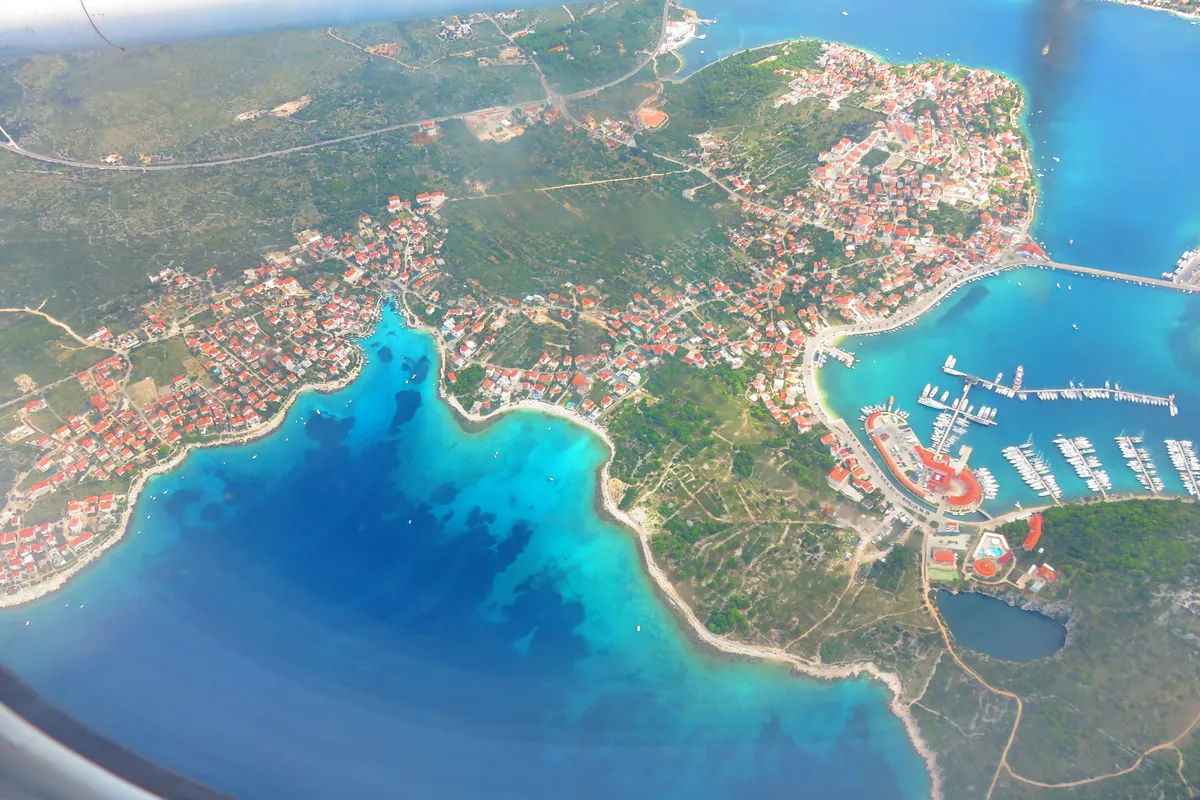
In recent weeks, swimmers in the Rogoznica and Primošten areas have increasingly encountered unusual and vibrant marine organisms. These are fireworms, whose touch can cause extremely intense and prolonged pain. Although the species Hermodice carunculata is native to the Mediterranean, the warming of the sea has triggered their mass reproduction and spread toward the northern Adriatic.
Colorful Intruders Whose Bristles Burn Like Fire
The fireworm resembles a colorful centipede in appearance. It can grow up to 30 centimeters, but specimens most commonly found in shallow waters are between 5 and 10 centimeters long. Their bodies consist of about a hundred segments, with colors ranging from greenish and brown to bright red with characteristic white stripes. It is precisely this attractive appearance that easily draws the attention of curious swimmers, especially children, which is the greatest danger.
On each body segment, there are thick bundles of white bristles that act as protection. These bristles, scientifically called chaetae, are extremely fragile and behave like tiny glass needles. Upon contact, they break off, penetrate the skin, and release a complex neurotoxin. The reaction is immediate: intense, burning pain that can last for days, accompanied by redness, swelling, and itching. In severe cases, nausea and dizziness may occur. There has been a reported case of a boy on a beach in Rogoznica who required emergency medical attention after encountering the worm. Individuals allergic to bee and wasp stings may experience even more pronounced reactions.
From the South to Krk: How Warming Pushes Worms North
Although often mistakenly described as an invasive species, the fireworm is a native inhabitant of the Mediterranean. Scientists today increasingly refer to it as a "native intruder" because its population is rapidly growing and expanding beyond its usual habitats. The key reason is global warming. The Adriatic Sea is warming, and higher temperatures favor the growth of fireworm larvae, which cannot survive in water below 22°C.
Studies along the Italian and Maltese coasts indicate a massive increase in the number of individuals. In some areas, the number of individuals is hundreds of times higher than in the 1990s. A similar trend is being recorded in the Adriatic. Once rare and mostly confined to the southern islands, the fireworm is now a regular sight along the central Dalmatian coast, and it has even been recorded further north, all the way to the island of Krk. Its spread has become a kind of biological indicator of sea warming.
A Nightmare for Fishermen: Destroying Up to 70 Percent of Catches
The problem is not limited to the safety of swimmers. Fireworms are extremely voracious organisms that feed on carrion and corals, but they also act as predators. Fishermen face great difficulties when they attack fish caught in nets or on hooks. Experiences of fishermen in Sicily show the scale of the damage: worms enter caught fish through the eyes and gills and eat them from the inside, often leaving only skin and skeleton.
According to estimates, in some places they can destroy up to 70 percent of the catch. To reduce losses, fishermen are forced to shorten the time nets remain in the sea, leading to smaller catches and additional financial losses. Research conducted in Malta estimated that fishermen can lose up to 52.5 percent of their profits due to destroyed catches. An additional problem is the practice of discarding damaged fish and unwanted bycatch back into the sea, especially near ports. This provides fireworms with a constant food source, which may further contribute to the growth of their population.
What to Do If Stung by a Fireworm?
Controlling the number of fireworms in the Adriatic is extremely challenging because they have no known natural enemies here and possess an extraordinary ability to regenerate. A cut worm can regenerate lost body parts, so mechanical removal does not solve the problem.
For swimmers, the most important thing is to be cautious. Fireworms should not be touched or approached. In case of contact, the area should be rinsed with seawater. Remaining bristles should be carefully removed with adhesive tape, not with bare hands. After that, compresses with alcohol can help, and in case of a stronger reaction, medical attention should be sought.