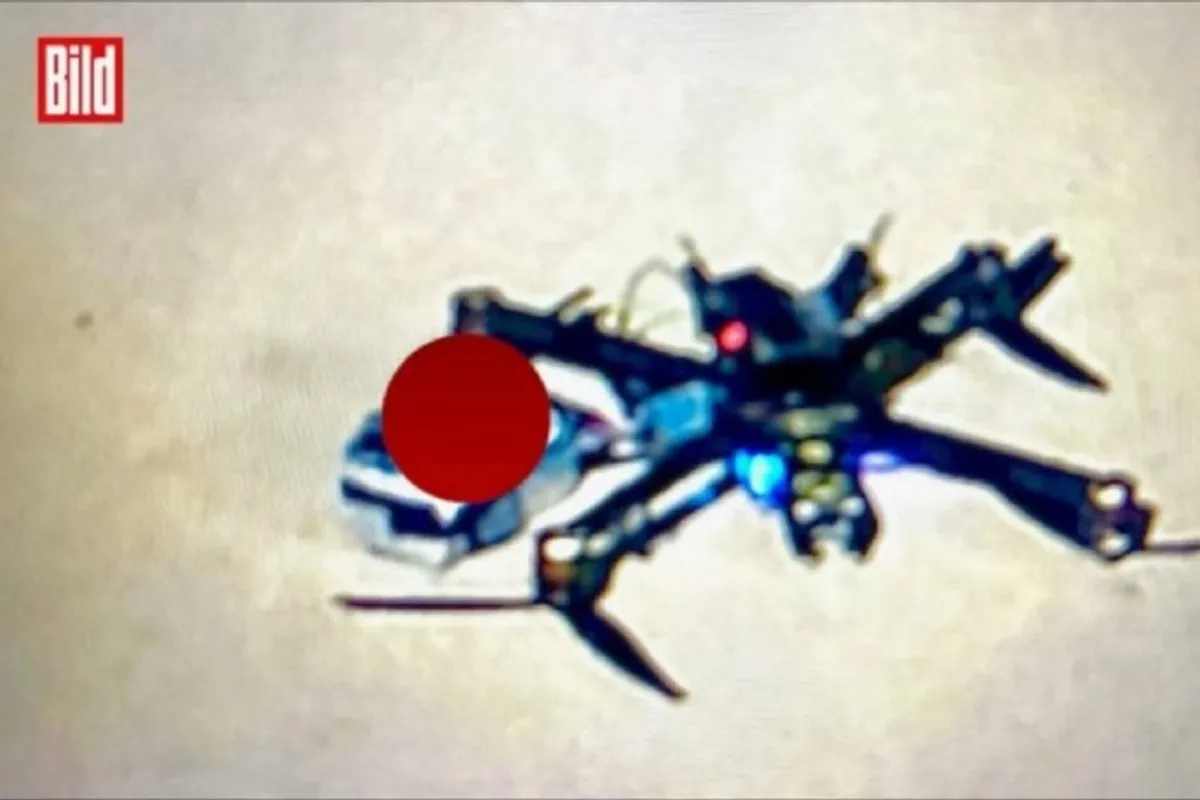
German investigative authorities have released new details about an attempted attack on the Ukrainian cargo aircraft Antonov An-124 'Ruslan' at Leipzig Airport. According to an analysis of surveillance camera footage published by Die Zeit on Monday, an FPV drone packed with the plastic explosive Semtex struck the aircraft's wing on August 4, 2026, but the explosive device did not detonate.
Attack captured on camera
CCTV footage shows the drone approaching the parked aircraft directly at around 7:30 p.m. and striking its wing. The wings are a particularly vulnerable part of the aircraft as they house the fuel tanks, indicating the attacker targeted the most critical point. After impact, the drone bounced off and fell to the ground, with marks on the Antonov's wing confirming this sequence of events.
Why the explosive did not detonate remains unknown for now. Die Zeit notes that Semtex is so powerful it would likely have destroyed the entire aircraft. The explosive device was found some distance from the drone itself, suggesting it separated upon impact with the wing.
Chance discovery by bus driver
The drone was only discovered four hours after the attack. A tour bus driver accidentally noticed the device on the ground, stopped, and alerted security personnel. Initial reconstructions suggested the driver had kicked the drone and then secured it, but surveillance footage shows the drone was already lying on the ground when he approached.
Detlef Seif, a CDU member of the Bundestag who, along with other lawmakers responsible for internal affairs, received a government briefing on the incident on Thursday, confirmed this version of events. The case was taken over by Germany's Federal Criminal Police Office over the weekend.
Professional execution and traces pointing to state actor
According to Die Zeit, the investigation so far has found no clear evidence that Russia was behind the attempted attack, but several details point to a high level of professionalism on the part of the perpetrator. The drone was not purchased from a store but was custom-built for this purpose in a manner that goes beyond the capabilities of opportunistic criminals or amateurs.
Because it was a non-commercial drone, it could not be detected by conventional radar systems. Semtex, although occasionally available on the black market, is typically a military-grade explosive. The hypothesis that a state actor was somehow involved in the attempted attack is now considered more likely than before.
U.S. intelligence agencies have linked the incident to Russia, while the Russian embassy in Berlin described the Leipzig event as a fabricated provocation. It was previously assumed that the drone might have been intended as a warning, but after analyzing the footage, that hypothesis is almost untenable: Leipzig Airport narrowly avoided a devastating terrorist attack.