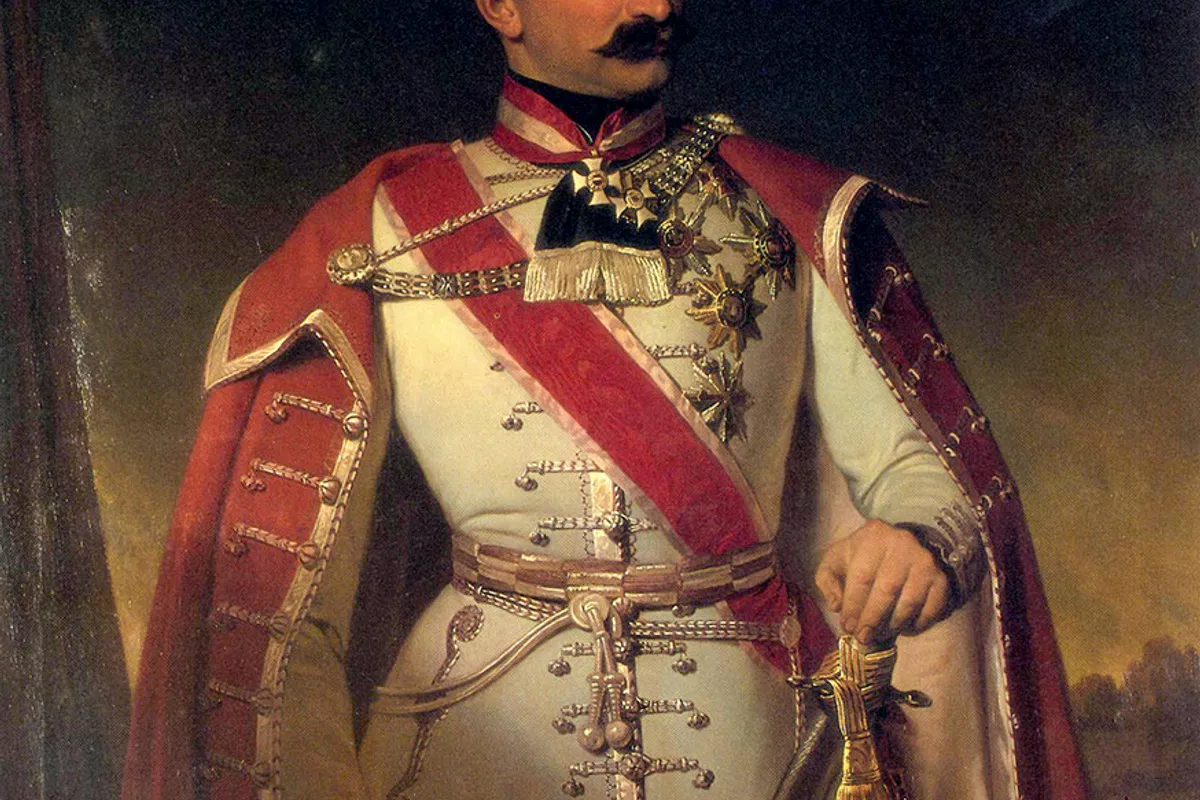
On this day, August 10, 1861, Field Marshal Lieutenant Count Đuro Jelačić stood before the representatives of the Croatian Parliament to deliver his inaugural speech as the newly appointed Vice-Captain of the Kingdom. His words, imbued with resistance to the growing Germanization pressures within the Habsburg Monarchy, resonated so powerfully that they quickly led to his dismissal and forced retirement. This act brought an end to the brilliant military career of one of the most prominent Croatian officers of that era.
Wartime Path and the Shadow of a Famous Brother
Although the surname Jelačić evokes the image of Ban Josip in collective memory, his younger brother Đuro (1805-1901) left behind a biography that is hardly less rich. He fought on the battlefields of the Italian wars, took part in the Austrian military expedition in Syria, and particularly distinguished himself in the battles of Brescia and Novara, as well as during the siege of Venice. For his demonstrated bravery, he was awarded the Military Cross of Merit and rose to the rank of Field Marshal Lieutenant.
Unlike his older brother, whose name is associated with the revolutionary year 1848, Đuro's fate was sealed precisely by that parliamentary appearance. This patriotic address became the turning point that defined the end of his military ascent.
'The Turks may be satisfied with the property and sometimes the bodies of oppressed peoples, while civilized nations demand from those they rule not only property and bodies but also their soul, that is, their nationality,' Đuro Jelačić, Field Marshal Lieutenant and Vice-Captain of the Kingdom, said on that occasion.
From Arms to Plow: A New Life at Novi Dvori
Forced retirement did not mean withdrawal from public life. Quite the contrary, it opened an entirely new chapter. At the Novi Dvori estate near Zaprešić, which he inherited from his brother Josip, Đuro threw himself wholeheartedly into economy, agriculture, and the modernization of production processes. As early as 1865, he launched the First Croatian Fruit and Vegetable Drying Facility, an undertaking that ranks among the most ambitious economic initiatives of contemporary Croatia.
On his own estate, he experimented with new agricultural crops and livestock breeds, paying particular attention to viticulture. He actively engaged in the fight against downy mildew and phylloxera, diseases that devastated European vineyards in the second half of the 19th century.
Leading Economic Transformation
His tenure at the helm of the Croatian-Slavonian Economic Society left perhaps the most profound mark. He assumed the presidency in 1873 and remained in that position until the end of his life. Under his leadership, the organization expanded its network of branches, strengthened ties with Slavonia and Dalmatia, and developed close cooperation with the Agricultural College in Križevci, one of the pillars of Croatian agricultural education.
He also strongly advocated for the development of cooperatives. It was precisely through his initiative that one of the first Croatian credit cooperatives, then known as advance societies, was founded in Brdovec in 1873. Through his efforts, the Society's representative palace in Zagreb was also erected, and he financially supported a whole range of scientific and humanitarian institutions.
Jubilee Exhibition as the Crown of His Work
The pinnacle of his public activity was the organization of the Jubilee Exhibition of the Croatian-Slavonian Economic Society in Zagreb in 1891. As president of the Central Committee, he oversaw a project aimed at showcasing Croatia's economic, agricultural, and craft achievements at the end of the 19th century. By then, Đuro Jelačić was already a member of economic societies in Ljubljana and a representative of similar organizations from Kraków and Linz, which speaks volumes about the reputation he enjoyed beyond Croatia's borders.
A New Beginning Instead of an End
History has largely preserved Đuro Jelačić as the younger brother of Ban Josip and as a man whose military career was cut short by a single speech. Yet, his greatest contribution took shape precisely in the years following his retirement. Instead of spending the rest of his life as a retired officer, he grew into one of the key drivers of modernization in Croatian economy, agriculture, and cooperatives. The story of Đuro Jelačić is therefore much more than a footnote about a conflict with Germanization policy; it bears witness to a man who, after losing his military career, found an entirely new purpose in life.