Juka Films Documentary about the Sinj Rera
The author traveled the entire route of the former narrow-gauge railway from Split to Sinj to capture memories of the legendary railroad before the last traces disappear.
The author traveled the entire route of the former narrow-gauge railway from Split to Sinj to capture memories of the legendary railroad before the last traces disappear.
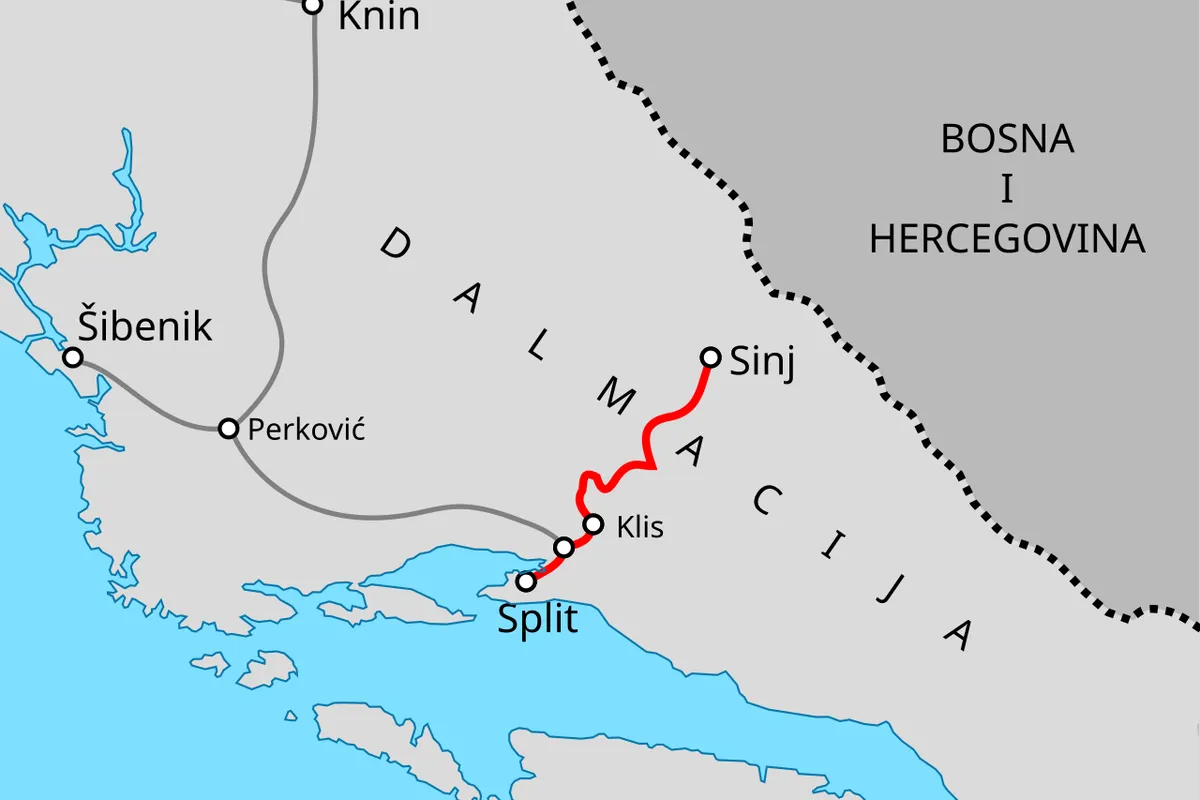
As a boy, documentary filmmaker Juka listened to his grandfathers' tales of a train so slow that passengers would get off, rest, and catch up with it on foot at the next station. These family anecdotes, told with humor and nostalgia, inspired him to follow the path of the former Sinj Rera and make a documentary about one of Dalmatia's most beloved railways.
Grandfather Slavko often asked him, "Do you know that the folks from the hinterland used to take the train to Split to sell their goods? They'd even sit on the roof when there was no room in the carriages?" These words painted scenes in the author's imagination reminiscent of exotic documentaries. On the other hand, Grandfather Jure, from the village of Nisko in the Dalmatian hinterland, remembered a different picture: "There was nothing better than having a sip of wine and singing a song with the folks all the way to Split."
Although they came from different backgrounds, both were tied to the Rera by the same emotion. "It wasn't until many years later that I realized it wasn't just about the train. It was the lifeline that connected Split, Sinj, and the entire Cetina region for decades," the author explains, adding that these stories prompted him to tour the entire route and leave a lasting record.
While railways were transforming Europe in the mid-19th century, Dalmatia remained a transport-isolated province of the Habsburg Monarchy. Goods and people moved along old caravan routes and Napoleon's roads. The first study on connecting Adriatic ports with the interior was conducted as early as 1836, but political will for implementation was lacking.
The key breakthrough came on December 21, 1898, when a law was passed for the construction of a narrow-gauge railway from Split towards Aržano, with a branch to Sinj. This was the first phase of a planned rail link to Sarajevo, which at the time took up to five days of travel. The tender for the contractor was announced in 1901, and the contract was awarded to a consortium from Split, Antićević and Company. The construction was overseen by imperial engineer Henrik Weidlich.
The work progressed at an incredible pace. By the end of 1902, almost all stations were completed, tunnels were dug, the impressive viaduct in Klis was built, and all necessary infrastructure was in place. The new line was nearly five kilometers longer than the existing road between Split and Sinj, but it was precisely this layout that allowed the steep slopes of Kosa, Klis, and Rupotina to be conquered.
The first train to Sinj departed on September 12, 1903, but not amid a festive atmosphere-rather, under heavy police escort. Locals were unhappy because station signs were in Italian and German, and the promise to extend the line to Aržano was never fulfilled. There was a prevailing opinion that the railway was not built for them but primarily for the military needs of Austria-Hungary and to connect Split with the large military garrison in Sinj.
While touring the route, the author discovered numerous hidden traces of the former railway. In Vranjic, the stone two-story building of the former Vranjic-Solin railway station still stands, almost completely hidden behind dense vegetation. The station name is still visible on the western facade, while children play carefree in the yard, unaware that thousands of passengers passed through the building for decades.
Deep beneath today's Split bypass lies the Jadro tunnel, dug in 1903. At just 118 meters long, it is the shortest on the entire route. Both entrances still preserve well-preserved Italian bunkers from World War II. Not far from there was the Kosa stop, opened in 1910, of which only a memory of a modest shelter remains.
At the foot of Klis Fortress stands one of the most beautiful structures on the entire route-the Vetmin Bridge. Built of dressed stone, about 77 meters long, with seven elegant arches, it still withstands the test of time. After the rails were removed, the bridge did not lose its purpose; a local road now passes over it.
The Tri kralja tunnel, dug in 1903 through the Greben rock, is only 123 meters long. Today it is closed and used for mushroom cultivation. The same fate befell the longest tunnel on the line, Gornja Rupotina, at 400 meters, which has also been converted into a mushroom farm. The railway station in Klis, a stone building larger than 300 square meters, thanks to the people living in it, remains the most beautiful on the entire route.
The journey from Sinj to Split took about two and a half hours, and in the opposite direction almost three hours due to steep climbs. While the bus covered the same distance in about an hour, passengers on the steam train patiently accepted the slow pace. However, what the Rera lacked in speed, it made up for in experience. From the slopes of Mosor, there was a beautiful view of Split, Solin, and the Kaštela Bay.
In the carriages, people talked, sang, ate, and traded. Farmers transported meat, vegetables, handicrafts, lambs, and chickens to the Split market. Children hid under seats to avoid paying the fare, and conductors often turned a blind eye. The Rera was used to travel to the Sinjska Alka, fairs, political rallies, to the doctor, or to school. It was a meeting place where friendships were formed and songs were sung that became part of collective memory.
The Croatian Parliament proposed the closure of the line in April 1962. The estimated cost of renovation was one billion two hundred fifty million dinars at the time, which proved uneconomical. The last ride of the Sinj Rera took place on September 30, 1962.
Signalman Marko Grbeša, who raised the whistle for the last time that day, described the moment: "That day, the last whistle of the ferata, the Rera as the people called it, was heard, and it was the saddest day of my life. With the Rera, I also died; I disappeared with its last whistle."
Today, more than sixty years after the last ride, the documentary's author wants to preserve the memory of this legendary railway. "People don't remember the locomotive. They remember the feeling of the journey," concludes Juka, convinced that the Rera was not just a train but an indelible part of the identity of the Dalmatian hinterland.