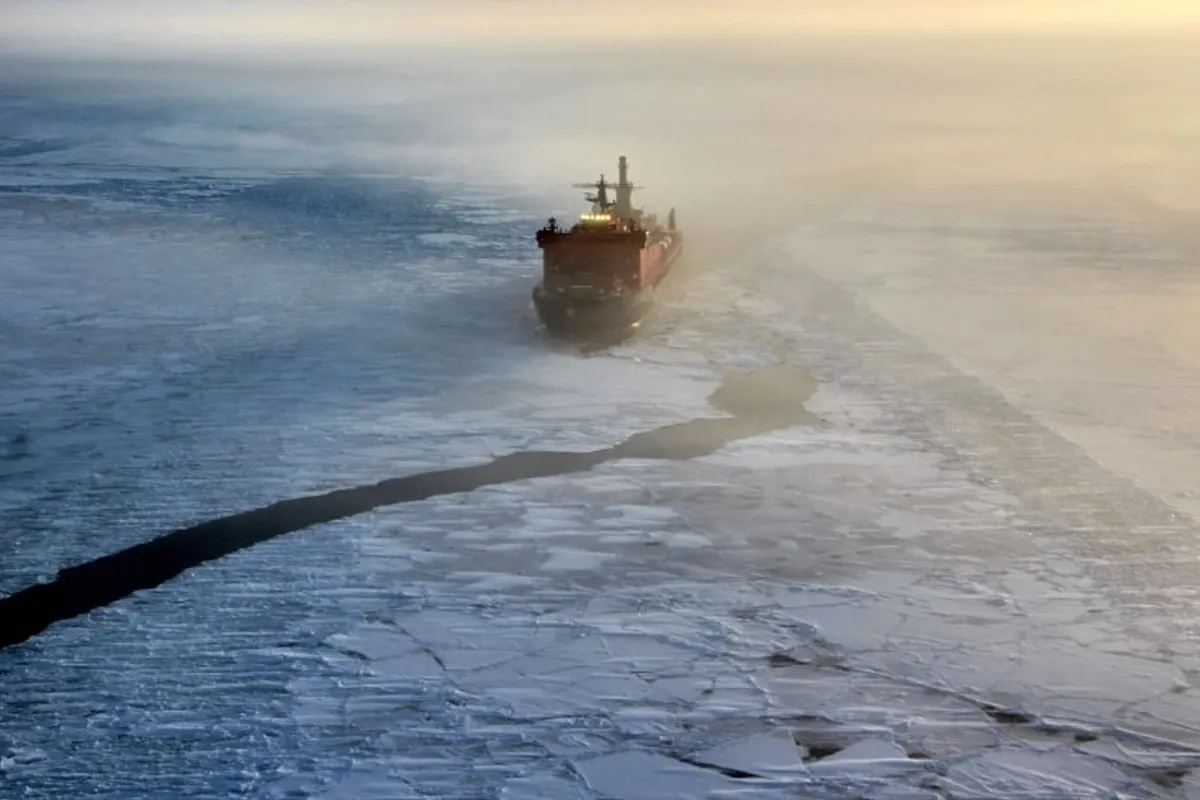
Chinese shipping company Sea Legend has launched the first regular container service through the Arctic, connecting the Chinese port of Ningbo with the UK's Felixstowe. The route, which the company has named the Polar Silk Road, runs almost the entire length of the Russian Arctic coast and shortens the voyage from about 40 days, which is the time it takes to sail through the Suez Canal, to approximately 20 days.
According to Nenad Stekić, a docent at the Faculty of Security Studies at the University of Belgrade, the company is launching the first regular China-Europe Arctic Express service with seven vessels with capacities ranging from 1,528 to 4,890 TEU. By early October, eight weekly departures are planned, with additional European ports including Rotterdam, Wilhelmshaven, and Gdańsk. Sailing is only possible from August to October, when the ice recedes enough for ships to pass.
Why now? Tensions on traditional routes
The Suez Canal has been the main link between Asia and Europe for over 150 years, but in recent years it has shown its vulnerability. When blockades were introduced on the canal in 2021 and merchant ships were attacked in the Red Sea, there were disruptions in traffic and increased costs, forcing shippers to look for other options. Sailing around the Cape of Good Hope takes about 50 days, and the China-Europe rail corridor takes about 25 days, making the Arctic route of 20 days increasingly attractive.
The main reason for the initiative is precisely the tensions around the Red Sea, the Bab-el-Mandeb Strait, and the Strait of Hormuz, Stekić pointed out. "Companies are facing constant disruptions around traditional maritime 'choke points,' especially where attacks on merchant ships have increased risks and transport costs," he said. This is particularly reflected in the so-called Malacca dilemma, China's fear of dependence on easily blockable points. The Arctic is offered as one of the answers to this dilemma, but not as a replacement, but as a supplementary route.
Russia holds the keys to the corridor
The route is unthinkable without Russian infrastructure, which is a key asymmetry in this cooperation. "China has the ships and the cargo, but Russia possesses what China does not yet have: a navigation system, ice data, emergency rescue capabilities, hydrography, and the ability to provide icebreaker escort," Stekić explained. Data from the U.S. Coast Guard shows that Russia had more than 40 icebreakers in early 2026, far more than any other country.
For Russia, this means revenue from transit fees and escort services, but also a political advantage because it controls an alternative route at a time when Western markets are partially inaccessible. Sanctions, however, are slowing the renewal of Russia's icebreaker fleet, so Moscow now uses its existing nuclear icebreakers up to 270 days a year, which carries technical and environmental risks.
Western companies have withdrawn
Major Western shipping companies such as Maersk, CMA CGM, and Hapag-Lloyd have practically abandoned this route, citing the risk of sanctions, insurance costs, and environmental reasons. That business was then taken over by smaller operators, mostly from China. Even the Chinese company COSCO stopped sailing the Northern Sea Route in 2022.
A 2026 report by Allianz Commercial warns that sanctions and geopolitics are as much a barrier to the route's development as the ice itself. Navigational risks are significant: satellite communication and GPS are less reliable at high latitudes, rescue capabilities are limited, and in the last ten years more than 500 maritime incidents have been recorded in the Arctic. The total volume of cargo through the Northern Sea Route is still negligible compared to Suez.
Environmental concerns
Advocates of the route claim it is more environmentally friendly because shorter voyages mean lower fuel consumption, but the reality is more complex. The Norwegian organization Bellona points out that the development of Arctic shipping could lead to higher black carbon emissions and negative impacts on the sensitive ecosystem. Russia's plan worth 1.8 trillion rubles has no concrete targets for reducing this impact, and Moscow has announced the use of tankers without reinforced hulls for transporting oil through the Arctic, increasing the risk of spills. Arctic ice shrank by 5.8 percent during the winter peak of 2024-2025, slowly extending the navigable period.
British port as gateway for Russian route
The fact that the British port of Felixstowe will become the European terminal for a route operationally controlled by Russia and organized by a Chinese company is one of the most striking details of the whole story, Stekić assessed. "This is an extraordinary political paradox: Felixstowe and Gdańsk are becoming terminals for a Chinese corridor that passes through Russian waters, while Europe, which has been reducing its dependence on Russian energy for the past three years, is now being offered a faster supply chain that, instead, depends on Russian permission," he said.
The service was accelerated after the closure of the Polish rail hub in September 2025, when more than 130 trains on the China-Europe route with cargo worth 25 billion euros were halted. This fits into China's Belt and Road Initiative, whose Arctic extension is the Polar Silk Road.
In 2018, in its white paper on Arctic policy, China for the first time declared itself a near-Arctic state. "What was then declarative is now taking on a concrete, regular, commercial form," Stekić concluded. However, due to seasonal limitations and Russian control, this route will likely be supplementary, not a replacement for the Suez Canal.