Collapse at Ukraine's Borders: 7,754 Trucks Stuck
After the halt of Black Sea port operations, all freight traffic has been redirected to land border crossings, creating massive congestion.
After the halt of Black Sea port operations, all freight traffic has been redirected to land border crossings, creating massive congestion.
As many as 7,754 trucks are stuck in queues at the exit from Ukraine, according to data from the official electronic tracking system for freight vehicles reviewed by the Russian news agency TASS. The sudden surge in vehicles, up nearly 50 percent in the past 24 hours, is a direct consequence of the suspension of operations at key Ukrainian Black Sea ports, which have been inactive since July 22, 2026.
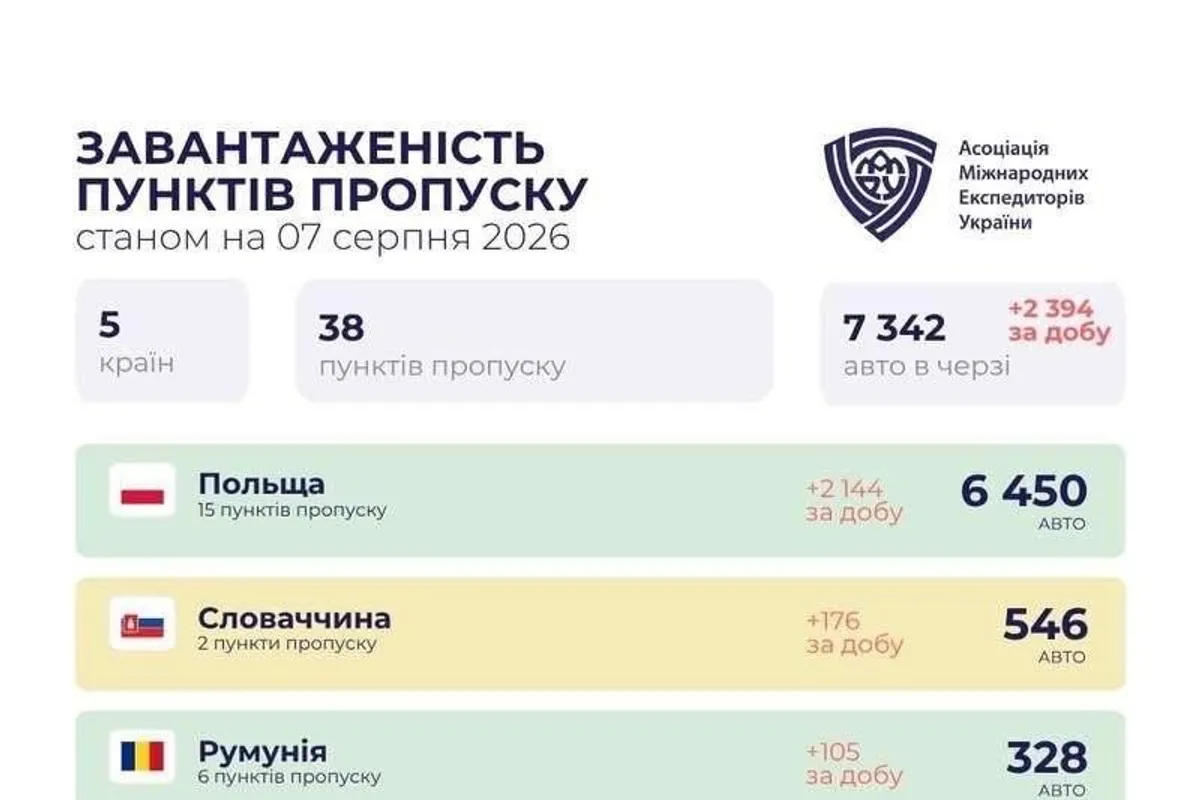
The border with Poland is under the most pressure, with between 6,450 and 6,835 trucks waiting there, depending on the source. The Telegram channel Voenacher reported 6,500 stuck vehicles, while TASS, citing the official electronic system, puts the figure at 6,835. The Association of International Freight Forwarders of Ukraine, whose data is carried by the Ukrainian channel UNIAN, reported 6,450 trucks on that stretch alone. The discrepancies in numbers are likely due to different measurement times.
The busiest single crossing is Yahodyn-Dorohusk, where 2,950 trucks are queued. Waiting times at this crossing have reached extreme levels: for loaded trucks, it exceeds seven days, while empty trucks wait more than five days to exit. UNIAN notes that for some vehicle categories, the wait is "almost seven days."
Although the situation is most dramatic at the Polish border, delays have also been recorded elsewhere. At the border with Slovakia, 581 trucks are waiting, while 325 vehicles are logged at the exit to Romania. Interestingly, congestion is most pronounced at crossings that serve standard trucks, while queues at checkpoints with a weight limit of up to 7.5 tons are significantly shorter.
The root of the problem lies in the fact that since July 22, three key Ukrainian Black Sea ports-Odesa, Chornomorsk, and Pivdennyi-have not been receiving or dispatching foreign cargo ships. These ports are normally responsible for the bulk of Ukraine's grain and metallurgical exports, and their inactivity at the height of the harvest season has forced producers to seek alternative, more expensive routes.
Goods are now being redirected to the Danube ports of Izmail, Reni, and Ust-Dunaisk, as well as via the Romanian port of Constanta, and also by road and rail toward the country's western borders. It is this sudden influx of cargo to land crossings that has led to the described collapse. Such disruptions in supply chains could also impact global food prices, including the Croatian market, which is sensitive to fluctuations in grain imports.