Musk Builds the Largest Building on Earth
The Terafab project in Texas will span 9.29 million square meters and could ultimately cost as much as $119 billion.
The Terafab project in Texas will span 9.29 million square meters and could ultimately cost as much as $119 billion.
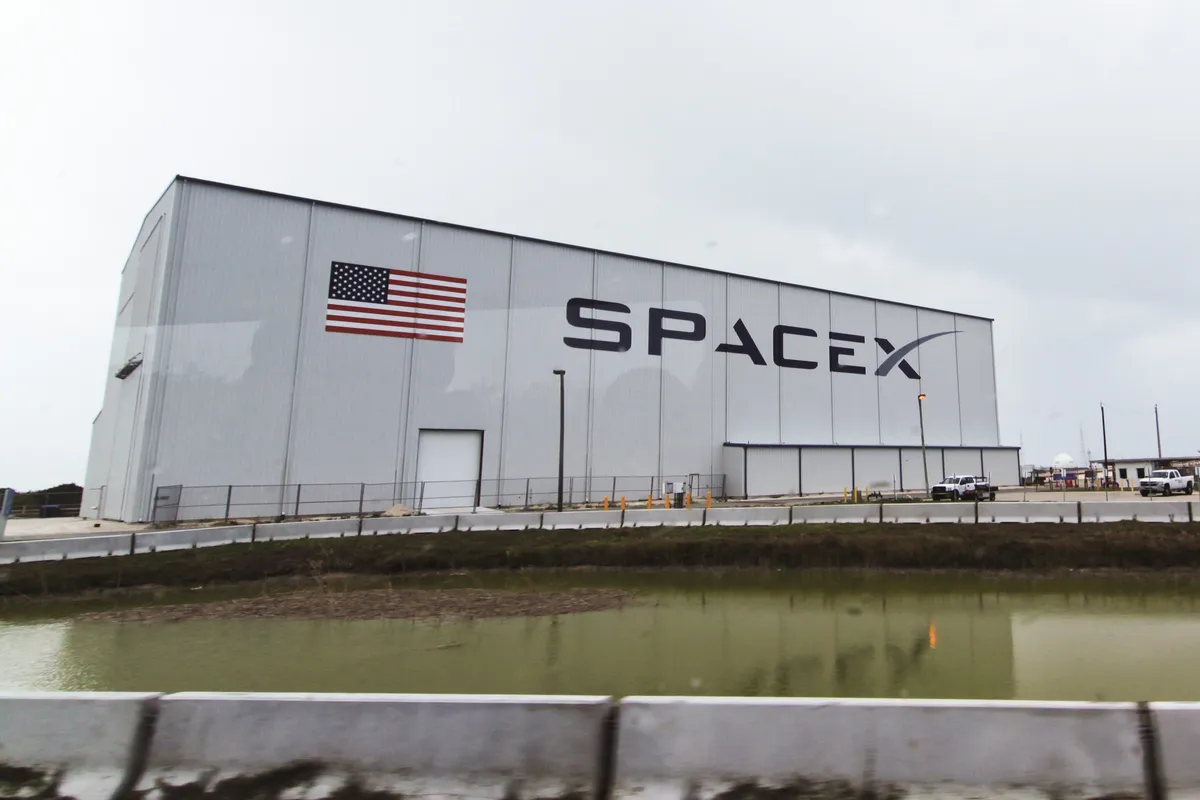
American billionaire Elon Musk shared on his platform X a visualization of the Terafab Texas project, a massive semiconductor factory he claims will be "the largest and most valuable building on Earth." The project, jointly built by his companies Tesla and SpaceX, will be located in Grimes County, Texas, just outside Houston, with the first phase of construction already estimated at $16.8 billion.
"And it will be incredibly beautiful," Musk wrote, sharing renders of the complex, the visualization of which was posted on X by Nic Cruz Patane. The visualization reveals a scale that defies previous architectural giants.
When completed, Terafab is expected to span 9.29 million square meters. For comparison, the Pentagon, currently the largest building in the U.S., covers about 613,000 square meters, while Apple Park spans 262,000 square meters. Even the Mall of America, with its 520,000 square meters, pales in comparison to Musk's project. Terafab would be larger than the Pentagon, Apple Park, and the Mall of America combined.
To illustrate the enormity, Patane posted a comparative visualization on X on August 6, showing Terafab alongside Giga Texas, the Pentagon, Apple Park, and the Mall of America. "There has never been a building of this size," his post reads. The complex is expected to be more than five times larger than the current world record holder, China's New Century Global Center in Chengdu.
The project was first brought to market in March 2026 with an initial value of $25 billion. Although that figure has been reduced to $16.8 billion for the first phase, total investments across all planned phases could reach $119 billion.
However, Terafab is not just a mere chip factory for AI processors. It is a comprehensive facility that will house the production of logic and memory chips, lithography, packaging, and testing under one roof. The goal is to produce more than one terawatt of computing power annually.
"Both Tesla and SpaceX will need far more chips than current and future global production can provide," Tesla stated, presenting the project as an existential supply issue.
SpaceX clarified on its website that "the facility will be an advanced semiconductor factory that will bridge the gap between current global chip supply and future computing demand."
Chips from Terafab will not only end up in laptops and phones. The companies plan to produce chips optimized for edge computing that will be integrated into Tesla's Optimus robots and self-driving Cybercab robotaxis. Additionally, high-power chips will be developed for SpaceX's space data centers.
The project is expected to create at least 3,000 jobs, with recruitment drawing from Grimes County and neighboring Brazos County. Tesla and SpaceX highlight that at their other Texas locations, between 60 and 80 percent of new hires came from the local population, and they expect that pattern to repeat here.
While Musk builds the largest building on Earth, his Tesla is also achieving other impressive numbers. David Moss became the first Tesla owner to drive 25,000 miles using FSD Supervised, the supervised self-driving system. "That's equivalent to one full lap around the Earth, or two years of driving for the average American," Sawyer Merritt wrote on X.
Users are also sharing personal experiences. Andy Slye recounted how his Tesla slowed down even though he didn't see an obstacle on the road. "I realized that the camera on the right pillar had seen a small deer running beside me. It slowed and braked until the deer crossed the road. The deer and I both made it home safely."
Ed, an 80-year-old from Atlanta, even sold his $200,000 Mercedes S-Class and bought a Tesla Model Y Performance specifically because of FSD. "I like the self-driving. It's really great. I feel much safer," he said.