Our Photos from Krapanj: How the Eclipse Bit the Sun over the Adriatic
The 5MIN.hr camera captured the eclipsed Sun at 7:49 PM, just a few minutes before it sank behind the hill above the Šibenik archipelago.
The 5MIN.hr camera captured the eclipsed Sun at 7:49 PM, just a few minutes before it sank behind the hill above the Šibenik archipelago.
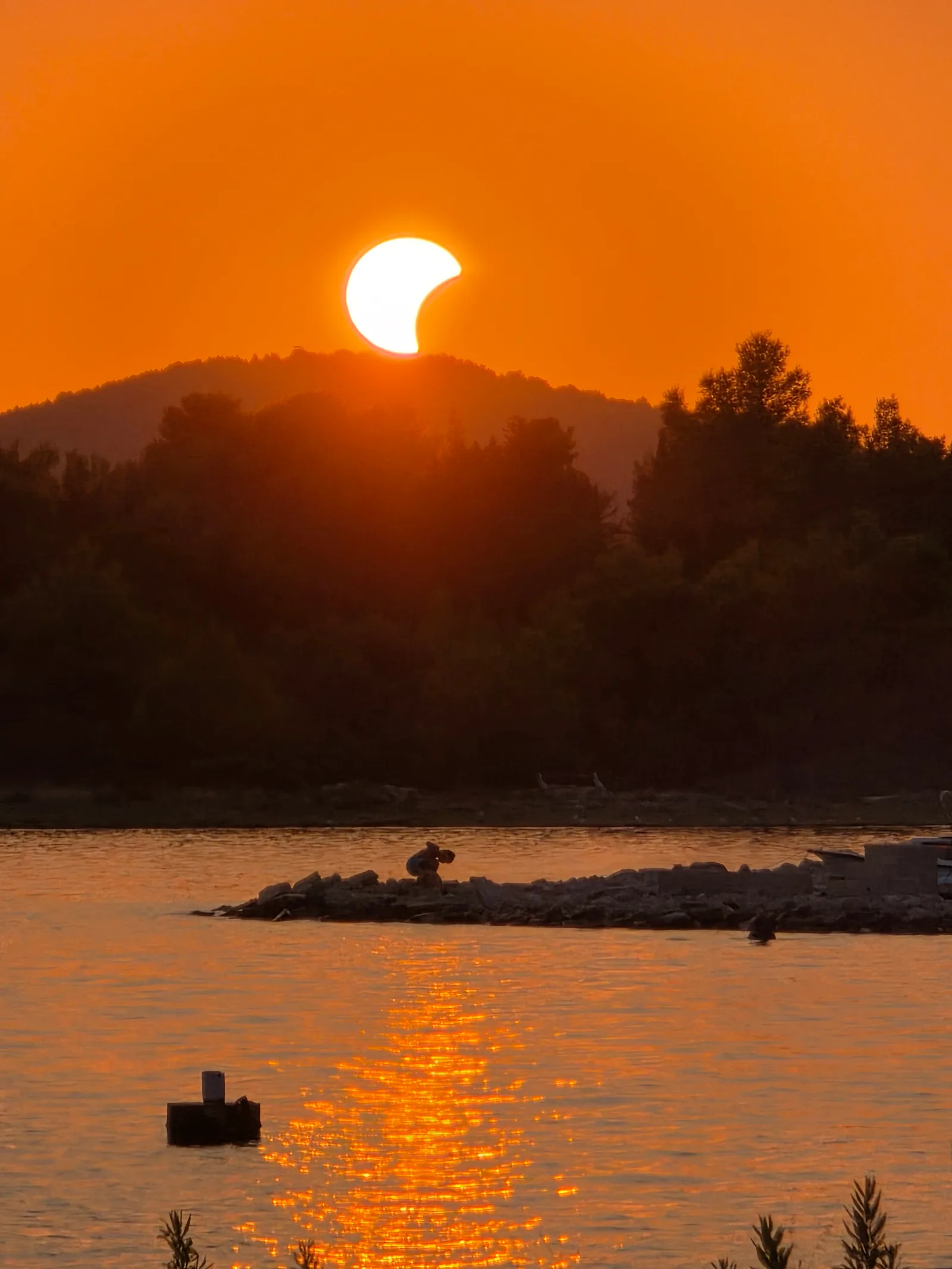
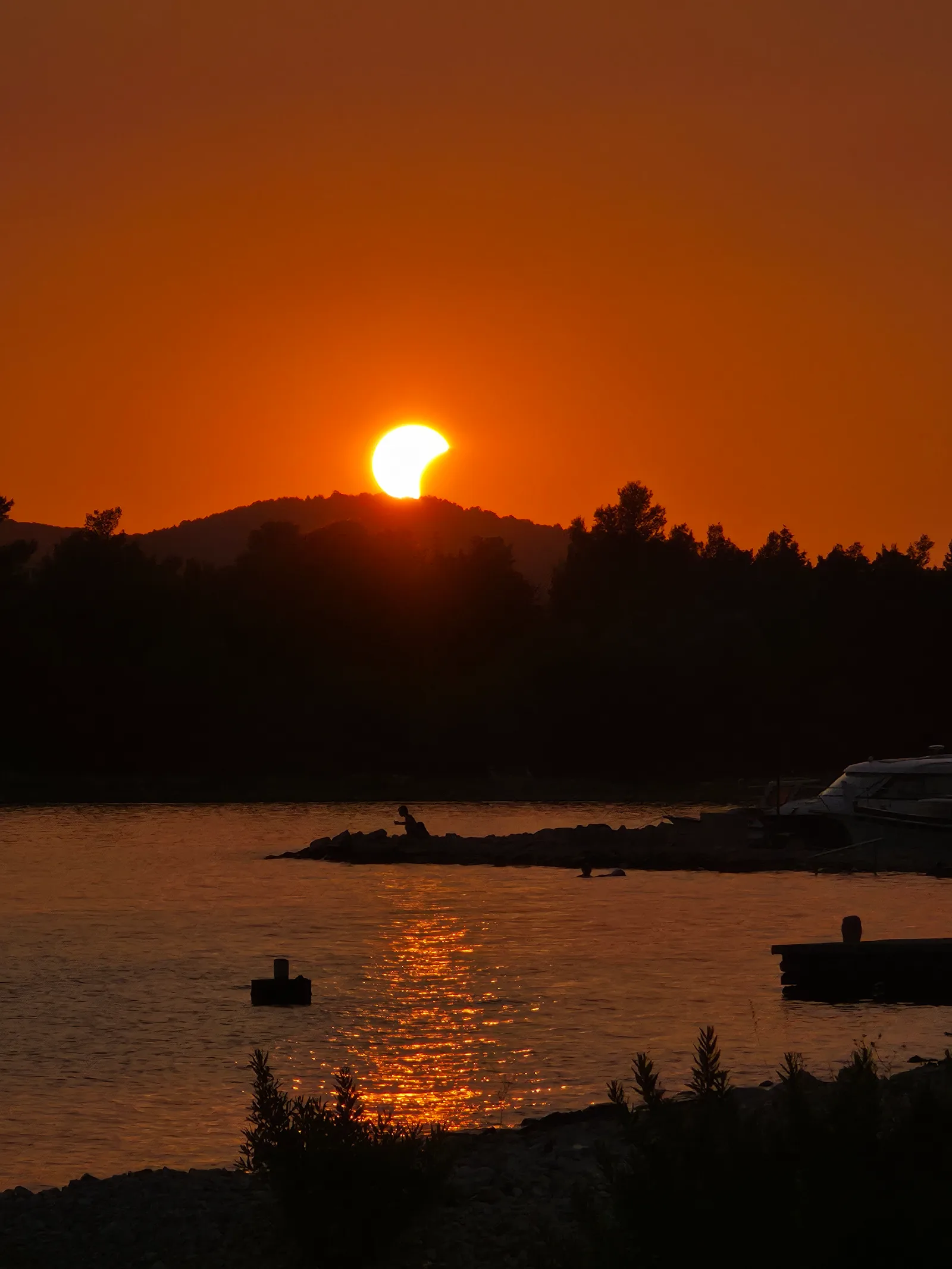
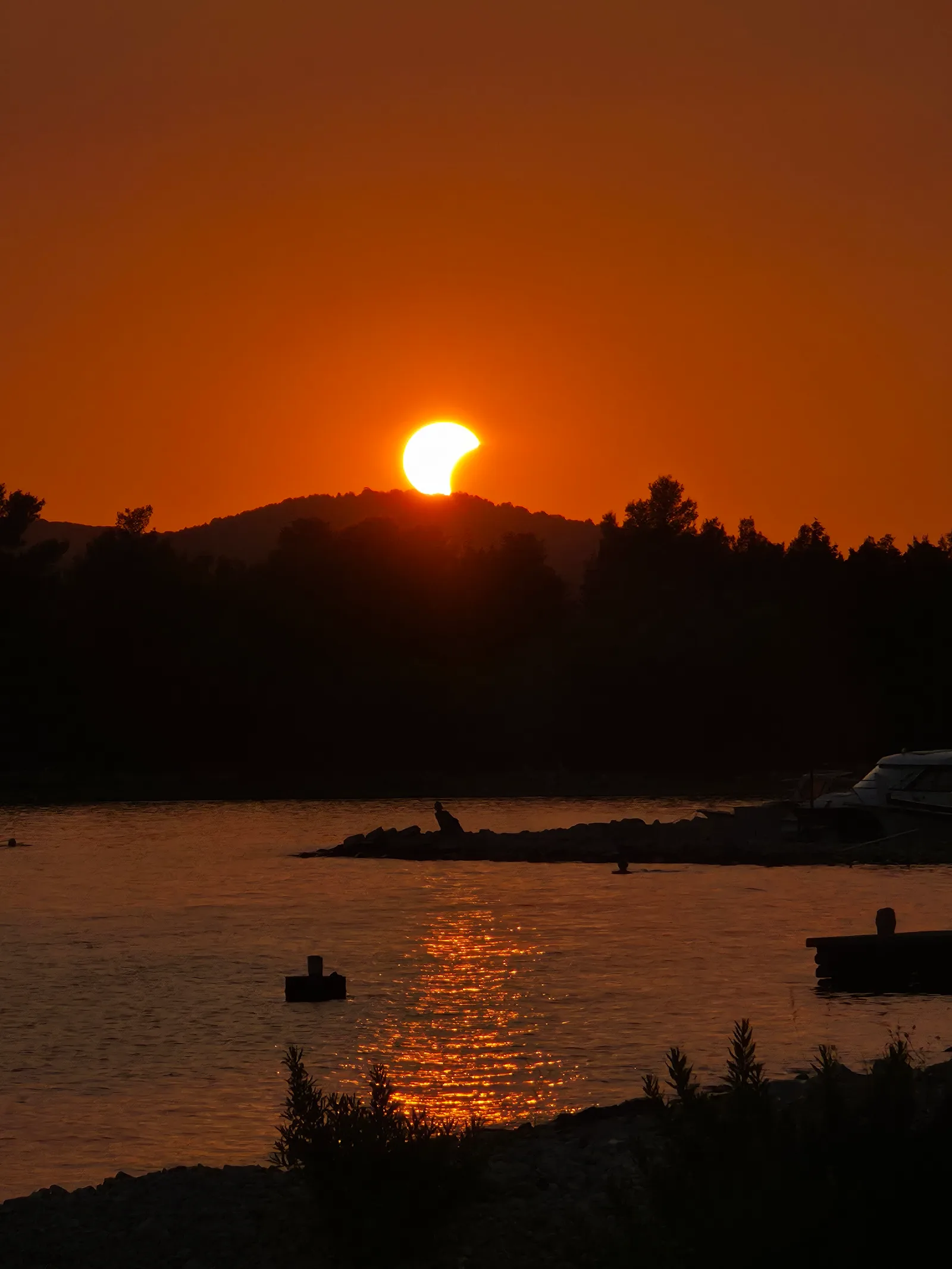
As light dimmed over the western Adriatic, a man stood on the stone breakwater of the island of Krapanj, his phone pointed at the Sun. Our photographer captured the scene he was watching at 7:49 and 7:50 PM, on Wednesday, August 12, 2026. By then, the Moon had already taken a significant bite out of the Sun's disk, and what remained hung low over the pine-covered hill, casting a golden path across the calm sea.
The photos we are publishing are our own, taken on location, without any manipulation. They show exactly what could be seen from the shore: an orange pre-sunset sky, a clear bite out of the Sun, a black buoy in the foreground, and the silhouette of an observer crouching to capture the shot.
While our photographers focused on Krapanj, other spectacular scenes unfolded across Croatia. In Zaton near Zadar, the Moon gradually covered part of the Sun's disk, and the Sun and Moon together descended toward the sea horizon, creating one of the most striking sights of the evening. On Kolovare Beach in Zadar, swimmers jumped into the sea and posed, creating silhouettes against the orange sky, while acrobatics on a ring got an unusual natural light backdrop. Particularly impressive photos were also taken at Punta Planka near Rogoznica, where the partially obscured Sun descended toward the Adriatic, and from Vela Luka came images of the Sun looking like a glowing sickle before sunset.
In Zagreb, many citizens gathered at the plateau of the Observatory, the Jarun embankment, and other spots with an open view to the west. Especially attractive photos were also taken on Sljeme, where astronomers and photographers set up telescopes and other equipment to follow the phenomenon. Eclipse viewing glasses, which were hard to find in stores before the event, were seen everywhere tonight. There was also a scramble for spots at the observatory in Varaždin.
The Zagreb Observatory explained that this year's partial eclipse coincided with sunset, so its maximum phase occurred only after the Sun had already disappeared from view. From Croatia, only the first, but visually most rewarding part of the event was observed-the one during the golden hour.
The percentage of obscuration increased toward the northwest. Residents of Istria and Kvarner saw the most: in Poreč, the Moon covered 89.44 percent of the Sun's disk, in Pula 86.30 percent, and in Rijeka 85.05 percent. Zagreb recorded 77 percent. Farther south, the numbers drop: in Knin, 60.62 percent starting at 7:28 PM, in Split 54.27 percent at 7:29 PM, and Dubrovnik saw the least, 34.05 percent. The Šibenik area, where Krapanj lies, falls between the Knin and Split values. The Sun set between 7:53 PM and 8:17 PM, depending on location.
The warning astronomers repeat every time applied tonight as well. "It is important to emphasize that you should never look at the Sun with the naked eye or through binoculars or a telescope without proper protective filters," said the Zagreb Observatory. Sunglasses, smoked glass, and improvised solutions do not protect; only certified filters marked ISO 12312-2 are allowed. The danger is insidious because the eye does not feel pain during exposure, and just a few seconds can permanently damage the retina.
What appeared as a bite from Croatia turned into a brief night along a narrow band across Iceland, northern Spain, the Balearic Islands, and Greenland. Madrid, outside the zone of totality, recorded 99.96 percent obscuration. Continental Europe had not seen a total eclipse since August 11, 1999, so the 27-year wait drove many to travel.
For those who missed the sight tonight, the next opportunity comes on August 2, 2027, when a partial eclipse will again be visible from Croatia. However, a total one is a generational wait, occurring on September 3, 2081.
After the Sun set, the show continued. That same night, from August 12 to 13, the Perseids reach their peak. Conditions this year are exceptional because the Moon is new, so its light does not interfere with observation. Estimates suggest 80 to 100 meteors per hour, with the strongest activity expected after midnight, until dawn.
No equipment is needed for the Perseids. Just lie down, look up, and give your eyes twenty to thirty minutes to adjust to the dark. An island without streetlights, like the one where these photos were taken, is better for this than any city backyard.