The New Cold War: The Race for AI Dominance
While Washington treats advanced AI models like nuclear weapons, Beijing shares them as open source, creating two opposing global blocs.
While Washington treats advanced AI models like nuclear weapons, Beijing shares them as open source, creating two opposing global blocs.
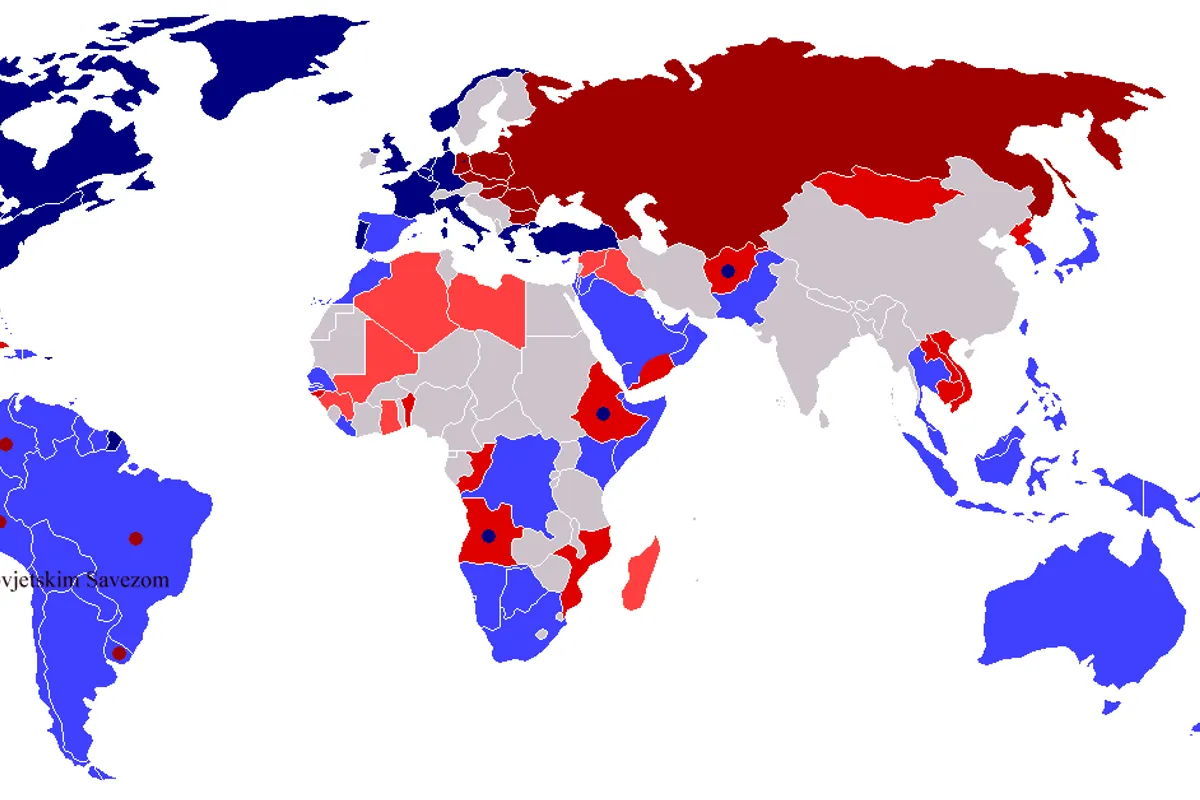
For decades, the world watched the nuclear arms race between superpowers. Today, a new, equally consequential struggle is unfolding before our eyes. China and the United States have entered a relentless race for supremacy in artificial intelligence, and their approaches could not be more different. While Washington views frontier AI models as potential weapons of mass destruction, Beijing sees them as tools of soft power to be shared with the world. Adding to the tension are occasional attacks on China by President Donald Trump, which coincide with Chinese technological breakthroughs.
American columnist Ross Douthat draws a clear parallel with the early Cold War. He recalls how Washington and Moscow then "treated nuclear technology as a tool of soft power and diplomacy-something to be shared and exported, a seal of alliance and a sign of friendship." During Dwight Eisenhower's presidency, the U.S. launched the Atoms for Peace program, while Moscow shared technology with Eastern Bloc countries and Mao's China.
Today, history repeats itself, but with artificial intelligence in the leading role. "The United States is acting as if frontier AI models could be the equivalent of nuclear weapons, offering a highly destructive form of power that requires careful and jealous monitoring," Douthat explains. American tech leaders, he argues, constantly speak as if they are in an Oppenheimer-style race.
China has chosen the opposite path. It treats its AI models as lower-risk technology, something that can be commercialized and shared to win allies and undermine Silicon Valley's dominance. "We don't yet have a Chinese model that surpasses ours, but this week a model was introduced that could come close-Kimi K3 from Chinese company Moonshot AI," Douthat notes. Beijing offers this model, like all previous ones, as open source, without any concern about the risks, guardrails, and export controls that the U.S. imposes.
"American AI companies and the national security state seem to assume that we are already at a point where we simply cannot allow the world to use the best AI models without controls and guardrails," Douthat warns. On the other hand, the Chinese are ready to shrug and leave security concerns to the U.S., operating on the assumption that AI is a normal technology whose safety issues will be resolved along the way.
A turning point in this global race occurred in mid-July 2026, when the World AI Conference was held in Shanghai. Chinese President Xi Jinping called on countries to seize the "historic opportunity" of open-source AI, promising assistance to developing nations. At the same time, he warned of the emergence of "new historical injustices" due to unequal access to technology.
The day after the conference, China launched the World AI Cooperation Organization (WAICO), which 29 member countries joined. Xi called the organization a "milestone in the history of global AI development." On the other side, Washington is rallying 35 countries behind its Declaration on AI Opportunities. The only country supporting both initiatives is Kazakhstan.
"Xi's message is clear: China will not follow anyone in AI technology or standards. Instead, China will lead the world in both aspects," interprets George Chen, head of digital practice at consultancy The Asia Group. Alfredo Montufar-Helu, managing director at Ankura China Advisors, told Reuters: "You have the leader of the world's second most powerful country, a country that continues to make real technological progress despite everything happening with the U.S., standing up and presenting China's stance on AI."
Estimates of how far China lags behind the United States hover around six months. "That's not a huge advantage," warns Graham Webster, a professor at Stanford University. Over the past 18 months, Chinese companies have been intensively releasing open-source models, with DeepSeek drawing particular attention-a company originally part of a hedge fund that developed AI for sophisticated financial models.
A key constraint for China is U.S. export controls on the most advanced semiconductors. "The U.S. has export controls on the most advanced semiconductors, which are essentially produced by Nvidia, and has prevented their official sale to China," explains Kyle Chan, a foreign policy fellow at the Brookings Institution. Only watered-down versions of the chips are allowed for sale, forcing China to develop its own capabilities, with Huawei leading the way.
While America focuses on frontier models, China is strongly oriented toward practical AI applications and robotics. Kyle Chan describes daily life in Chinese cities: "In major Chinese cities, you can see autonomous robots delivering packages and food. In restaurants, you might see a robot waiter bringing food." In hotels, robots deliver orders to rooms, and autonomous cars and drone delivery are increasingly common.
In Shanghai, Xi Jinping announced that "China will provide AI training and develop AI cooperation centers with BRICS countries, ASEAN, Latin America, and the African Union."
The seriousness of the moment is underscored by an appeal from Pope Leo, who in his encyclical described AI as a "valuable tool that requires vigilance." Cultural critic Anton Barba-Kay, writing in The Hedgehog Review, asks: "Must we already declare such an age?" and suggests the Pope instead call for an "age of resistance to AI." Some critics go so far as to compare the Pope's words to claiming that "cocaine can be a valuable drug to snort with a pinch of salt."
New York Times columnist Ana Swanson adds that America is at a crossroads and must decide whether to use "China's cheap and advanced battery technology" or spend significantly more to develop an independent supply chain. The tech war, which began with 5G technology and Washington's attempts to prevent Chinese companies like Huawei from building global infrastructure, has now expanded far beyond telecommunications to encompass robotics and artificial intelligence.