The global military balance and geopolitical tensions in the Middle East have reached a point that could irreversibly alter the structure of global power, warned Lawrence Wilkerson, a retired U.S. Army colonel, during an appearance on the YouTube channel "Dialogue Works" with host Nima Ali.
Aircraft Carriers Out of Harm's Way
Regarding the deployment of the U.S. Navy, Wilkerson noted that key warships and aircraft carriers are currently positioned in the Indian Ocean, roughly a thousand nautical miles from the Strait of Hormuz. According to him, moving closer is not an option because the threat of being destroyed and sunk is all too real.
The former symbol of American imperial power and its capacity to project force across the planet, aircraft carriers no longer hold that role, he emphasized. The destruction or sinking of several such vessels would dramatically confirm that failure, Wilkerson added.
Nuclear Weapons as a Last Resort
In Wilkerson's assessment, a potential American defeat in this conflict would represent a fundamental collapse of the empire, with consequences far surpassing the withdrawals and wars in Afghanistan, Iraq, Somalia, and Libya. He expressed concern that the moment the oligarchs and ruling circles in Washington realize America is losing ground, they might reach for the nuclear arsenal. He claims this option is already being discussed within circles close to Donald Trump, specifically in the context of a potential strike on Iran.
Internal Tensions and Resource Strain
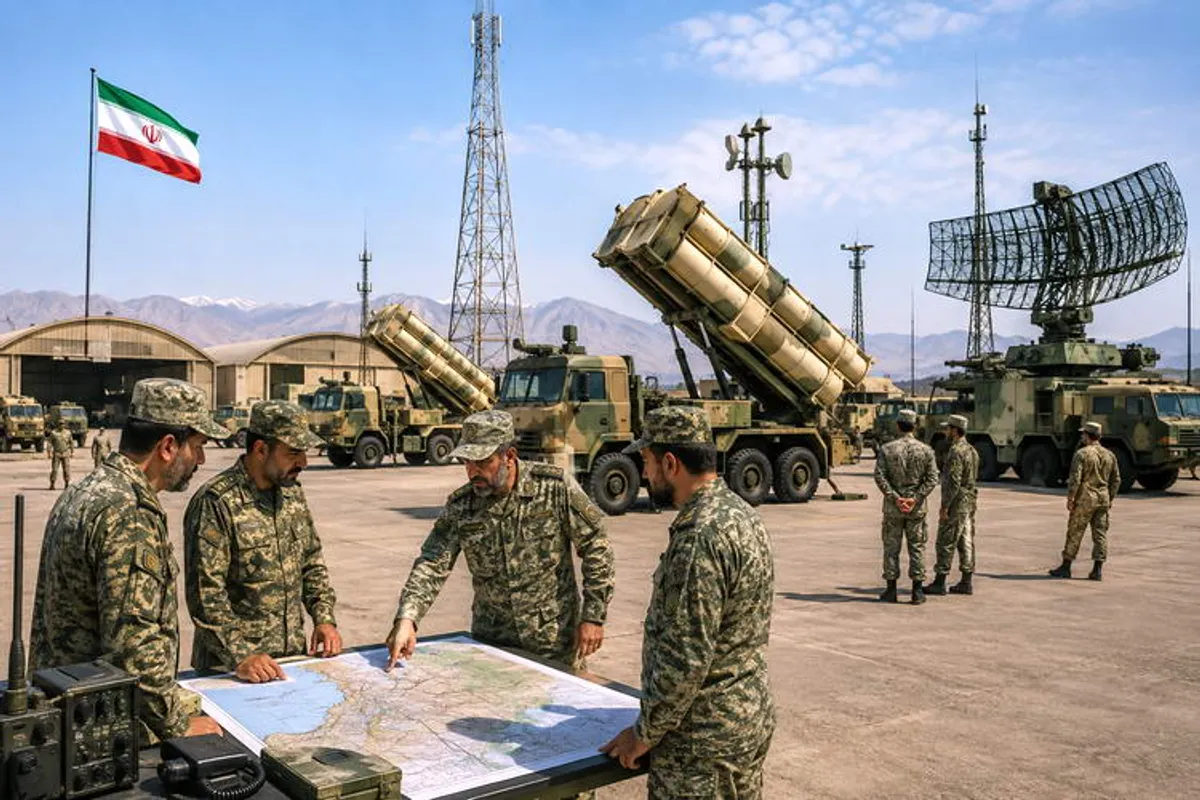
Commenting on the pressure facing the U.S. military command, Wilkerson revealed that commanders of operational sectors for Europe, Africa, and the Pacific are intensely pressuring General Caine. Their opposition concerns the rapid depletion of ammunition stockpiles and the sharp reduction in the number of "Patriot" and "THAAD" defense systems, warning that resources crucial for executing war plans in other global locations are being exhausted.
So far, he added, these commanders are not succeeding in changing the stance of Donald Trump and his associates. Wilkerson describes Trump's approach as a complete lack of a clear plan and constant vacillation.
Questionable Feasibility of Strait Operation
Analyzing a hypothetical military operation to reopen the Strait of Hormuz, Wilkerson expressed doubt about the actual capabilities of the U.S. military. He questions how Admiral Bradley Cooper, head of U.S. Central Command (CENTCOM), even intends to guarantee navigational safety when he keeps carriers far from the operational zone out of fear. To establish at least temporary air superiority and protect traffic near the port of Chabahar, carriers would need to enter an area where their aviation could operate without excessive reliance on aerial refueling. Wilkerson asserts that the Iranians are fully aware of this and are prepared to destroy one or two American carriers as soon as they enter that space.
A Series of Incidents and Escalation
Host Nima Ali referenced a statement from the Islamic Revolutionary Guard Corps (IRGC) from two days prior, stating that the blockade is considered a direct declaration of war and that there is no room for a ceasefire or negotiations, except for contacts between Iran and Oman regarding exchanges. Mediation initiatives are still being attempted by Pakistan and Qatar.
He also recalled a recent drone attack on the Saudi refinery at Jama, for which no one claimed responsibility, prompting speculation that Riyadh is either disseminating false information or preparing a joint attack with the U.S. on a portion of Iraqi forces. He also mentioned a drone attack on American ships in Egypt. While The New York Times reported that Iran was behind it, Iran's foreign minister denied this, emphasizing that they consider Egypt a friendly country, a denial later corroborated by an Egyptian government investigation.
Disintegration of the Alliance Network
Wilkerson believes these incidents are tactical in nature but have the potential to escalate in an instant into operational-strategic conflicts. He stressed that Saudi Arabia is sinking into increasing isolation and will find it difficult to continue its previous course of relying on the U.S. A similar trend of distancing is noticeable in Kuwait, Qatar, the United Arab Emirates, Oman, and Bahrain. The entire structure in the Persian Gulf is collapsing, which will ultimately force America to leave the Gulf region and Southwest Asia.
Regarding Saudi Arabia's nuclear ambitions, Wilkerson states that Riyadh conditions its survival on an agreement that would allow it to develop such a program, but Trump has said this is feasible only if Saudi Arabia signs the "Abraham Accords." The Saudis refuse as long as there is no viable path toward the creation of a Palestinian state, because abandoning that demand would trigger serious unrest on the streets.
Responsibility and Global Consequences
Wilkerson concluded that all these factors lead to the expulsion of the U.S. from the region, the collapse of the Gulf Cooperation Council (GCC), and a global conflict. He characterized the conflict in Southwest Asia as Donald Trump's choice, while the war in Central Europe he called a proxy war chosen by Joe Biden, with support from allies in London, Paris, and Berlin.
He also confirmed that attacks on Bahrain and Jordan have virtually destroyed all early warning capabilities the U.S. had in the area. When asked whether the Saudi leadership understands it is heading toward a scenario where it could become "Ukraine 2.0," given that Ukraine, after losing key ports around Odesa, has been turned into a completely dysfunctional state, Wilkerson replied that he is not sure Ukraine can even be considered a state in its current condition.