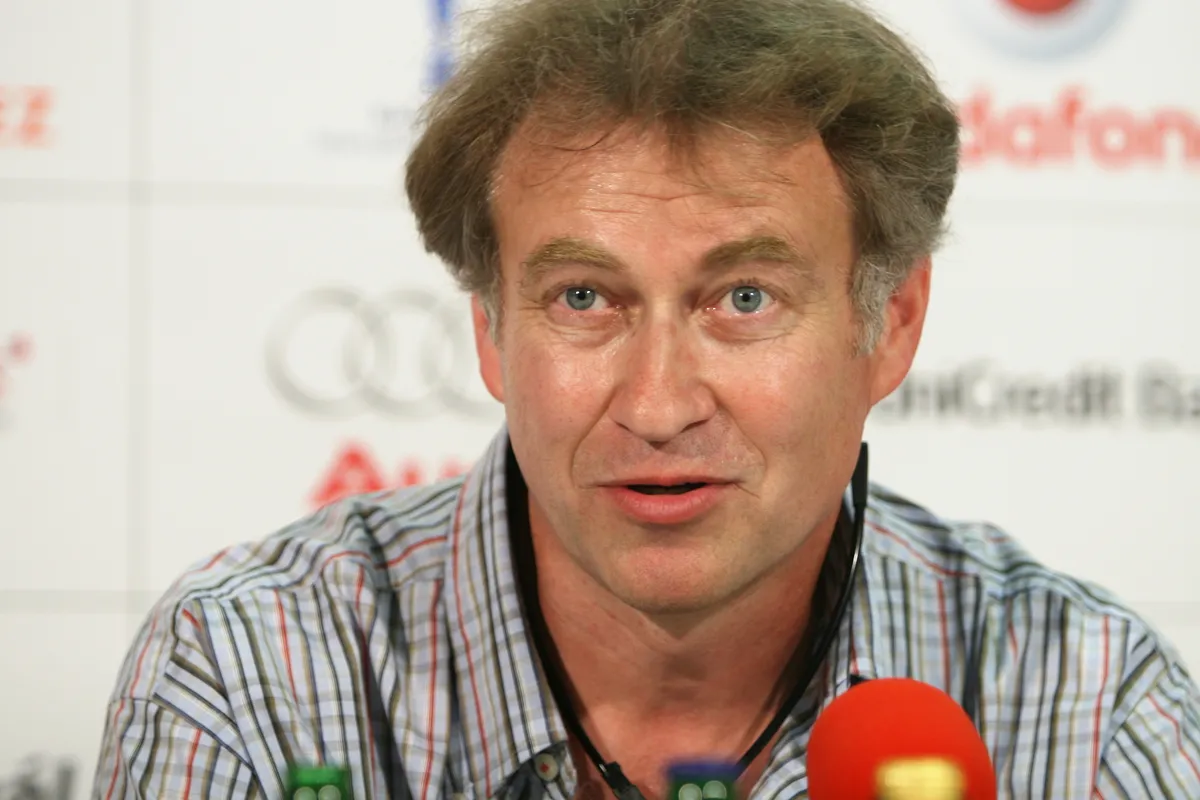
The author of this text found himself near the British Film Institute (BFI) in London when news of Zrinko Ogresta's sudden passing (October 5, 1958 - July 3, 2026) reached him. Just before, a screening of John Woo's action thriller "A Better Tomorrow 2" was about to begin. The symbolism was inevitable: the institution of film, the cinema, and in mind a man who marked Croatian cinematography for over three decades.
Ogresta did not belong to the genre world that Woo built. His closest encounter with action was "Red Dust" (1999), a crime drama partly influenced by the first "Rambo." However, his influences were found in Eastern Europe, among auteurs like Krzysztof Kieślowski and Zdeněk Svěrák, not in the Far East.
Despite that, Ogresta was an institution for Croatian film, a national treasure, and one of the most significant directors since the 1990s. His works won as many as four Big Golden Arenas, and he remained the most steadfast domestic author, always thoughtful in approach and communicative with a mature audience.
From "Fragments" to "The Blue Flower": A Chronicle of Croatian Reality
From his first feature film, "Fragments: Chronicle of a Vanishing" (1991), shot at the dawn of Croatian statehood, Ogresta positioned himself as an author preoccupied with the individual and society. He specialized in bleak existential dramas, mostly socially critical, with heroes from the working class and an unvarnished view of Croatian everyday life during post-war and post-communist transition.
The debut was striking: a story about a dissident family told through multiple time levels, a narrative device then rare in domestic cinema. "Fragments" was nominated for the European Film Academy award in the debut category, and at the first Croatian Film Days, it won the Oktavijan for best feature film.
A similar mosaic structure marked the bitter drama "Here" (2003), the absolute winner of the Pula Festival, which received a special jury mention in Karlovy Vary and the Krzysztof Kieślowski Award in Denver. In the manner of short stories, the film painted a grim picture of Croatia after the post-war hangover, connecting the fates of a disillusioned veteran, a young heroin addict, and a lonely retiree.
He also won Pula with "Washed Out" (1995), a social drama about a girl living in a dysfunctional family who seeks space for intimacy with her soldier boyfriend. In "Red Dust," he tackled privatization and touched on genre cinema.
The Rise from "Behind the Glass" to "The Blue Flower"
Although many consider Ogresta's most prolific period to be up to "Here," his creative ascent came with "Behind the Glass" (2008) and lasted until "The Blue Flower" (2021). "Behind the Glass" revealed him as a director of emotional, melancholic melodramas through a love triangle with a tragic outcome, featuring Leon Lučev, Daria Lorenci, and Jadranka Đokić.
"The Blue Flower," focused on a divorced middle-aged woman quietly in love with her married boss, composed a bouquet of blue emotions. Both films rank among the most emotional Croatian dramas.
Ogresta took his artistic experiment to the end in "Projections" (2013), his most virtuosically directed but also least well-received work. The action takes place in a single space and in real time, following group psychotherapy as a mirror of the collective Croatian psychosis.
The metaphysical undertone from "Projections" and "Behind the Glass" was further developed in the drama "On the Other Side" (2016), with a provocative premise about a woman trying to revive love with her husband, a war criminal. The film rests on the acting dialogue of Ksenija Marinković and Lazar Ristovski and a final twist.
An Unfulfilled Dream: A Film About the Vukovar Hospital
There could have been more such films. Ogresta hid additional "blue flowers" in his bouquet. In a 2021 interview for Slobodna Dalmacija, he stated:
"I would be overjoyed if I had the luck to make a film about an event from our recent history that has marked us so much, say, about the Vukovar hospital; the fact that I don't have such a film in my biography is frustrating for me."
He also revealed that he had thoroughly worked on a script for a new film with Živorad Tomić, which passed two competition phases and reached the final, production stage. But filming never happened because the HAVC rejected the project, as well as at least two others. Crushed by this, Ogresta turned to theater. A director of his reputation did not deserve to be ostracized from Croatian cinema at the end of his life.
After his death, only "The Blue Flower" and "Washed Out" were shown on HRT. There remains hope that the director will receive a full retrospective in the foreseeable future.