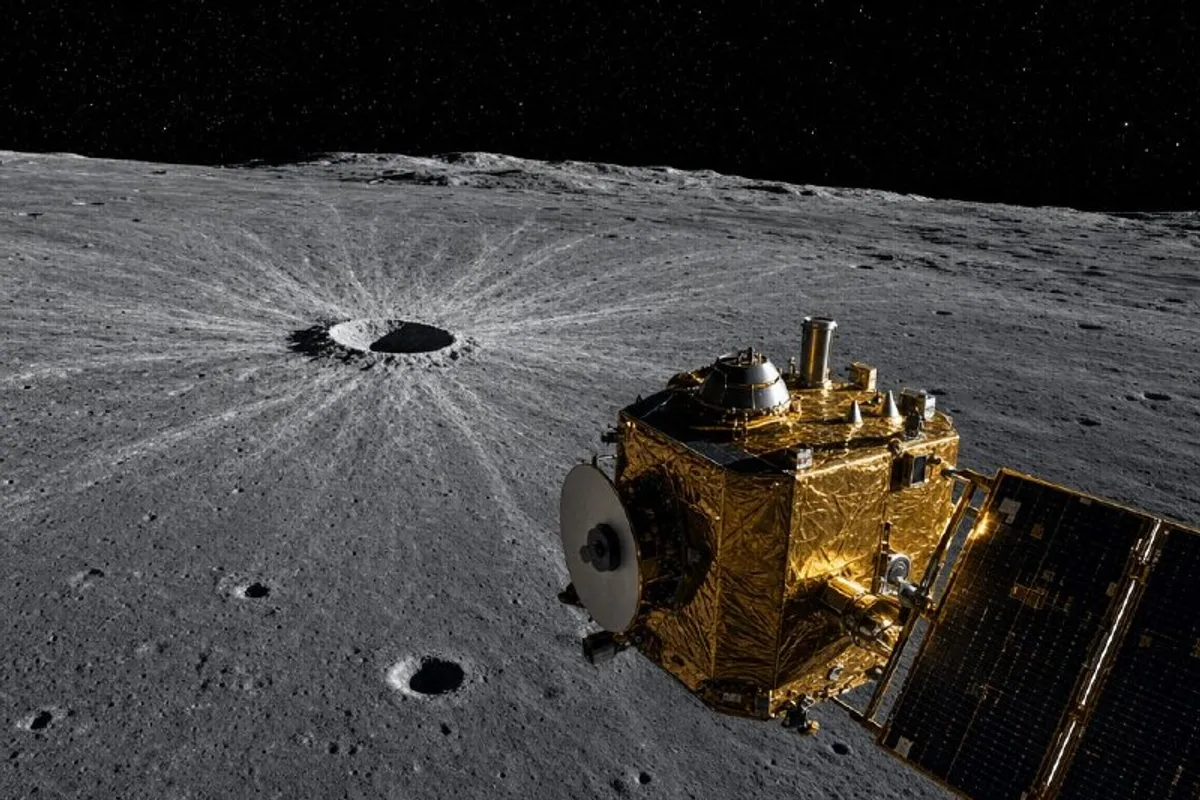
South Korea's space agency, KARI, has released the first photographs of the spot on the Moon where the second stage of a SpaceX Falcon 9 rocket crashed on August 5, 2026. The images, taken by their lunar orbiter Danuri from an altitude of about 100 kilometers, clearly show the newly formed crater and traces of ejected material, confirming what astronomers had predicted.
What makes this event particularly valuable for science is that Danuri managed to photograph the area both before and after the impact. The orbiter began observing about thirty minutes before the predicted crash and, over eight passes above the site, located near the Einstein and Bell craters, documented the resulting changes. "Danuri obtained images before the impact and immediately after, allowing for analysis of changes caused solely by the collision and providing important research data," KARI stated.
A 27-Meter Crater and a Cloud of Lithium
While earlier estimates suggested a crater up to 30 meters in diameter and 5 meters deep, more precise analysis of the images indicates that the resulting scar on the surface is nearly 27 meters wide and several meters deep. These orbital observations are complemented by ground-based data. Using the Very Large Telescope (VLT) in Chile, astronomers detected a cloud of sodium and lithium rising from the surface immediately after the impact. Scientists believe the sodium originates from the lunar surface, while the lithium may come from the rocket itself, providing the final proof of the collision.
NASA's Lunar Reconnaissance Orbiter (LRO) is expected to image the area in the coming days, providing higher-resolution pictures and even more accurate measurements of the crater's dimensions.
The Mission and the Disputed Nature of the Impact
Details about the rocket's launch and mission vary depending on the source. The rocket was launched in January 2025 and successfully completed its mission of delivering lunar landers. On the other hand, the Logično portal claims the rocket was launched in January 2026 and carried two specific spacecraft to the Moon: the Blue Ghost lander from Firefly Aerospace and the Japanese Resilience module, which missed its soft landing and crashed into the surface.
Sources also disagree on the nature of the impact itself. 24sata describes the event as an unforeseen collision, an accident that occurred after more than a year in an unstable orbit. The Logično portal, however, claims it was a planned event, explaining that SpaceX intentionally lets the rocket's second stage, which is not designed to return to Earth, fall onto the Moon.
SpaceX: Controlled Deorbiting Isn't Always Possible
SpaceX itself explains that this involves complex orbital mechanics and that such outcomes are not always under their direct control. "For most of our missions, we plan a controlled deorbit of the Falcon second stage so it safely enters the atmosphere over the ocean. For higher-energy missions, like those heading to a lunar transfer orbit, nearly all of the vehicle's power is dedicated to successfully placing the payload into its intended orbit, so a controlled deorbit maneuver isn't always possible," SpaceX stated in a written statement.
They add that over time, solar activity and gravity diverted the second stage toward the Moon. "We are actively working to be as responsible as possible with hardware left in space and to ensure space safety, even on more complex missions. In this case, over time, solar activity and gravity diverted the second stage toward the Moon. Impacts like this are rare, but they can happen with objects in these types of orbits, and we are working with NASA to find the optimal disposal solution," the company's statement reads.
The Growing Problem of Space Debris
This incident has once again brought the growing problem of space debris to the forefront, even in lunar orbit, which is currently far less congested than Earth's. The accelerating pace of lunar missions by government agencies and private companies increases the risk of debris accumulation and potential collisions, as well as contamination of scientifically important sites.
The European Space Agency (ESA) has already responded by updating its debris mitigation guidelines, shortening the allowed time for satellite disposal from 25 to 5 years. In the United States, on the other hand, the regulatory framework for these issues is still developing. Experts warn that without international regulations and better oversight, we could see the so-called "Kessler syndrome", a chain reaction of collisions that would make orbits unusable. Given that the Moon has no atmosphere to burn up debris upon entry, every impact on its surface leaves a permanent mark.