Putin Visits Disputed Kuril Islands for First Time
The Russian president toured Iturup, an island Tokyo considers its own territory, as relations between the two countries are already strained by the war in Ukraine.
The Russian president toured Iturup, an island Tokyo considers its own territory, as relations between the two countries are already strained by the war in Ukraine.
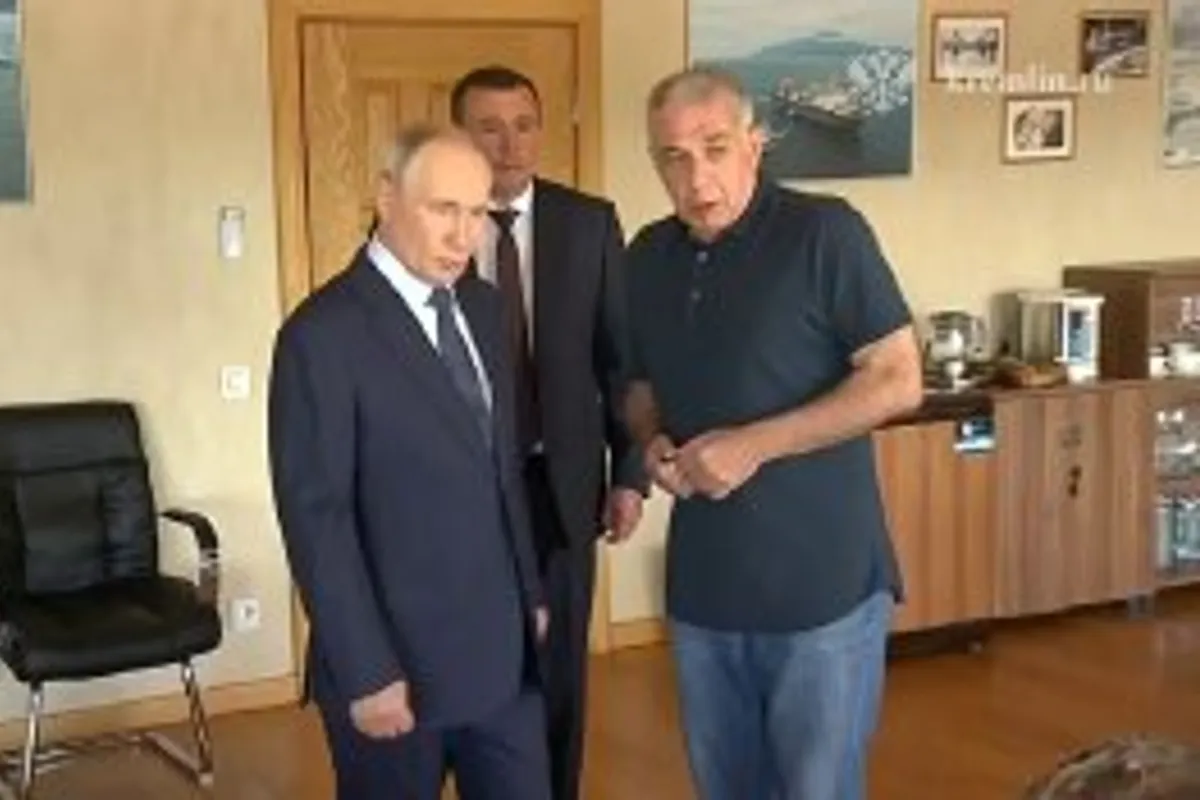
Russian President Vladimir Putin on Thursday visited the Kuril Islands for the first time, a disputed archipelago in the Far East that Japan considers its own territory. Putin toured Iturup, an island in the southern part of the chain, after earlier visiting nearby Sakhalin, where the Russian navy was conducting military exercises with the Pacific Fleet.
The Kremlin released video of Putin's visit, and Russian media reported that he toured a fish processing plant where he was presented with caviar. On Sakhalin, according to the RIA Novosti agency, he also held a meeting on securing Russia's eastern borders.
Putin's first personal visit to the island chain came after the Russian president oversaw navy exercises in the country's far east, and a day earlier, Russia's ally North Korea fired ballistic missiles toward waters east of the Korean Peninsula, ahead of major joint military exercises between Seoul and Washington that Pyongyang condemns.
During his visit to Iturup, Putin sampled fish roe and spoke with local residents of the island, Russian state media reported.
Tokyo's reaction was immediate and sharply worded. Japan's Ministry of Foreign Affairs stated that the four northern islands, including Iturup, are "inherent territories of our country both historically and from the standpoint of international law," and that Japan expresses a "resolute protest" over the visit.
Japan's Foreign Minister Toshimitsu Motegi further emphasized that the Northern Territories, as Japan calls them, are "an integral part of Japanese territory both historically and under international law, and the Japanese government strongly protests this visit." The Japanese foreign minister also lodged a protest note against Putin's visit, and on the X platform wrote: "The Northern Territories, including Etorofu, are Japanese territory-both historically and under international law."
The Soviet Union seized the volcanic archipelago north of Hokkaido in the final days of World War II, declaring war on Japan on August 8, 1945, six days before the end of the conflict. After the occupation, Moscow deported about 17,000 Japanese from the islands, which today are home to approximately 20,000 Russian citizens.
The four disputed islands are named Kunashir, Habomai, Shikotan, and Iturup in Russian, and Kunashiri, Habomai, Shikotan, and Etorofu in Japanese. The chain stretches from Russia's Kamchatka to Japan's Hokkaido, and besides its strategic position, it has deposits of gold and silver and rich fishing grounds.
Negotiations over the islands' status have been conducted intermittently for decades. Soviet leader Nikita Khrushchev in 1956, when diplomatic relations were established, suggested that two of the disputed islands could be returned under a peace treaty. Talks continued after the fall of the Soviet Union in 1991, but without progress. Moscow and Tokyo have never signed a formal peace treaty from World War II because the main obstacle has been the unresolved territorial dispute over the islands, which Japan calls the Northern Territories.
Putin's visit carries strong symbolism. Dmitry Medvedev, the former president, became the first Russian leader to visit the disputed territory in 2010, and later did so as prime minister. Putin himself had not previously visited the islands, which, according to Japan's Kyodo agency, was interpreted among Japanese diplomats as a sign that Moscow did not want to completely close the door to negotiations on a peace treaty.
Relations between Russia and Japan have further deteriorated since Russia's invasion of Ukraine in 2022, while Moscow has simultaneously strengthened ties with China and North Korea. Kyodo notes that among Japanese diplomats, the prevailing assessment now is that this consideration toward Tokyo has been cast aside.