Record-low water levels on the Rhine, a key European transport artery, threaten to completely halt commercial navigation on parts of the river in Germany. Jens Schwanen, Managing Director of the German Inland Navigation Association (BDB), told the Rheinische Post on Monday, August 10, 2026, that "the evolution of water levels does not bode well."
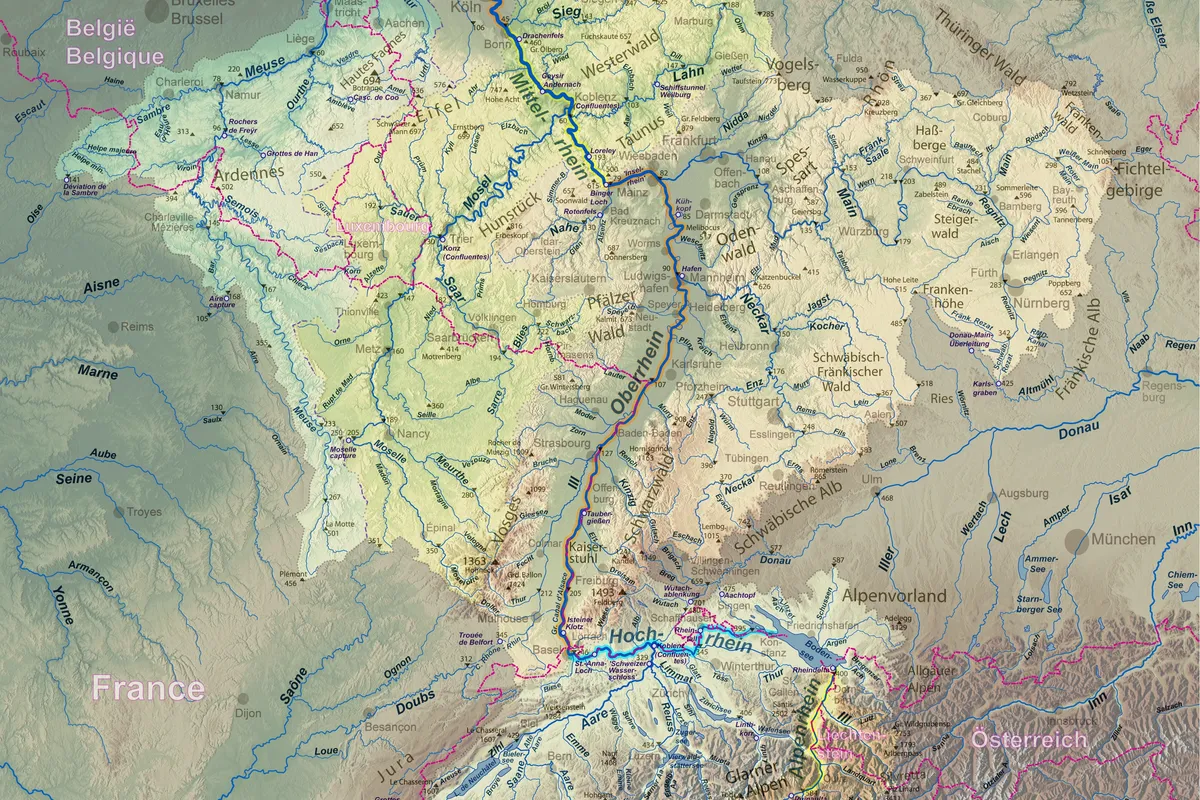
According to him, the water level at the reference gauge in Kaub, located in Rhineland-Palatinate between Koblenz and Mainz, is expected to drop below 10 centimeters for the first time this week. This would mean that the Rhine "will no longer be continuously navigable and will be split into two parts," Schwanen warned, adding that it would no longer be possible to transport goods by commercial or excursion boats in that area.
Kaub Gauge at Historic Low
On Monday morning, the reference level at the Kaub gauge stood at just 17 centimeters, corresponding to a navigable channel depth of 130 centimeters. The previous minimum reference water level at the same gauge was recorded in 2018 at 25 centimeters, according to data from the German Federal Waterways and Shipping Administration (WSV).
A WSV spokesperson told AFP that the water level is expected to continue to decline slightly in the coming days, but there is no official navigation ban for now. The decision to adjust cargo volumes to lower water levels is left to individual captains.
Navigation Possible Only in the North and South
According to BDB estimates, river traffic will remain possible on the northern section of the Rhine, from the ARA ports (Amsterdam, Rotterdam, Antwerp) through the Netherlands and further to the area around Cologne in the German state of North Rhine-Westphalia. In the south, navigation will be feasible on the tributaries Neckar, Moselle, and Main, as well as on the Main-Danube Canal.
However, a large part of the Rhine in Germany will become impassable for ships, effectively cutting this vital waterway into two separate segments. The consequences of the prolonged dry spell and intense heatwaves are already visible on the Danube, whose water levels have been at record lows since the end of July.
Trucks as an Alternative, Driving Bans Lifted
Due to the dramatically low water levels, cargo ships have been carrying only a fraction of their usual capacity for days, and carriers are forced to increase the number of trips, significantly raising logistics costs. To redirect freight to road transport, German Transport Minister Steffen Bilger mentioned last Thursday, August 6, the possibility of temporarily lifting the ban on truck driving on Sundays and public holidays.
The federal states of Saarland and Rhineland-Palatinate have already introduced this measure, trying to mitigate the economic consequences of the interruption of river transport through the industrial heart of Europe's leading economy. Over the past weekend, record-low water levels were recorded on the Rhine in North Rhine-Westphalia, and experts warn that climate change is further exacerbating these extreme hydrological events.