Wars Collide on the Caspian Sea
A Ukrainian strike on a vessel in the Caspian Sea in late July drew threats from Tehran and revealed how deeply the war in Ukraine and Iran's confrontation with the West are intertwined.
A Ukrainian strike on a vessel in the Caspian Sea in late July drew threats from Tehran and revealed how deeply the war in Ukraine and Iran's confrontation with the West are intertwined.
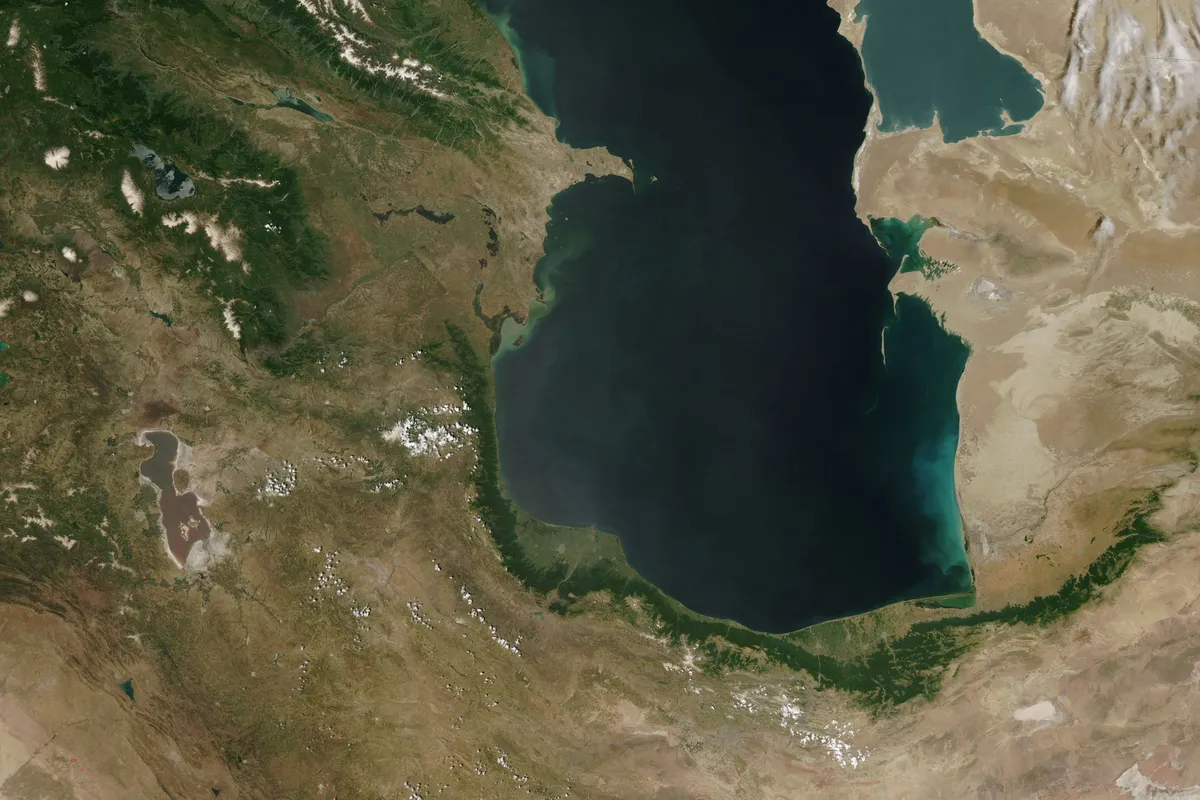
A Ukrainian attack on vessels in the Caspian Sea on July 25, 2026, drew a sharp reaction from Iran and exposed the deepening interconnection between two seemingly separate conflicts-Russia's war against Ukraine and Iran's confrontation with the United States and its allies. Although the actors and ultimate goals differ, the networks of weapons, intelligence systems, and maritime routes are becoming increasingly intertwined.
Mohsen Rezaee, a former commander of Iran's Revolutionary Guard and a senior military adviser to Iran's leadership, said Tehran was prepared to strike three targets in Ukraine in retaliation for the attack. The operation, according to him, was called off after Kyiv issued an apology. Ukraine has not publicly confirmed a formal apology, but its Foreign Minister Andrii Sybiha told his Iranian counterpart Abbas Araghchi that the damage to the civilian vessel and its crew was unintentional.
The conflict began when Ukrainian forces carried out strikes in the Caspian Sea. Ukrainian President Volodymyr Zelensky stated that the targets included a Russian warship and vessels transporting military cargo linked to Iran. Iran, however, reported that its commercial vessel was hit, killing one sailor and injuring another, and summoned Ukraine's chargé d'affaires for talks.
Geopolitical strategist and national security expert Jason Jay Smart dismissed the idea that this was an isolated incident. "Well, it's not the first time they've hit a target linked to Iran. If you're carrying something that's part of the war, it's a legitimate target," Smart told The Media Line. He also rejected claims that Ukraine was acting as an extension of Washington: "No, it's not connected. Why would it be? There have been many Ukrainian strikes on Iranian targets. Why is this one special?"
Iran's involvement in Russia's war against Ukraine has persisted for years. Russia has been using Iranian Shahed drones since 2022, and Tehran admitted in November 2022 to supplying them, although it claims the deliveries occurred before the invasion began. The European Union established a special sanctions framework in July 2023 and, in January 2026, imposed additional measures against Iran's drone and missile programs, calling them a direct threat to European security.
Smart emphasizes that Iran's support has been continuous. "I think Iran has been helping in the war against Ukraine for four years. This is not new. It's a continuation of what they've been doing," he said. "Unfortunately, I think people haven't realized that Iran has been fighting in the war with Ukraine. They see it in the context of the Middle East. But no, North Korea and Iran are the only two countries actively supporting Russia in its war."
Middle East analyst Mohammed Ali Ghanamizadeh Fallahi offers a more nuanced view. "The two wars have not yet become one war. However, they have crossed the line of simple political overlap and are becoming what can be called an interconnected conflict system," he told The Media Line. "The actors, military commands, and ultimate goals are different, but their weapons networks, intelligence systems, maritime routes, energy interests, and air defense needs are increasingly linked."
Fallahi warns that Rezaee's statement about planned strikes should not necessarily be taken at face value. "The claim that Iran was ready to carry out three strikes could have been partly a form of deterrence through public messaging," he said. "Iran has shown it has the capability and intention to respond, while Ukraine provided an explanation that allowed Tehran to back down without looking weak. Both sides thus managed to avoid escalation without testing whether the Iranian threat was real."
Smart is even more direct in assessing Iran's capacity for a direct strike on Ukraine: "I don't think they have the capacity for that." Fallahi adds that the real form of retaliation could be more subtle-something he describes as a "reverse proxy war." "Instead of using a non-state armed group, Iran could use the military capability of a partner state that is already at war," he explained, emphasizing that there is no evidence this has occurred since the ship incident.
One of the key but less visible links between the two conflicts is the competition for limited military resources. "The most important link may not be direct military cooperation. It may be the competition for a limited number of interceptor missiles, radar systems, and American military resources," Fallahi said. In late July, Reuters reported that interceptor missiles originally intended for Ukraine were redirected to U.S. forces and allies in the Gulf.
At the same time, concerns are growing over intelligence sharing. Zelensky has made claims that Russia conducted satellite surveillance of U.S. military facilities in Bahrain, Jordan, and Kuwait, and that these images became available to Iran and coincided with Iranian attacks. Fallahi sees this as potentially the most significant development: "One country can detect and track a target, while the other attacks. When that happens, the distinction between military support and direct participation becomes less clear."
Despite the growing integration, both analysts note that the alliance has its limits. "Both countries want cooperation, but both also want to avoid being dragged into the other's war," Fallahi concluded. Smart, for his part, believes it is strategically wisest for Ukraine to focus on Russia and leave Iran to the Americans and Israelis, calling it a "division of labor." However, he also warns of a broader message: "There's a benefit in globally showing that the alliance they have with Iran, with Russia, with North Korea is successful. And capable of stopping European and North American powers."