Romania Shuts Down Nuclear Plant for First Time in 23 Years Due to Drought
Due to record-low Danube levels, the Cernavoda plant has halted its second reactor, and the country has begun importing electricity from Ukraine.
Due to record-low Danube levels, the Cernavoda plant has halted its second reactor, and the country has begun importing electricity from Ukraine.
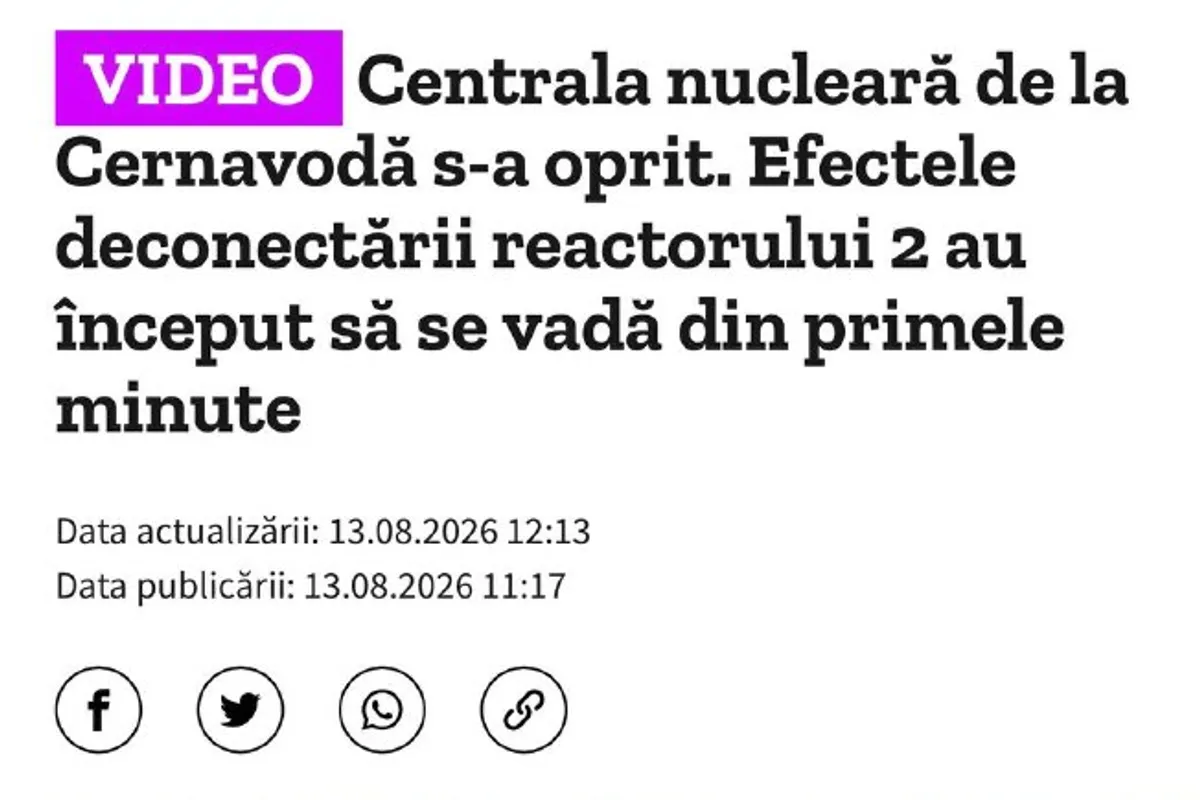
Romania on Thursday began the controlled shutdown of the second reactor at the Cernavoda nuclear power plant because the water level in the Danube fell below the level required for the plant's operation, AP World News reports. This is the first time in 23 years that the plant has been completely halted.
The plant's operator, Nuclearelectrica, explained in a statement to the Bucharest Stock Exchange that "the decision to controlled shutdown of Unit 2 is conditioned by the continued significant drop in the water level of the Danube River." They added that "maintaining both units in a safe shutdown state has no impact on nuclear safety parameters, including personnel, environment, and population."
The Cernavoda plant, which uses river water to cool its two reactors, covers about 20 percent of Romania's electricity production when fully operational. The first reactor was shut down in late July due to extremely low water levels, and after the shutdown of the second reactor, the country relies on alternative sources and imports.
Romania's Ministry of Energy announced on Wednesday that electricity supply would be "fully covered by alternative sources and imports." According to Romanian portal Digi 24, the country has begun importing electricity from Ukraine.
Acting Prime Minister Ilie Bolojan declared a national state of alert in the energy sector for August on July 31. Last week, Romanian authorities began sinking four barges filled with stones near the Bala channel on the Danube, which the military blasted with explosives, to create an underwater barrier and redirect water toward the plant.
Despite these efforts, the water has receded below the level necessary for the plant's operation. A similar situation threatens neighboring Hungary, where the only nuclear power plant, Paks, is on the brink of shutdown for the first time in its 44-year history. Hungarian authorities plan to raise the Danube's level this week to ensure its continued operation.