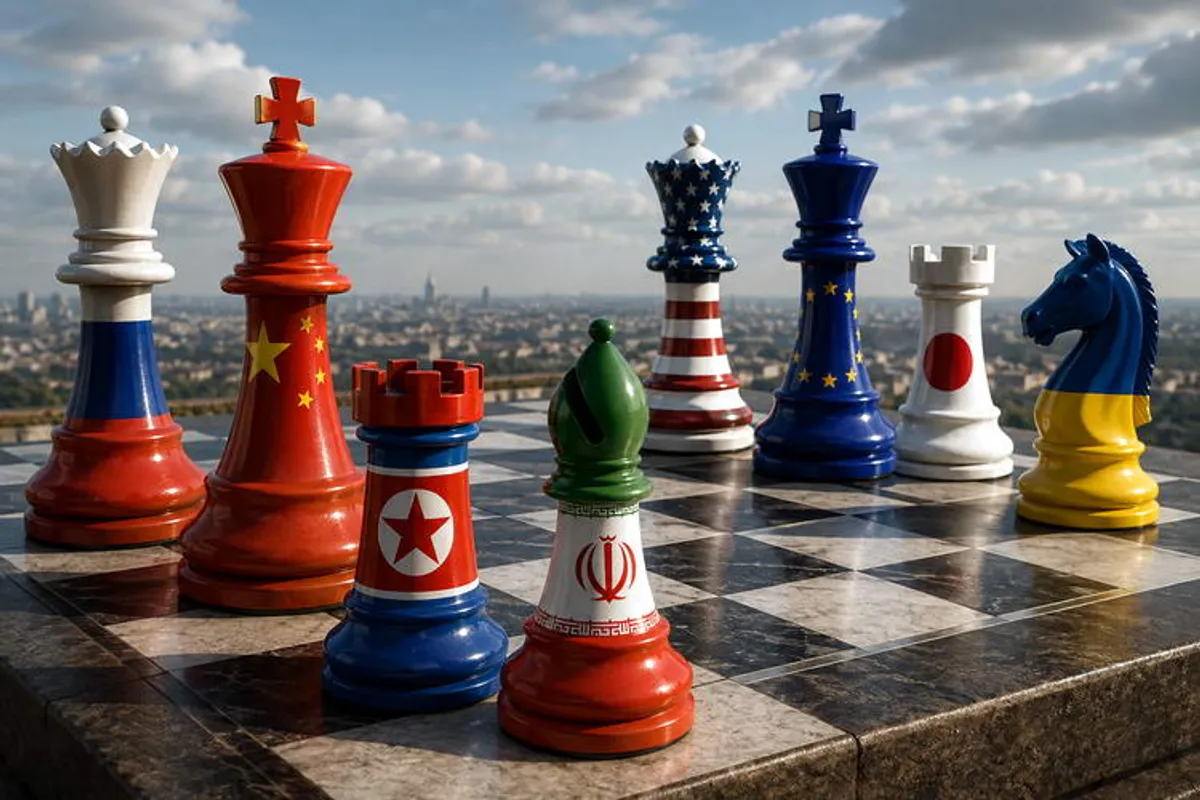
Cooperation between Russia, China, Iran, and North Korea has taken on an entirely new dimension in recent years, creating a bloc that could fundamentally alter the world order. The American agency Bloomberg calls this group the "Big Four", and their rapprochement has accelerated notably since the start of Russia's invasion of Ukraine.
Relations between Moscow, Beijing, Tehran, and Pyongyang are no longer just a series of separate bilateral arrangements. They are increasingly taking the form of a broader strategic alliance, driven by a shared goal: countering Washington and the collective West. This cooperation spans key resources-from economic support and technology to weapons and intelligence.
Who Gives What, and Who Gets What?
Each member of the "Big Four" plays a specific role. China supports Russia's economy and provides much-needed technology. Iran has helped Russia by supplying drones, while North Korea sends ammunition and missiles and has also deployed its troops.
Cooperation is not one-sided. Moscow reciprocates Tehran with intelligence and military technology, assists Pyongyang in weapons development, and in return, Beijing gains access to advanced Russian military technologies. This creates a network of interdependence that transcends individual interests.
The Interweaving of Global Crises
Because of this alignment, the conflict in Ukraine, crises in the Middle East, and potential wars in Asia can no longer be viewed in isolation. Bloomberg cites concrete examples: Russia helps Iran carry out strikes on American bases in the Persian Gulf, while Ukraine has struck an Iranian ship in the Caspian Sea to disrupt strategic trade between Moscow and Tehran.
At the same time, reports are emerging that China is preparing to sell air defense systems to Iran, and that North Korea might send additional forces to support Russia in its war against Ukraine. Russia and China are already demonstrating through joint military exercises their readiness to act together in the event of a new major military crisis.
Key Factors Solidifying the Bloc
The strengthening of the "Big Four" has not been influenced solely by the war between Israel and the United States against Iran. A crucial psychological and strategic moment was Tehran's ability to withstand a direct confrontation with Washington and Tel Aviv long enough to bring the fighting to a stalemate. This has changed assessments of Iran's military capabilities.
Another factor is Russia's resilience, which has been holding out against the Western bloc in Ukraine for the fifth year now. At the same time, China's overall economic, political, and military power is growing, while North Korea, long internationally isolated, has gained significantly more room for cooperation with states that share similar strategic interests.
What Comes Next?
For now, there is no formal alliance binding Russia, China, Iran, and North Korea through a single agreement. Nevertheless, the possibility that their current rapprochement could evolve into a formalized alliance in the future cannot be ruled out.
For the United States and its allies, the consequence of such a development would be the emergence of a far more complex international environment. According to Bloomberg's assessment, the world is entering an era of revisionist states aligning and conflicts converging across the planet, where crises in different parts of the world can no longer be easily isolated.