US Deploys Aircraft to Bulgaria, Iran Protests Over Bezmer Base
US KC-135 tankers have arrived at Bulgaria's Bezmer military base to support operations in the Middle East. Tehran has sent an official note of protest to Sofia.
US KC-135 tankers have arrived at Bulgaria's Bezmer military base to support operations in the Middle East. Tehran has sent an official note of protest to Sofia.
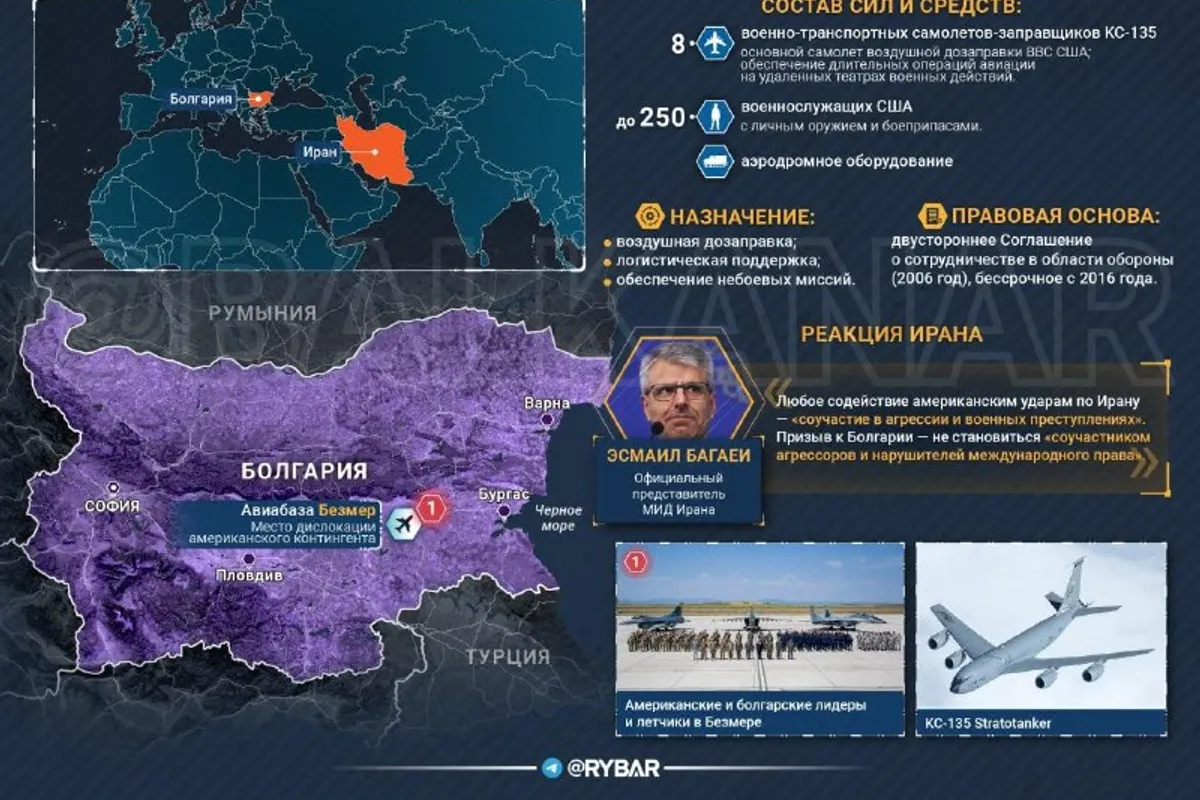
US military KC-135 aerial refueling aircraft began arriving on July 25, 2026, at Bulgaria's Bezmer military base, located in the Yambol Province in southeastern Bulgaria. The Bulgarian parliament has authorized the deployment of up to eight such aircraft and up to 250 US troops, with a mandate lasting until October 1, 2026. The mission is based on the bilateral Defense Cooperation Agreement from 2006, which was granted indefinite status in 2016.
According to information relayed by the Russian Telegram channel Rybar, which is close to Russian military circles and whose claims should be taken with caution, the purpose of the deployment is aerial refueling of aircraft involved in US operations in the Middle East, logistical support, and ensuring non-combat missions. The Bulgarian government insists that this is exclusively a "logistics mission" and that Sofia does not thereby become a party to the conflict. The legal basis for the presence of US forces is a joint agreement on the use of military facilities, which has been in force for two decades.
Despite Bulgarian assurances, Iran reacted sharply. Tehran sent an official diplomatic note of protest to the Bulgarian Ministry of Foreign Affairs. Iranian Foreign Ministry spokesman Esmail Baghaei stated that any assistance to US strikes on Iran constitutes "complicity in aggression and war crimes," and called on Sofia not to become, as he put it, "an accomplice of the aggressor and a violator of international law." The Iranian note marks a diplomatic escalation that places Bulgaria, as a NATO and EU member, in an awkward position between allied obligations and regional geopolitical tensions.
The deployment has not met with unanimous support even within Bulgaria itself. According to the same source, there is local resistance in the region around the Bezmer base to the presence of US aircraft. Residents of the region warn that Yambol Province could be drawn into a foreign conflict, despite government guarantees about the safety of the mission. The Bulgarian government has so far not published a detailed response to the Iranian protest or to internal objections.
The Bezmer base is not new in the context of US-Bulgarian military cooperation. The US and Bulgaria have been developing a joint defense framework since the mid-2000s, and Bulgaria, as a NATO member since 2004, has regularly participated in allied exercises and missions. However, the specific deployment of tankers to support operations outside Europe, namely in the Middle East, adds a new dimension to this cooperation. The question is how far the responsibility extends for a country providing logistics for operations in another region, which is precisely the core of Iran's objection.
The deployment in Bulgaria coincides with intensified conflicts in Ukraine. On the same day US aircraft arrived at Bezmer, Russia launched a missile attack on Kyiv that, according to a report from Dutch public broadcaster NOS, struck an area where a defense industry fair was being held, killing at least ten people and wounding over a hundred. Ukrainian President Volodymyr Zelensky warned on the same day that he possesses intelligence about preparations for a new massive Russian missile attack within 48 hours. Geopolitical pressures coming from multiple fronts simultaneously, from Ukraine to Iran, are placing European allies of the US before increasingly complex security challenges.