After a 52-hour drive through Ukraine, Poland, Germany, and France, 70 Ukrainian firefighters arrived on August 2, 2026, in a convoy of 15 vehicles, including 10 fire engines, to assist their French counterparts in fighting the devastating wildfire in the Gironde department. The very next day, August 3, they joined firefighting operations in the Le Temple area, west of Bordeaux, where they worked on extinguishing hot spots at the edge of the burned and spared forest to prevent the fire from reigniting.
This is the first such mobilization of Ukrainian firefighters in France. "Any help is useful and valuable, so Ukraine offered its support and we naturally accepted," Thomas Mimiague, communications officer for the Gironde fire and rescue service, told AFP. Ukraine offered its assistance through the European Union's Civil Protection Mechanism.
'Firefighters are one big family that knows no borders'
The arrival of the Ukrainian rescuers carries a powerful symbolic message of solidarity. "We always try to help those who need our help, even though it is very difficult for us right now, as you well know, we are at war," said Khrystyna Pertsovych, spokesperson for the Ukrainian emergency response team. She added that their rescuers work under fire every day but still find ways to help those who help Ukraine. "When Ukraine needed help, France stood by us," Pertsovych emphasized.
The scale of the disaster is immense. Since the beginning of the year, France has recorded 12,500 fires that have consumed 44,000 hectares. In Gironde alone, where the fire broke out on July 22, 42,000 hectares have burned, an area four times the size of Paris. In the Arcachon basin, the fire destroyed 2,000 hectares and forced 12,000 people to evacuate. Meanwhile, a new fire is raging in the Var department, where 1,800 hectares have been affected since July 31. According to Stéphane Nepper, spokesperson for the Var firefighters, 1,500 firefighters were mobilized on Monday morning, racing against time to contain the blaze before conditions worsen. As he explained to AFP, "stronger winds and rising temperatures are expected, while humidity levels drop." Since the first fire in the Gros Bessillon area on July 21, 70 homes have been affected in Var, 41 of which were completely destroyed.
Return to Devastated Homes and Anger Over Fire Management
As firefighters battle the flames, residents of the hardest-hit areas are slowly returning to their homes. In the municipality of Porge, where residents were allowed to return on August 3, the scenes are heartbreaking. "It's a heart-wrenching sight, above all. It hurts, it really hurts to see all this damage. Tears welled up and still do," resident Armel Labatut told France 2. Her husband, Martine Labatut, admits they are considering leaving: "It's a beautiful neighborhood, but staying here amidst this carnage will be tough."
Yet, there is a glimmer of hope. "It's a return to life. It's a return to hope, a return to rebuilding," said Martial Zaninetti, mayor of Porge. Resident Paula-Cristina Coelho de Susa described the pain of returning: "It's good, but it's sad to see the forest like this. It's not the same when you watch it on TV... But when you're there, it hurts." According to data, 183 homes in Porge will need to be rebuilt. At the same time, nearly 1,000 residents of the affected areas have expressed a desire to file a lawsuit against unknown persons, questioning the management of the fire in the first hours after it broke out.
France Also Deploys Military Airbus A400M
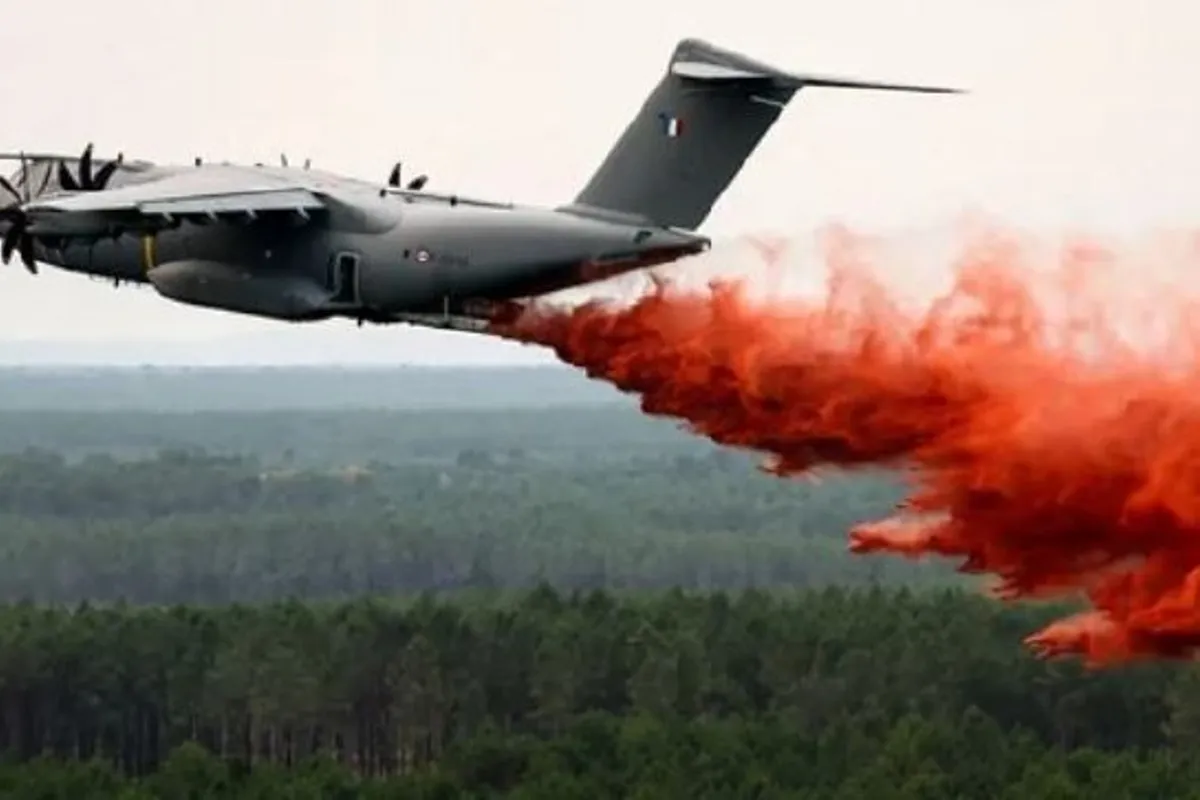
To strengthen its firefighting capabilities, France has fast-tracked the operational deployment of the military transport aircraft Airbus A400M Atlas, equipped for firefighting. An agreement for "operational use" between the Ministry of the Interior, the Ministry of the Armed Forces, and Airbus was signed on July 17, 2026, and the aircraft was prepared in less than two weeks.
The aircraft uses a removable Roll-on/Roll-off (RORO) module installed in the cargo hold without modifications to the aircraft's structure. The module carries 20 tonnes of water or fire retardant, released through the rear ramp in less than 10 seconds, creating a continuous line 400 to 500 meters long and about 100 meters wide. After removing the module, which takes about 10 minutes, the A400M can immediately return to military transport missions. Aviation expert Alexej Zaharov notes that the main value of the A400M lies in delivering powerful, targeted water drops on large fires, although turnaround time is longer because it requires landing at an airport to refill, unlike the Canadair, which scoops water from natural sources in 12 seconds.
France's firefighting fleet, under the interagency "Hephaestus" system, already includes 12 Canadair CL-415 aircraft, 8 Bombardier Dash 8 Q400 MR, three Beechcraft Super King Air 350, and about forty helicopters. The introduction of the A400M is considered critical because the average age of the Canadair fleet is 30 years. The concept of using the A400M for firefighting was tested in Spain in July 2022 and in France at Nîmes-Garon airport in April 2025.